Solid vs Plated Gold Star Stud Earrings: A Material Guide
Compare solid, vermeil, and plated gold star stud earrings. Discover material properties, durability, and pricing to choose the perfect pair.


Star-shaped jewelry has maintained a steady presence in trend cycles, but the celestial motif presents unique structural challenges that many buyers overlook. When shopping for gold star stud earrings, the intricate points and crevices of the star shape interact with your skin, hair, and clothing in ways that simple round studs do not. Consequently, the material composition of your earrings dictates not just their price, but their longevity, hypoallergenic safety, and structural integrity.
In this comprehensive guide, we break down the metallurgical properties of the various "gold" options on the market. Whether you are looking at solid 14k, gold vermeil, or flash-plated alternatives, understanding these material differences is crucial for making an informed purchase in 2026.
The Anatomy and Vulnerabilities of Star Studs
Unlike a classic round bezel or a smooth hoop, a star stud features sharp vertices and deep inner angles. These geometric properties create specific wear-and-tear vectors:
- Friction Points: The outer tips of the star are highly susceptible to friction. They catch on sweaters, hair, and pillowcases, causing the outermost layer of metal to wear away faster than the center of the earring.
- Crevice Accumulation: The inner angles of the star trap sebum, dead skin cells, and cosmetic products. If the base metal is prone to corrosion, this trapped moisture accelerates tarnishing and degradation.
- Snagging and Bending: If the gold alloy is too soft, the delicate points of the star can bend or warp when snagged, permanently altering the silhouette of the earring.
Material Breakdown: Solid, Filled, Vermeil, and Plated
The term "gold" is heavily regulated, yet marketing language often obscures the actual metallurgical makeup of the jewelry. Here is how the primary gold categories perform when cast into star-shaped studs.
Solid Gold (14k vs. 18k)
Solid gold is an alloy, meaning pure 24k gold is mixed with other metals (like copper, zinc, or silver) to increase durability. For gold star stud earrings, the karat weight dramatically affects the structural integrity of the star's points.
14k Gold (58.5% pure gold): With a Vickers hardness (HV) of approximately 120-150, 14k gold is significantly harder than higher-karat options. This makes it the superior choice for star studs. The harder alloy ensures the sharp points of the star resist bending and maintain their crisp edges over years of daily wear. Furthermore, 14k gold is highly resistant to the acidic pH of human sweat.
18k Gold (75% pure gold): While 18k offers a richer, deeper yellow hue, its lower hardness (around 90-110 HV) makes it softer. An 18k gold star stud is more prone to micro-scratches at the vertices and can bend if caught forcefully on clothing. According to the Gemological Institute of America (GIA), the higher the pure gold content, the more malleable the alloy becomes, requiring careful consideration for intricate shapes.
Gold Vermeil
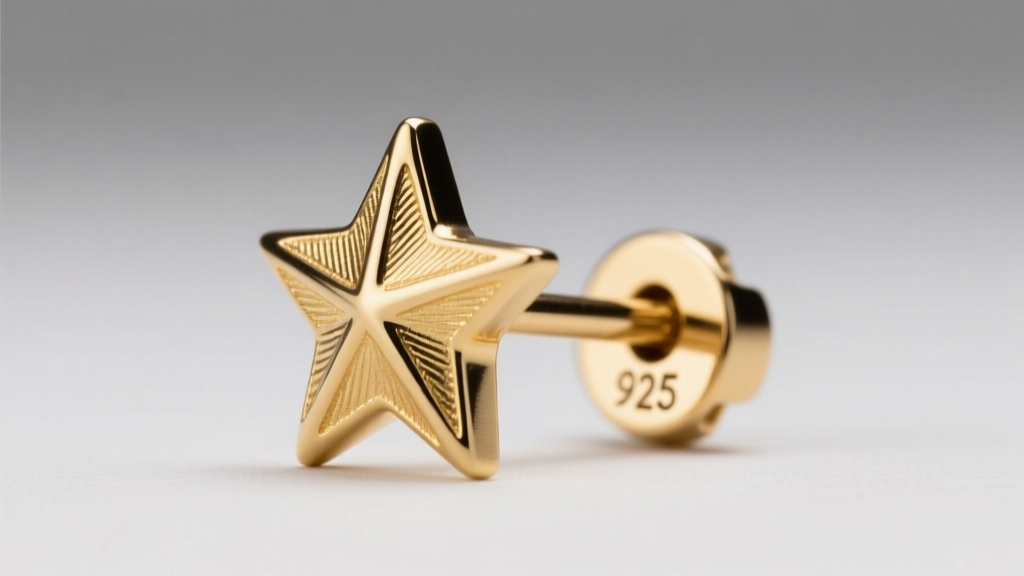
Gold vermeil (pronounced ver-may) is a specific type of heavy plating. By Federal Trade Commission (FTC) guidelines, vermeil must consist of a sterling silver (925) base coated with a minimum of 2.5 microns of gold (usually 14k or 18k). Vermeil star studs are an excellent mid-tier option. Because the core is sterling silver, even if the gold eventually wears off the high-friction star points, the exposed silver is generally hypoallergenic and will not turn your skin green. However, the star points will eventually show silver wear patches, requiring occasional re-plating.
Gold-Filled
Gold-filled jewelry features a thick layer of gold mechanically bonded to a brass or copper core, comprising at least 5% of the total weight. While incredibly durable for hoops and chains, gold-filled material is typically produced in sheets or wire. Creating a 3D cast star shape from gold-filled sheet metal often results in a hollow or stamped appearance, lacking the crisp, detailed edges of a solid cast star stud. Therefore, gold-filled is less common for high-detail star studs.
Gold-Plated (Flash Plated)
Standard gold-plated earrings feature a microscopic layer of gold (often less than 0.5 microns) over a base metal like brass, copper, or nickel alloys. For star studs, flash plating is highly discouraged. The sharp points of the star will wear through the plating within weeks of daily wear. Once the base metal is exposed, the combination of trapped moisture in the star's crevices and the reactive brass core will rapidly cause contact dermatitis and green skin discoloration.
Comparative Data: Durability, Pricing, and Allergies
To help you evaluate the market, we have compiled a technical comparison of the materials commonly used for gold star stud earrings. Prices reflect standard 5mm to 8mm star studs.
| Material Type | Base Metal | Gold Thickness / Purity | Avg. Price Range | Hypoallergenic? | Star Point Durability |
|---|---|---|---|---|---|
| Solid 14k Gold | N/A (Homogeneous Alloy) | 58.5% Pure Gold | $120 - $350 | Yes (if nickel-free) | Excellent (Will not wear off) |
| Solid 18k Gold | N/A (Homogeneous Alloy) | 75% Pure Gold | $200 - $600+ | Yes (Highly biocompatible) | Good (Prone to micro-bending) |
| Gold Vermeil | 925 Sterling Silver | ≥ 2.5 microns | $45 - $95 | Yes (Silver core is safe) | Moderate (Points will expose silver) |
| Gold-Filled | Brass / Copper | ≥ 5% total weight | $30 - $70 | Mostly (Rarely exposes core) | N/A (Rarely cast into 3D stars) |
| Gold-Plated | Brass / Nickel Alloy | < 0.5 microns | $10 - $25 | No (High allergy risk) | Poor (Points degrade rapidly) |
Gauge Sizes and Backing Mechanisms for Star Studs
The material of the star face is only half the equation; the post and backing dictate the earring's security and comfort.
Post Gauge Thickness
Standard earlobe piercings are typically done at 20-gauge (0.81mm) or 18-gauge (1.02mm). Because star studs have a wider surface area that can catch on hair, a thicker 18-gauge post is highly recommended for solid gold stars. The extra 0.21mm of thickness provides crucial lateral support, preventing the post from bending if the star gets snagged.
Friction Backs vs. Screw Backs
Most vermeil and plated star studs utilize standard "butterfly" friction backs. While cheap to produce, friction backs rely on tension that degrades over time. If you are investing in solid 14k or 18k gold star stud earrings, look for screw-back mechanisms. Screw backs thread securely onto the post, ensuring that a heavy or snagged star face will not pull the backing off and result in a lost earring.

Care and Maintenance for Intricate Star Shapes
Maintaining the brilliance of gold star studs requires specific cleaning protocols due to their geometry. The inner angles of the star act as traps for lotions and dead skin, which can dull the metal's reflectivity.
- For Solid Gold: Use a soft-bristled baby toothbrush with a mild solution of warm water and phosphate-free dish soap. Gently agitate the bristles into the inner corners of the star. Solid gold can also safely withstand ultrasonic cleaners, which use high-frequency sound waves to dislodge microscopic debris from the star's crevices.
- For Gold Vermeil and Plated: Never use ultrasonic cleaners or harsh chemical dips on plated or vermeil jewelry. The cavitation bubbles in an ultrasonic cleaner can literally blast the thin gold layer off the star's sharp points. Instead, wipe them gently with a microfiber cloth and use a dry, soft brush to clear out the crevices.
- Storage: Store star studs in individual soft pouches. The sharp points of one star stud can easily scratch the polished face of another if they are tossed loosely into a jewelry box.
Final Verdict: Which Material Should You Choose?
When selecting gold star stud earrings, your choice should align with your wearing habits. If you intend to wear them daily, sleep in them, and never worry about the points tarnishing, solid 14k gold is the undisputed champion. Its metallurgical hardness perfectly complements the structural demands of the star shape.
For those who prefer to rotate their jewelry frequently and want a budget-friendly option without the risk of nickel allergies, gold vermeil is a safe, stylish alternative. Just be prepared to embrace the eventual silver wear on the star's tips as a natural patina of use. Avoid flash-plated options entirely, as the geometry of a star guarantees that the plating will fail at the points long before the rest of the earring shows wear.


