Styling Golden Hills Turquoise Earrings: 2026 Trends
Discover 2026 styling trends for Golden Hills turquoise earrings. Explore matrix grading, setting styles, and pricing for this rare Nevada gem.

The Resurgence of Golden Hills Turquoise in 2026
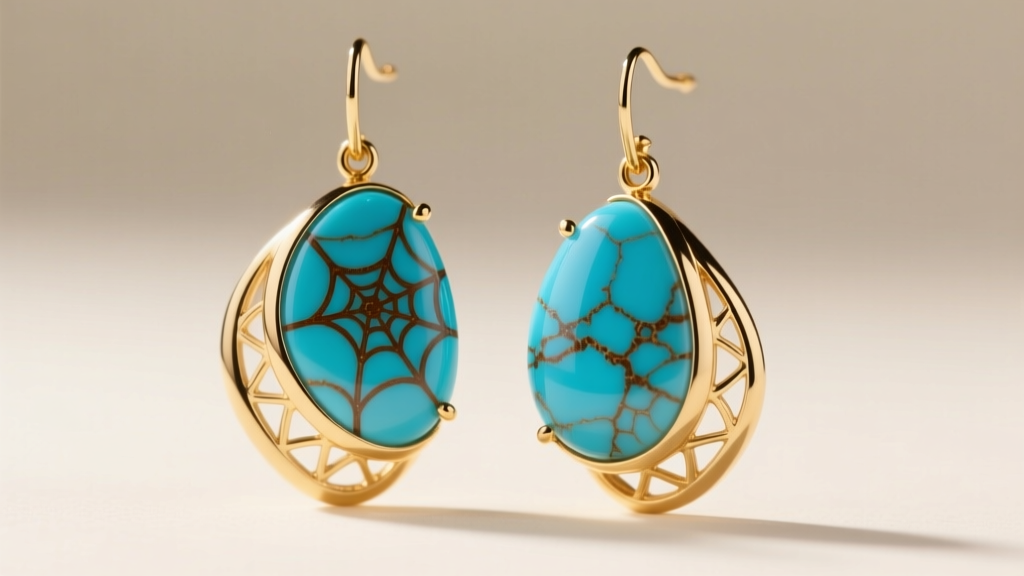
As we navigate the jewelry landscape of 2026, the demand for region-specific, traceable gemstones has reached an all-time high. Among the most coveted of these are golden hills turquoise earrings, sourced from the remote Candelaria Hills mining district in Mineral County, Nevada. Unlike the uniform, matrix-free sky-blue of the famous Sleeping Beauty mine, Golden Hills turquoise is celebrated for its complex visual depth. It offers a striking palette ranging from apple-green to deep sky-blue, heavily intersected by a brown-to-black limonite and ironstone spiderweb matrix.
This year, the shift toward "organic luxury" and "desert gothic" aesthetics has propelled Golden Hills turquoise to the forefront of high-end artisan jewelry. Designers are moving away from perfectly symmetrical, highly polished Southwest settings, embracing instead the raw, untamed beauty of the stone's natural inclusions. For collectors and style enthusiasts alike, understanding the nuances of this specific Nevada turquoise is essential for making informed, high-value acquisitions.
Mineralogy and Matrix: Grading the Golden Hills Standard
To truly appreciate golden hills turquoise earrings, one must understand the geological factors that dictate their value. According to the Gemological Institute of America (GIA), turquoise is a porous, hydrous phosphate of copper and aluminum. The Golden Hills claim is unique because its copper-to-aluminum ratio, combined with localized iron deposits, creates its signature high-contrast matrix.
When evaluating these earrings in 2026, gemologists and master jewelers look at three critical factors:
- Color Saturation: The most prized Golden Hills stones exhibit a vibrant, saturated "robin's egg" or deep apple-green hue. Chalky or pale stones indicate lower copper content and are generally relegated to stabilization treatments.
- Matrix Webbing: The "spiderweb" matrix in Golden Hills stones is naturally occurring ironstone. High-grade stones feature tight, intricate, and evenly distributed black or dark brown webbing. Clumped or muddy matrix patterns lower the stone's cabochon value.
- Hardness and Stability: Natural, untreated Golden Hills turquoise ranks between 5.5 and 6.5 on the Mohs scale. This natural hardness allows it to be cut into precise cabochons without the need for epoxy stabilization, a crucial factor for premium earring sets.
In the current market, natural, untreated Golden Hills cabochons with premium webbing command anywhere from $20 to $45 per carat. Consequently, a pair of high-grade, hand-cut drop earrings can easily range from $600 to $1,500, depending on the metalwork and carat weight.
Top 2026 Setting Trends for Golden Hills Earrings
The way designers are setting this rare Nevada turquoise has evolved dramatically. Here are the dominant styles defining golden hills turquoise earrings this year.
1. Asymmetrical Raw-Edge Bezel Drops
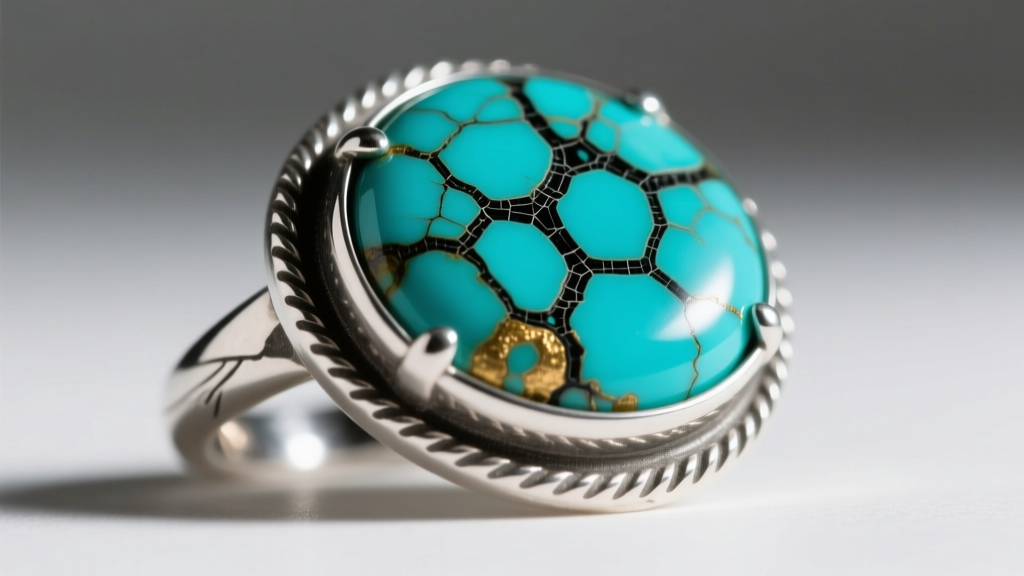
Perfection is out; organic texture is in. The leading trend for 2026 involves pairing mismatched, asymmetrical Golden Hills cabochons with raw-edge, hammered bezels. Jewelers are using oxidized sterling silver or 14k yellow gold, intentionally leaving the bezel edges slightly jagged to mimic the rough terrain of the Candelaria Hills. These drops typically measure between 1.5 to 2.5 inches in length, making a bold, sculptural statement.
2. Mixed-Metal Huggie Hoops with Channel Inlay
For everyday wear, the huggie hoop has been reimagined. Instead of traditional prong-set diamonds, 2026's luxury huggies feature channel-inlaid Golden Hills turquoise. The trend highlights mixed metals—such as a matte-finished 18k gold hoop with a rhodium-plated white gold inner track holding the turquoise. This requires precision cutting, as the turquoise must be calibrated to exactly 2mm or 3mm widths to sit flush within the metal channel.
3. Ear Climbers with Gradient Cabochons
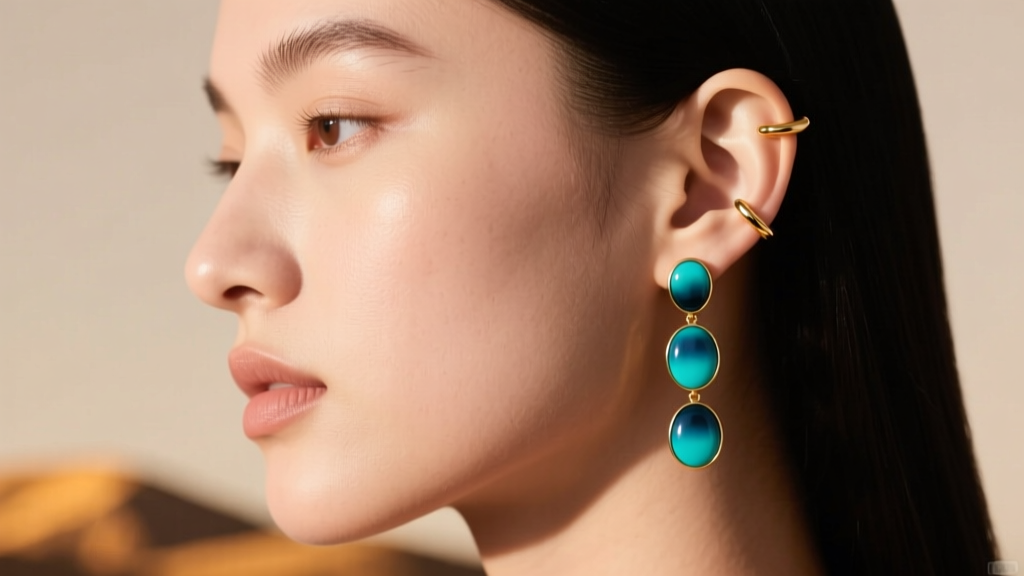
Cartilage and lobe combinations are thriving. Ear climbers featuring three to five graduating Golden Hills cabochons are highly sought after. The gradient effect is achieved by placing a lighter, greenish-blue stone at the base of the lobe and transitioning to a deep, dark blue stone with heavy matrix toward the upper cartilage. These are typically set in 14k rose gold, which provides a warm, contrasting backdrop to the cool blue-green tones of the stone.
Hardware Specifications: Gauges, Backs, and Weight
A common failure point in artisan turquoise earrings is inadequate hardware. Golden Hills turquoise is dense, and larger cabochons add significant weight. Wearing heavy stones on flimsy wire will cause earlobe stretching and tearing over time. Below is the structural framework you should expect from high-quality 2026 designs.
| Earring Style | Recommended Post Gauge | Optimal Backing Type | Avg. Stone Weight (Pair) | 2026 Price Range (14k Gold) |
|---|---|---|---|---|
| Small Studs (6mm) | 20-Gauge (0.8mm) | Standard Butterfly Friction | 2 - 4 grams | $350 - $500 |
| Huggie Inlay Hoops | 18-Gauge (1.0mm) | Hinged Snap Closure | 6 - 9 grams | $800 - $1,200 |
| Medium Drops (1 inch) | 18-Gauge (1.0mm) | Silicone Disc Backs | 10 - 15 grams | $900 - $1,400 |
| Heavy Statement Drops | 16-Gauge (1.2mm) | Threaded Screw Backs | 18 - 25+ grams | $1,500 - $2,500+ |
Expert Tip: If you are purchasing heavy statement drops, insist on 16-gauge posts with threaded screw backs. Silicone disc backs (often called "jumbo backs") are also excellent for distributing the weight of a 15-gram stone across a wider surface area of the earlobe, preventing the dreaded "drooping lobe" effect.
Authenticity Check: Spotting Fakes and Treatments
With the surging popularity of golden hills turquoise earrings, the market has seen an influx of imitations. It is vital to distinguish between natural, stabilized, and completely fake stones. The Federal Trade Commission (FTC) Jewelry Guides mandate that any gemstone treated with colorless epoxy or resin must be disclosed as "stabilized."
While stabilization is an accepted industry practice for softer, lower-grade turquoise (using resins like Opticon to harden the stone and enhance color), it drastically reduces the collector value compared to natural, untreated Golden Hills stones. Here is how to protect your investment:
- The Magnification Test: Use a 10x jeweler's loupe to inspect the matrix. Natural Golden Hills matrix is composed of actual ironstone and limonite, which will show metallic flecks or natural geological layering. Painted or synthetic matrix (often found in block turquoise) will look like uniform, flat lines with no depth.
- The UV Light Test: Many stabilized turquoises will exhibit a slight fluorescent glow under long-wave UV light due to the epoxy resins used in the hardening process. Natural, untreated turquoise will generally remain inert.
- Dyed Howlite and Magnesite: These are the most common fakes. Howlite has a distinct grey or white base with dark grey veining. When dyed blue, the color often pools in the cracks, creating dark, unnatural concentrations of dye that look nothing like the organic brown/black webbing of genuine Golden Hills.
Face Shape & Styling Framework
Beyond the gemology and metalwork, styling golden hills turquoise earrings requires an understanding of facial geometry. The bold, high-contrast nature of this stone makes it a focal point, so balancing proportions is key.
- Round Faces: Opt for long, linear drop earrings (2 inches or longer). The vertical movement elongates the face and draws the eye downward. Avoid large, circular hoops or wide cluster studs, which will only accentuate facial width.
- Square Faces: Choose styles with curved lines, such as the mixed-metal huggie hoops or teardrop-shaped cabochons. The soft curves of the metal and the rounded edges of the cabochon will help soften a strong, angular jawline.
- Oval Faces: You have the versatility to pull off almost any style. In 2026, the gradient ear climber is the ultimate choice for oval faces, as it highlights the natural symmetry and balanced proportions of your bone structure without overwhelming it.
- Heart-Shaped Faces: Look for chandelier or wide-bottomed drop earrings. The visual weight at the bottom of the earring helps to balance a narrower chin and wider forehead.
Final Investment Verdict
Golden Hills turquoise is not just a passing fad; it is a finite geological treasure. As the Nevada mines yield less high-grade material each year, the value of natural, untreated golden hills turquoise earrings is projected to appreciate steadily through the late 2020s. By prioritizing 16-gauge or 18-gauge hardware, demanding transparent disclosure regarding stabilization, and embracing the raw, organic setting trends of 2026, you are not merely buying an accessory—you are securing a wearable piece of American mineral history.


