The Guy With the Dangly Earring: 2026 Men's Style Guide
Discover why the guy with the dangly earring dominates 2026 fashion. Explore styling tips, gauge sizes, and premium metals for men's dangles.

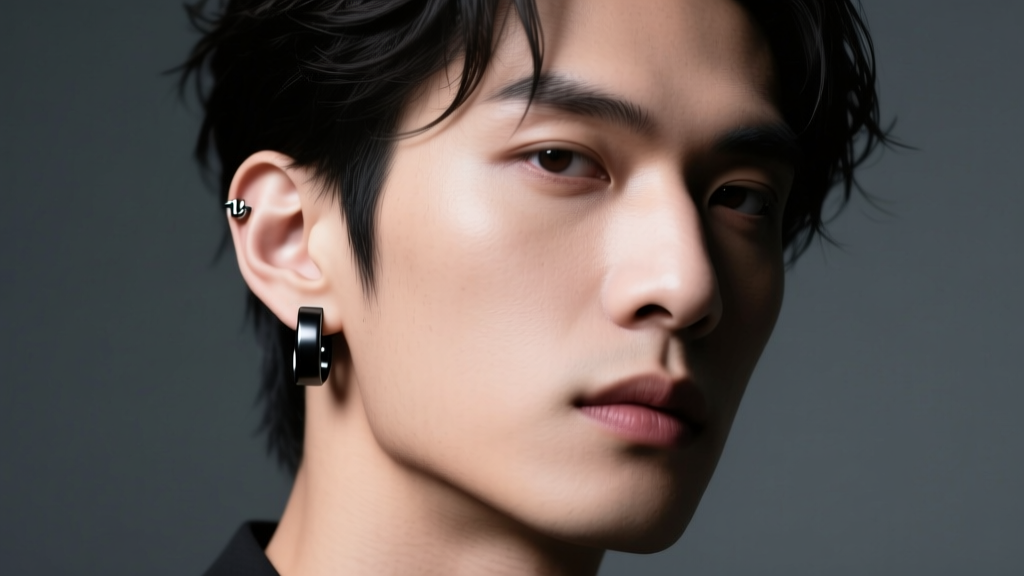
The Evolution of the Guy With the Dangly Earring
Once relegated to the realms of 18th-century maritime lore, 90s grunge frontmen, and bohemian stereotypes, the guy with the dangly earring has undergone a radical sartorial renaissance. As we navigate the fashion landscape of 2026, the men's dangle earring is no longer a rebellious anomaly; it is a cornerstone of contemporary masculine and gender-fluid styling. From the runways of Paris to the streets of Tokyo, the modern guy with the dangly earring leverages movement, asymmetry, and metallic contrast to elevate everything from oversized tailoring to minimalist streetwear.
However, pulling off this look requires more than just clipping on a piece of jewelry. It demands an understanding of proportion, facial geometry, and, crucially, the biomechanics of earlobe stress. This guide breaks down the technical specifications, styling frameworks, and material sciences required to master the dangle earring trend without compromising your piercing's health.
The Physics of the Dangle: Gauge, Weight, and the Cheese Cutter Effect
The most common failure mode for men adopting dangle earrings is underestimating the physics of suspended weight. When a heavy earring is supported by a thin wire, the downward force concentrates on a microscopic surface area of the earlobe. Over time, this causes the jewelry to migrate downward, slicing through the tissue—a phenomenon known in the body modification community as the 'cheese cutter effect.'
To prevent this, you must match the gauge (thickness) of the earring to its overall weight. According to guidelines from the Association of Professional Piercers, standard fashion earrings are often 20-gauge (0.8mm) or 18-gauge (1.0mm). These are entirely insufficient for men's dangles, which are typically larger and denser.
- Under 8 Grams: A 14-gauge (1.6mm) wire or post is the absolute minimum. This provides enough surface area to distribute the weight of small to medium geometric drops.
- 8 to 15 Grams: You must step up to a 12-gauge (2.0mm) or 10-gauge (2.4mm) thickness. This often requires having your lobes professionally stretched by a piercer using a taper and insertion kit.
- Over 15 Grams: For heavy, oversized statement pieces, an 8-gauge (3.2mm) stretch or the use of an ear-cuff support chain is mandatory to distribute the load across the cartilage and lobe simultaneously.
Hardware Mechanics: Why French Wires Fail Men
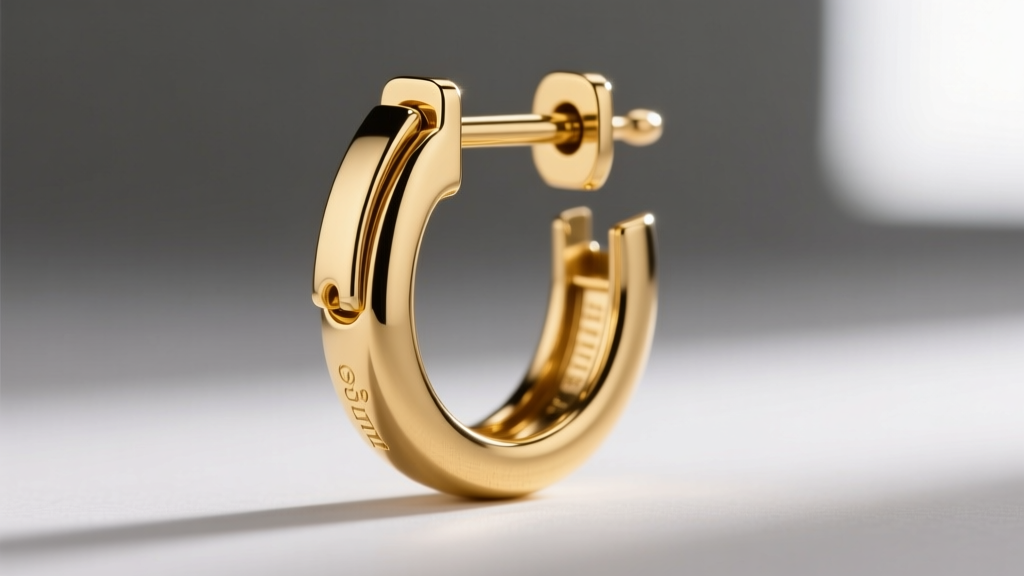
The traditional 'French wire' (the fishhook-style clasp) is a staple of women's fine jewelry but a liability for men. Men's fashion involves heavier fabrics, hoodies, and jackets with rough inner linings. French wires easily snag and rip out of the lobe. For 2026, the industry standard for men's dangles has shifted toward hinged continuous hoops with a secure clicker latch or threadless labret posts where the decorative dangle component press-fits into a secure, flat-back titanium anchor. These mechanisms sit flush against the ear and eliminate the snag-and-tear risk.
Material Grades and Skin Sensitivity
When investing in a piece that will endure the kinetic stress of a swinging dangle, material purity is non-negotiable. The friction and micro-tears caused by movement make the earlobe highly susceptible to contact dermatitis and heavy metal toxicity.
According to metallurgical standards referenced by the Gemological Institute of America, you must avoid silver-plated brass or low-karat gold alloys that contain nickel or cadmium. The only acceptable metals for a daily-wear men's dangle are:
- Implant-Grade Titanium (ASTM F-136): The gold standard for durability and biocompatibility. It is lightweight, reducing lobe strain, and can be anodized to achieve matte black, gunmetal, or deep bronze finishes without the use of toxic surface paints.
- Solid 18k or 14k Gold (Nickel-Free): Ideal for luxury streetwear. 18k gold offers a rich, warm luster but is softer, meaning the clasp mechanism must be engineered with a steel or titanium internal pin to prevent bending.
- Niobium: A highly reactive metal that allows for safe, vibrant anodized colors. It is slightly heavier than titanium, so it is best reserved for shorter, stockier dangle designs.
2026 Trend Matrix: Dangle Archetypes
The 'guy with the dangly earring' is not a monolith. The trend has splintered into distinct subcultural archetypes, each with its own material and design language. Use this matrix to identify the style that aligns with your wardrobe.
| Archetype | Design Language | Recommended Material | Avg. Weight | Price Range (USD) |
|---|---|---|---|---|
| The Brutalist | Raw, hammered textures, geometric blocks, asymmetrical shards | Oxidized Sterling Silver or Matte Titanium | 6g - 12g | $120 - $350 |
| The Neo-Goth | Articulated chains, dagger motifs, obsidian or onyx inlays | Black Rhodium-plated White Gold | 8g - 15g | $400 - $900 |
| The Quiet Luxury | Seamless continuous hoops with a single suspended bezel-set diamond | Solid 18k Yellow Gold | 4g - 8g | $1,500 - $4,000 |
| The Cyber-Y2K | Chrome finishes, industrial ball-bearings, modular detachable parts | Surgical Steel with PVD Chrome Coating | 10g - 18g | $60 - $180 |
Strategic Styling: Frameworks for the Modern Man
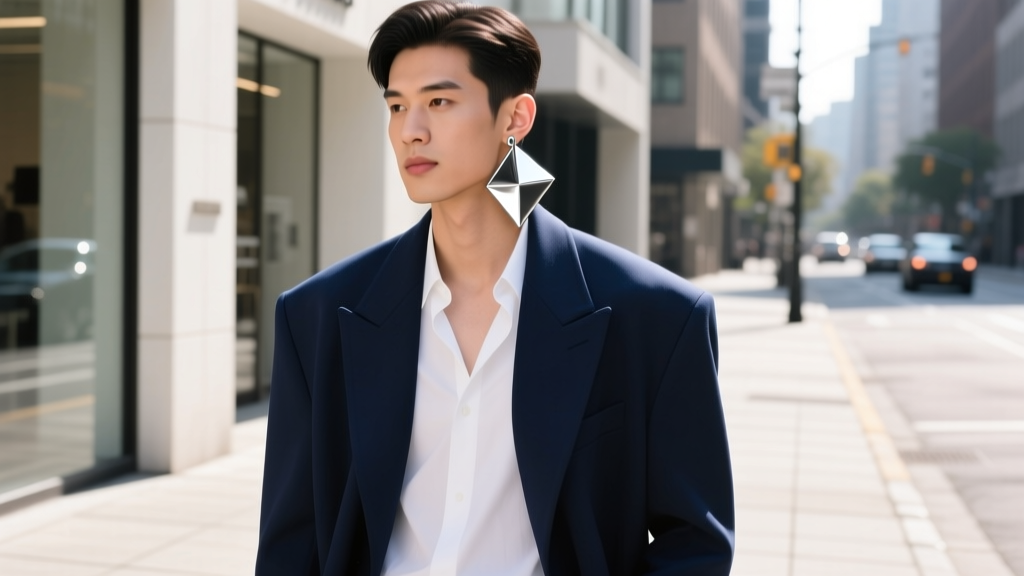
Wearing a dangle earring is an exercise in visual balance. Because the jewelry introduces kinetic energy to your face, the rest of your styling must act as an anchor. Here are three actionable frameworks to integrate the dangle into your daily rotation.
1. The Rule of Asymmetry and Neckline Pairing
A single, heavy dangle earring worn on one side creates a powerful focal point. However, it must be balanced by your neckline. If you are wearing a deep V-neck or an open-collar camp shirt, the bare skin of your chest will compete with the earring, making the look feel unanchored. Pair a single oversized dangle with a high, structured neckline—such as a mock-neck sweater, a tightly buttoned Oxford, or a heavyweight crewneck tee. The fabric frames the jawline and forces the eye upward to the jewelry.
2. The Proportional Contrast
Face shape dictates the ideal length of the dangle. Men with longer, narrower faces should opt for shorter, wider dangles (like a suspended horizontal bar or a geometric cluster) to add horizontal visual weight. Conversely, men with wider, more angular jawlines benefit from long, slender, linear dangles (such as a simple 2-inch titanium chain or a sleek dagger drop) which elongate the profile and soften the jaw.
3. The Metal-to-Hardware Pipeline
In 2026, mixing metals is acceptable, but matching your earring's hardware to your other functional accessories creates a cohesive, intentional look. If your watch features a brushed titanium case and a sapphire crystal, your dangle earring should mirror that brushed titanium finish. If you wear a classic 18k gold signet ring, your earring's clasp and primary metal should reflect that exact karat and warmth.
Lobe Longevity and Maintenance
The kinetic energy of a swinging dangle earring causes micro-trauma to the fistula (the piercing channel). To maintain the structural integrity of your earlobe over decades, you must adopt a proactive maintenance routine.
- The 8-Hour Rule: Never sleep in a dangle earring. The risk of catching it on bedding and tearing the lobe is high. Furthermore, the sustained pressure of lying on a heavy dangle restricts blood flow to the tissue.
- Jojoba Oil Massages: Twice a week, remove your jewelry and massage the lobe with pure, unrefined jojoba oil. This mimics the skin's natural sebum, promotes cellular turnover, and maintains the elasticity of the collagen matrix in the lobe, preventing the piercing from stretching out permanently.
- Rotation Resting: If you wear heavy dangles (10g+) daily, alternate them with lightweight, flush-fitting titanium studs on weekends to give the tissue time to contract and recover.
Final Verdict
The guy with the dangly earring has evolved from a niche subcultural signifier into a masterclass in modern masculine proportion and movement. By respecting the physics of gauge sizing, investing in biocompatible metals like ASTM F-136 titanium, and applying deliberate styling frameworks, you can harness this trend with confidence. In 2026, it is not just about wearing jewelry; it is about engineering your aesthetic from the skin outward.


