Hammered Earrings: 2026 Trend Forecast & Styling Guide
Discover the 2026 trend forecast for hammered earrings. Learn how to style textured gold and silver hoops, dangles, and studs for any face shape.

The Shift to Tactile Luxury: Hammered Earrings in 2026
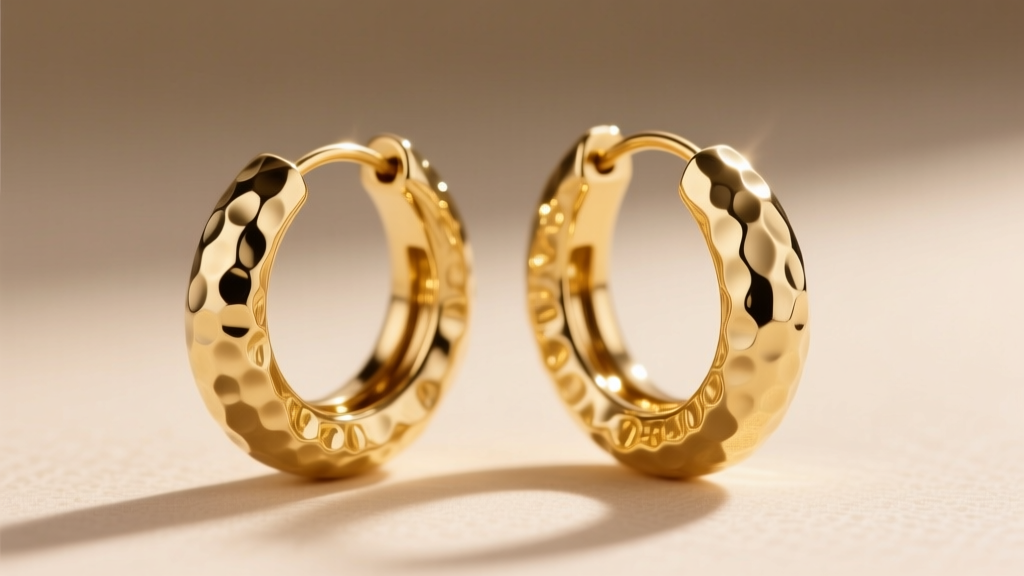
As we navigate the 2026 jewelry landscape, the industry is witnessing a definitive pivot away from the ultra-smooth, high-polish minimalism that dominated the early 2020s. Today’s consumers are gravitating toward "sensory luxury"—pieces that invite touch and interact dynamically with light. At the forefront of this movement are hammered earrings. Whether rendered as delicate 18k gold huggies or bold, oxidized silver dangles, the hammered finish has evolved from a niche bohemian staple to a cornerstone of contemporary fine jewelry design. But beyond their undeniable aesthetic appeal, hammered textures offer profound metallurgical benefits and unique styling opportunities that demand a closer look.
The Metallurgy of Texture: Work Hardening and Light Refraction
To truly appreciate hammered earrings, one must understand the physical transformation the metal undergoes during creation. When an artisan strikes a piece of gold or silver with a planishing or ball-peen hammer, they are not merely altering its surface appearance; they are fundamentally changing its internal crystal lattice structure. This process, known in metallurgy as work hardening or strain hardening, increases the dislocation density within the metal's grains.
According to metallurgical data from Rio Grande, annealed (soft) 14k yellow gold sits at roughly 130 on the Vickers Hardness (HV) scale. Through rigorous hand-hammering, that same 14k gold can reach upwards of 220 HV. This is why a 20-gauge hammered ear wire holds its shape significantly better than a smooth 20-gauge wire, resisting the bending and warping that often plagues heavy drop earrings. Furthermore, the micro-facets created by the hammer strikes act as tiny mirrors, scattering light in multiple directions. This optical diffusion makes lower-carat alloys, like 10k or 14k gold, appear far more brilliant and rich than they would with a flat mirror polish.
Artisan vs. Algorithm: Spotting Hand-Hammered vs. Machine-Stamped
The surging demand for textured jewelry in 2026 has inevitably led to market saturation by fast-fashion brands utilizing machine-stamping techniques. As a savvy collector or stylist, distinguishing between genuine hand-hammered earrings and their mass-produced counterparts is crucial for assessing both value and structural integrity.
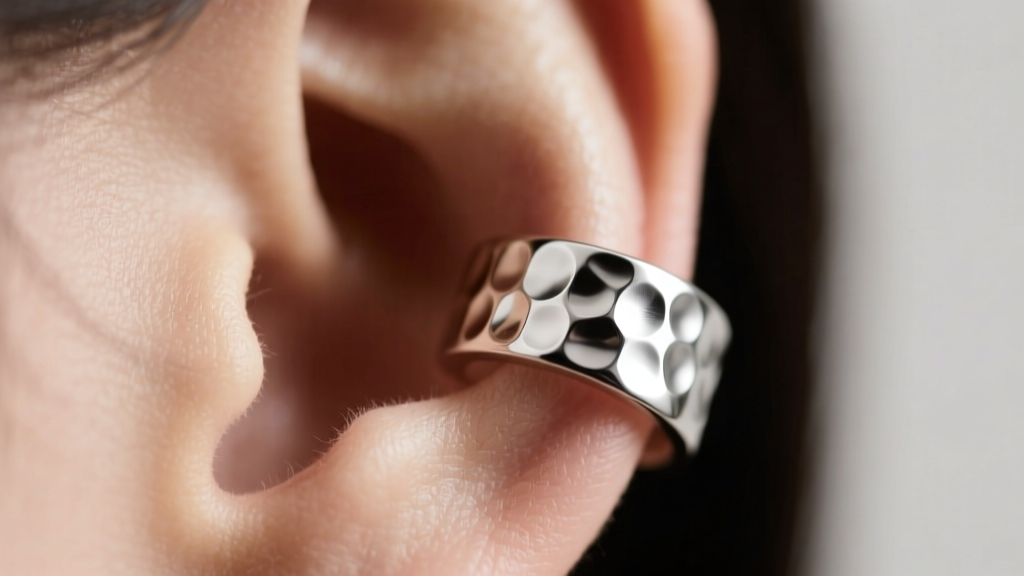
- The Perimeter Test: Hand-hammering displaces metal organically. If you examine the outer edges of a hand-hammered hoop or disc, you will notice slight, natural undulations and a softly rounded perimeter. Machine-stamped pieces are typically cut from a sheet of metal after stamping, leaving perfectly flat, razor-sharp, or laser-cut edges.
- The Dimple Pattern: Authentic hammer strikes overlap asymmetrically. The depth and diameter of the craters will vary slightly across the surface. Stamped earrings feature a uniform, grid-like pattern of identical indentations.
- Structural Integrity: Machine stamping merely displaces the metal without the kinetic force required to properly work-harden the alloy. Consequently, stamped earrings are more prone to bending and losing their shape under daily wear stress.
Silhouette Matrix: Matching Hammered Styles to Face Shapes
The light-scattering nature of hammered metals draws immediate visual attention to the wearer's face. Therefore, selecting the correct silhouette is paramount. The table below outlines the optimal hammered earring styles for various facial structures, leveraging the texture to enhance natural geometry.
| Face Shape | Recommended Hammered Style | Styling Rationale & Specifications |
|---|---|---|
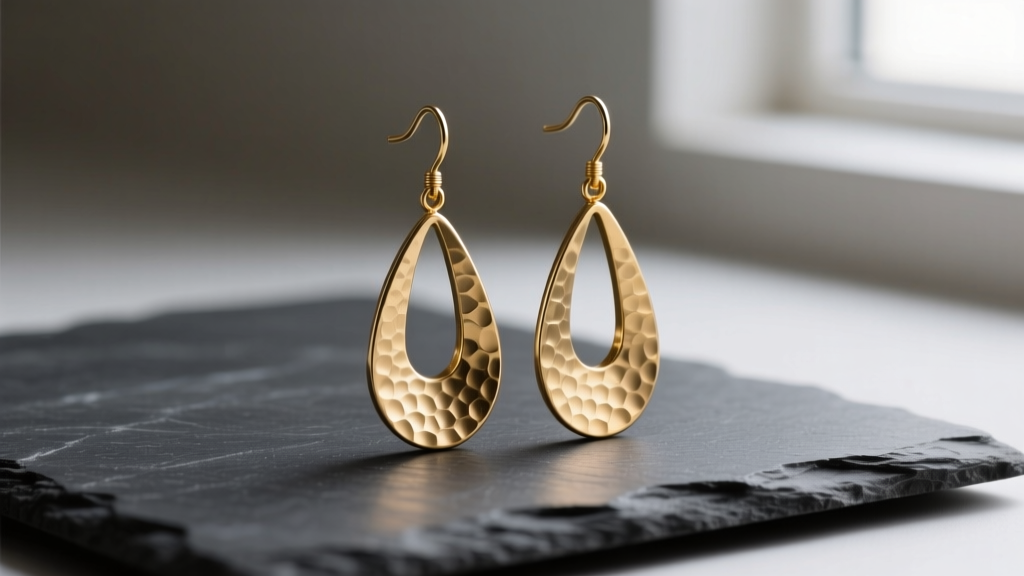
| Round | Elongated Hammered Dangles | Vertical lines and the elongated light reflection of a teardrop shape create the illusion of a longer, more sculpted jawline. Opt for 18-gauge French wires to support the weight. |
| Square | Medium Hammered Hoops (25mm-35mm) | The circular geometry of a hoop softens angular jawlines. The hammered texture diffuses the harshness of the metal, adding a soft, organic glow to the sides of the face. |
| Heart | Hammered Teardrop or Chandelier Studs | Width at the bottom of the earring balances a narrower chin. Ensure the backing is a secure friction-post or screw-back to handle the front-heavy distribution of the metal. |
| Oval | Hammered Huggies or Ear Cuffs | Oval faces possess natural symmetry that doesn't require corrective visual weighting. Close-to-the-ear huggies highlight the cheekbones without disrupting the face's natural harmony. |
Maintenance and Failure Modes: The Hidden Risks of Textured Metals
While hammered earrings are structurally robust, their topography introduces specific maintenance challenges that smooth jewelry does not face. The primary failure mode for textured jewelry is particulate trapping. Sebum, dead skin cells, cosmetic setting powders, and environmental dust readily accumulate within the micro-craters of the hammered surface. Over time, this buildup creates a dull, grayish film that completely neutralizes the light-refracting benefits of the finish.
Standard jewelry polishing cloths are largely ineffective—and potentially damaging—for deeply hammered surfaces. Rubbing a treated cloth over the metal will only polish the "peaks" of the hammer strikes, eventually flattening the texture and creating an uneven, patchy shine. Furthermore, aggressive rubbing can snag the cloth on microscopic burrs left by the artisan's tools.
The Expert Cleaning Protocol
To properly maintain hammered earrings in 2026, abandon the polishing cloth in favor of liquid dynamics. Utilize an ultrasonic jewelry cleaner operating at a standard 40 kHz frequency. The cavitation bubbles generated by the ultrasonic waves will penetrate the deepest dimples, dislodging trapped sebum without applying abrasive friction to the metal. Warning: If your hammered earrings feature friction-fit gemstone posts or delicate enamel accents, limit ultrasonic exposure to under three minutes to prevent vibration-induced loosening. For daily upkeep, a soft-bristled baby toothbrush dipped in a mild solution of warm water and phosphate-free dish soap is the safest mechanical option.
2026 Price Index: Valuing the Artisan's Labor
When shopping for hammered earrings, consumers must understand that they are paying for time as much as material. Hand-hammering a single pair of 2-inch continuous hoops requires an artisan to execute hundreds of individual strikes, interspersed with annealing cycles (heating the metal with a torch to prevent it from becoming too brittle and cracking). This labor-intensive process creates a distinct pricing hierarchy in the current market, as noted by industry analysts at Forbes Jewelry.
- Fine Jewelry (14k/18k Solid Gold, Hand-Hammered): Expect to pay between $280 and $750 for standard hoops or dangles. The premium reflects both the raw gold market value and the specialized bench-jeweler labor required to hammer high-karat gold without tearing it.
- Demi-Fine (925 Sterling Silver, Hand-Hammered): Ranging from $90 to $220. Silver work-hardens faster than gold, requiring more frequent annealing during the striking process, which keeps labor costs moderately high despite the lower material cost.
- Fashion/Stamped (Brass, Bronze, or Plated Alloys): Typically priced between $18 and $55. These pieces are mass-produced via hydraulic pressing and lack the structural work-hardening benefits of genuine artisan pieces.
Final Thoughts on the Hammered Renaissance
The dominance of hammered earrings in 2026 is not a fleeting fad; it is a fundamental recalibration of how we interact with our adornments. By choosing hand-hammered pieces, you are investing in superior metallurgical durability, supporting traditional bench-jeweler craftsmanship, and embracing a dynamic aesthetic that shifts and sparkles with every movement. Whether you are opting for a pair of heavy, oxidized silver cartilage cuffs or delicate, 18k gold hammered studs, understanding the science and artistry behind the texture ensures your investment will endure both structurally and stylistically for decades to come. For further reading on metal alloys and jewelry craftsmanship, the Gemological Institute of America (GIA) offers extensive resources on the materials that make these timeless pieces possible.


