Hammered Hoop Earrings: The Beginner's Guide to Textured Styling
Discover everything about hammered hoop earrings. Learn how to choose the right gauge, metal grade, and size for your face shape.

The Art and Science of Hammered Hoops
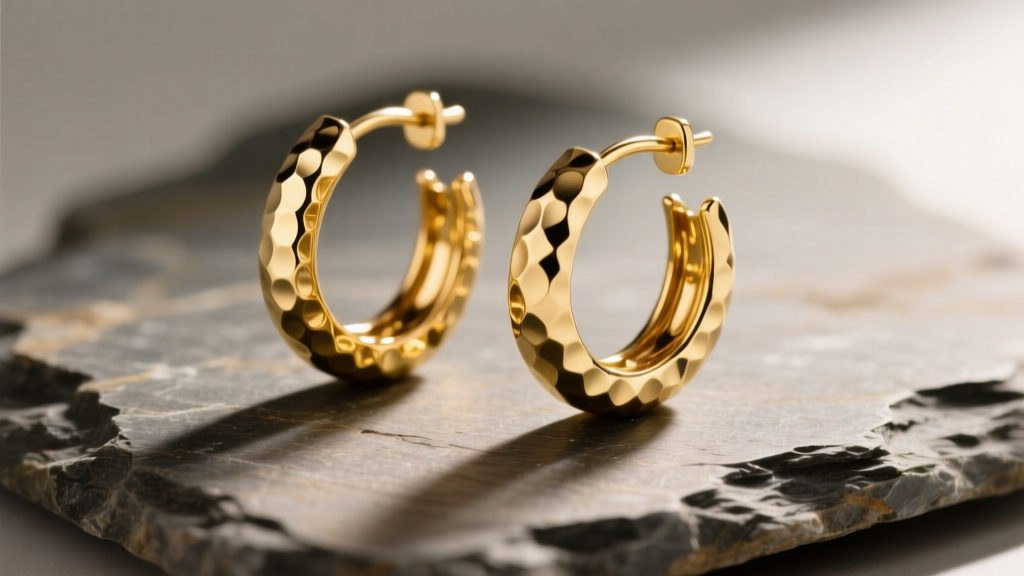
Hammered hoop earrings have surged in popularity, bridging the gap between artisanal craftsmanship and everyday wearability. Unlike machine-stamped, high-polish hoops that reflect light uniformly, hammered hoops feature a dimpled, organic surface created by striking the metal with specialized jeweler's hammers. This technique isn't just aesthetic; it fundamentally alters the metal's physical properties.
When a jeweler uses a planishing hammer or a ball-peen hammer on a wire or sheet of metal, they induce a process called work-hardening. This compresses the metal's crystalline structure, making the hoop significantly more durable and resistant to bending out of shape. However, if the metal is over-hammered without annealing (heating it to relieve internal stress), it can become brittle and snap at the closure point. Understanding this balance is the first step in recognizing high-quality hammered hoops from poorly manufactured ones.
Metal Grades and Hypoallergenic Safety
The textured surface of a hammered hoop increases its surface area, which can accelerate tarnishing in reactive metals. Therefore, choosing the right metal grade is critical, especially for sensitive earlobes. According to the Association of Professional Piercers (APP), nickel exposure is the leading cause of contact dermatitis in jewelry, and textured metals can trap microscopic debris that exacerbates irritation.
| Metal Grade | Hypoallergenic? | Tarnish Resistance | Average Price Range |
|---|---|---|---|
| 14k or 18k Solid Gold | Yes (Nickel-free alloys) | Excellent | $150 - $450+ |
| Argentium Silver (935) | Yes | High (Contains Germanium) | $60 - $120 |
| Sterling Silver (925) | Mostly (Check for Nickel) | Low (Requires Polishing) | $35 - $80 |
| Grade 23 Titanium (ELI) | Yes (Implant Grade) | Excellent | $40 - $90 |
| Gold-Plated Brass | No (High Irritation Risk) | Poor (Plating flakes in dimples) | $15 - $30 |
For beginners, Argentium Silver is a phenomenal entry point. Unlike traditional sterling silver, Argentium replaces some of the copper with germanium, creating a self-protecting layer that resists the dark oxidation that normally settles into the deep crevices of hammered textures. If you have newly pierced or highly reactive lobes, opt for Grade 23 Titanium (Ti-6Al-4V ELI), which the Gemological Institute of America (GIA) recognizes as a premier biocompatible material.
Decoding Gauge Sizes and Closures
The 'gauge' refers to the thickness of the wire used to form the hoop. Because hammering flattens and spreads the metal, a wire that starts at 16-gauge might end up measuring closer to 14-gauge in width while remaining 16-gauge in depth. Here is a breakdown of standard wire thicknesses for hammered hoops:
- 20-Gauge (0.81mm): Delicate and lightweight. Best for secondary cartilage piercings or a subtle, minimalist lobe look. Prone to bending if pulled.
- 18-Gauge (1.0mm): The industry standard for standard lobe piercings. Offers a great balance of durability and comfort without stretching the piercing hole over time.
- 16-Gauge (1.2mm): Thicker and more robust. Ideal for larger statement hoops (40mm+) where structural integrity is needed to prevent the hoop from warping into an oval shape.
The Closure Dilemma: Continuous vs. Hinged
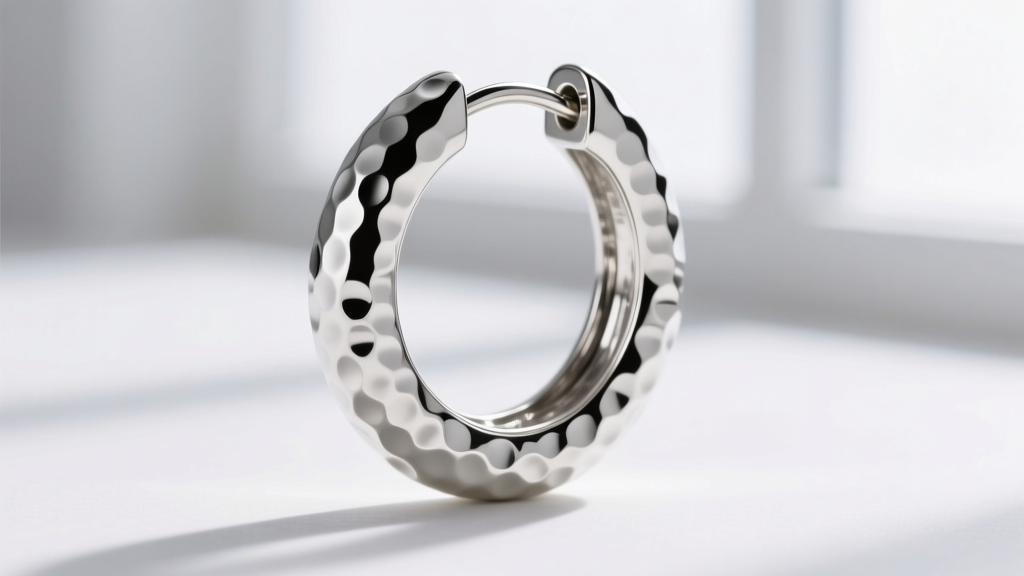
For hammered hoops, continuous (endless) closures are vastly superior to hinged snap-backs. A hinge requires a smooth, machined joint that interrupts the hand-hammered pattern, creating a visual break in the texture. Furthermore, the stress of opening and closing a hinged joint repeatedly can cause the work-hardened metal to fatigue and snap. A continuous hoop, where a slightly tapered end clicks securely into a hollow receiving tube, preserves the 360-degree texture and offers a seamless look.
Styling Hammered Hoops for Your Face Shape
The beauty of a hammered finish lies in its light diffusion. While a high-polish mirror finish creates sharp, high-contrast reflections that can emphasize angular features, a hammered surface scatters light softly. This makes hammered hoops incredibly forgiving and flattering across various face shapes.

Stylist's Tip: If you have a square or diamond face shape with prominent cheekbones and a sharp jawline, avoid thin, high-polish geometric hoops. Instead, choose medium-sized (25mm-35mm) hammered hoops with a slightly irregular, organic shape. The diffused light and curved, textured edges will beautifully soften your natural angles.
For round faces, opt for hammered hoops that are slightly elongated or teardrop-shaped rather than perfect circles. The vertical drop draws the eye downward, creating an illusion of length. For oval faces, virtually any hammered hoop works, but a classic 20mm circular huggie with a heavy ball-peen texture adds a modern, edgy contrast to balanced proportions.
Maintenance: Cleaning Textured Crevices
The very texture that makes these earrings unique also makes them magnets for lotion, sebum, and environmental dust. If you wear your hammered hoops daily, a simple wipe with a cloth won't suffice, as the fabric cannot reach into the microscopic dimples.
- The Ultrasonic Method: For solid gold, platinum, or titanium, an ultrasonic jewelry cleaner is the most effective tool. The high-frequency sound waves create microscopic cavitation bubbles that blast debris out of the hammered crevices in minutes.
- The Soft Brush Technique: For silver or oxidized pieces, avoid ultrasonic cleaners if the piece has intentional dark patina in the dimples. Instead, use a drop of mild dish soap, warm water, and a baby-soft toothbrush. Gently agitate the bristles over the texture.
- Avoid Polishing Cloths on Texture: Traditional jeweler's polishing cloths are infused with mild abrasives. If you rub them vigorously over a hammered surface, you will polish the high points to a mirror shine while leaving the low points dark, resulting in a patchy, uneven appearance.
Buying Guide: What to Expect at Every Price Tier
When shopping for hammered hoop earrings in 2026, the market is segmented into three distinct tiers. Knowing what to expect prevents you from overpaying for mass-produced items disguised as artisanal crafts.
Fast Fashion & Mass Market ($15 - $40)
At this price point, the 'hammered' effect is usually achieved via machine-stamping or electroforming over a brass or copper core. The plating is incredibly thin and will inevitably wear away at the highest points of the texture first, leaving you with a two-toned, flaking earring. Avoid these if you have sensitive skin.
Artisan & Independent Jewelers ($60 - $180)
This is the sweet spot for beginners. Independent metalsmiths typically use solid Argentium silver or 14k gold-filled wire. You will see slight variations between the left and right earrings—a hallmark of genuine hand-hammering. These pieces offer excellent longevity, proper annealing for durability, and high-quality continuous closures.
Fine Jewelry & Heritage Brands ($250 - $800+)
Luxury brands utilize solid 18k gold and employ master goldsmiths who use specialized, custom-textured hammer faces to create proprietary patterns (like a 'stardust' or 'lunar' finish). You are paying for the purity of the alloy, the precision of the seamless closures, and the brand's heritage. These are investment pieces meant to last generations without structural failure.


