The Ultimate Hoop Earring Size Guide for Every Face Shape
Master your style with our hoop earring size guide. Learn to match diameters, thicknesses, and metals to your unique face shape and 2026 trends.


Finding the perfect hoop earring is an exercise in geometry, physics, and personal style. While a classic circular silhouette seems universal, the millimeter-level differences in diameter, wire thickness, and inner clearance can completely alter how a piece sits on your ear and frames your face. Whether you are curating a minimalist everyday stack or making a bold statement for an evening event, understanding the nuances of sizing is non-negotiable. This comprehensive hoop earring size guide breaks down the exact measurements, material weights, and stylistic pairings you need to make an informed choice in 2026.
The Anatomy of a Hoop: Diameter vs. Thickness vs. Weight
Before diving into face shapes, we must clarify the three critical measurements that dictate a hoop's fit and drape. Many buyers mistakenly look only at the outer diameter, leading to ill-fitting purchases.
- Outer Diameter (OD): The total width of the earring from edge to edge. This is the visual size you see in the mirror.
- Inner Diameter (ID): The actual clearance space inside the hoop. This determines whether the earring will comfortably clear your earlobe or cartilage without pinching.
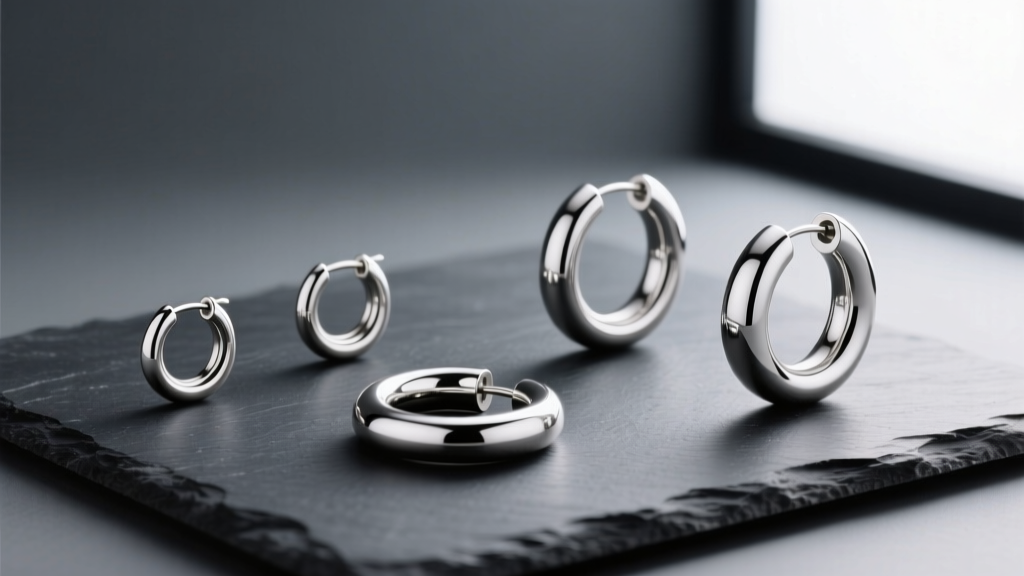
- Wire Thickness (Gauge): The thickness of the metal itself. Standard delicate hoops use 1mm wire (approx. 18-gauge), while statement hoops can feature 5mm+ hollow tubing.
The Golden Rule of Sizing: A 20mm OD hoop with a thick 5mm wire leaves only a 10mm ID. If your earlobe is thicker than 10mm, or if you are trying to fit a healed helix piercing, this hoop will sit too tightly, causing irritation and pressure necrosis. Always calculate the ID by subtracting the wire thickness from the OD.
The Hoop Earring Size Guide by Face Shape
The visual weight of a hoop can either balance your natural proportions or exaggerate them. Here is a strategic framework for matching hoop dimensions to your facial structure.
| Face Shape | Recommended OD Range | Ideal Silhouette & Thickness | Styling Rationale |
|---|---|---|---|
| Round | 30mm - 50mm | Angular, square, or geometric hoops; 2mm-3mm thickness. | Adds structure and elongates the jawline, countering soft curves. |
| Oval | 15mm - 40mm | Classic circles or slightly oval drops; any thickness. | Oval faces are naturally balanced; almost any proportion works beautifully. |
| Square | 40mm - 60mm | Large, perfectly round hoops or soft oval hoops; 1mm-2mm wire. | Softens a strong jawline and draws the eye vertically. |
| Heart | 25mm - 45mm | Teardrop hoops or bottom-heavy circular designs; 3mm+ thickness. | Adds visual weight to the lower half of the face, balancing a wider forehead. |
| Diamond | 20mm - 35mm | Small to medium huggies or oval hoops; 2mm thickness. | Highlights prominent cheekbones without overwhelming the narrow chin. |
Cartilage vs. Lobe: Why Inner Diameter (ID) is Everything
When transitioning from standard lobe piercings to cartilage placements like the helix, tragus, or conch, the hoop earring size guide shifts from pure aesthetics to anatomical necessity. Cartilage piercings are highly sensitive to pressure and angle.
According to the Association of Professional Piercers (APP), wearing a hoop that is too small in diameter forces the jewelry to bend inside the fistula (the piercing channel). This creates uneven pressure, leading to irritation bumps, delayed healing, and migration.
Sizing by Piercing Placement
- Tragus & Rook: Typically require a 6mm to 8mm ID. Because these areas are thick and fleshy, a snug fit is necessary, but the wire must be thin (1mm - 1.2mm) to allow for closure.
- Helix & Forward Helix: Usually need an 8mm to 10mm ID to clear the outer curve of the ear. If your helix is pierced at a steep angle, you may need a 12mm ID to prevent the hoop from jutting out awkwardly.
- Conch: Requires large IDs, often 12mm to 16mm, depending on how deep the piercing sits within the ear's bowl.
- Gauge Sizing: Standard lobes are usually 20G (0.81mm) or 18G (1.02mm). Cartilage is predominantly pierced at 16G (1.29mm) or 14G (1.6mm). Never force a 20G wire into a 16G cartilage piercing, as the thin wire can act like a cheese cutter and migrate through the tissue.
2026 Trend Analysis: Asymmetry, Tubing, and Mixed Metals
The styling landscape for 2026 has moved away from perfectly matched pairs. The current trend analysis highlights a strong preference for curated asymmetry. Stylists are pairing a chunky 40mm hollow-tube gold hoop in one lobe with a micro 10mm diamond-encrusted huggie and a seamless titanium cartilage ring on the opposite ear.
Furthermore, the Gemological Institute of America (GIA) notes that as consumers demand larger, bolder silhouettes, jewelers are increasingly utilizing hollow tubing rather than solid wire for hoops exceeding 30mm. This allows for the visual impact of a 5mm thick 'chunky' hoop without the prohibitive cost and ear-tearing weight of solid 14k or 18k gold. Mixed metals—specifically oxidized silver paired with high-polish yellow gold accents—are also dominating the mid-size 20mm-30mm category, offering a vintage, lived-in aesthetic.
Material Weight and Earlobe Health
A massive but frequently overlooked factor in sizing is gravity. A solid 14k gold hoop with a 50mm diameter and a 2mm wire thickness can weigh upwards of 8 to 10 grams per earring. Over time, wearing heavy, large-diameter hoops stretches the earlobe piercing, causing the hole to elongate and the jewelry to pull forward, which ruins the intended drape of the earring.
Expert Troubleshooting for Heavy Hoops:
- Opt for Hollow Tubing: For any OD over 35mm, always choose hollow or semi-hollow construction.
- Use Silicone O-Rings: If you own heavy solid hoops, place a small, clear silicone earring support disc behind the lobe to distribute the weight across a wider surface area.
- Choose Lightweight Alloys: Grade 23 Titanium (Ti-6Al-4V) is incredibly strong but weighs nearly 45% less than gold or stainless steel, making it the ultimate material for large, structural statement hoops.
How to Measure Your Existing Hoops Accurately
If you have a pair of hoops that fit perfectly and want to replicate the size, do not use a soft sewing tape measure. The flexibility of the tape will wrap around the curve of the metal, giving you a false, inflated reading.
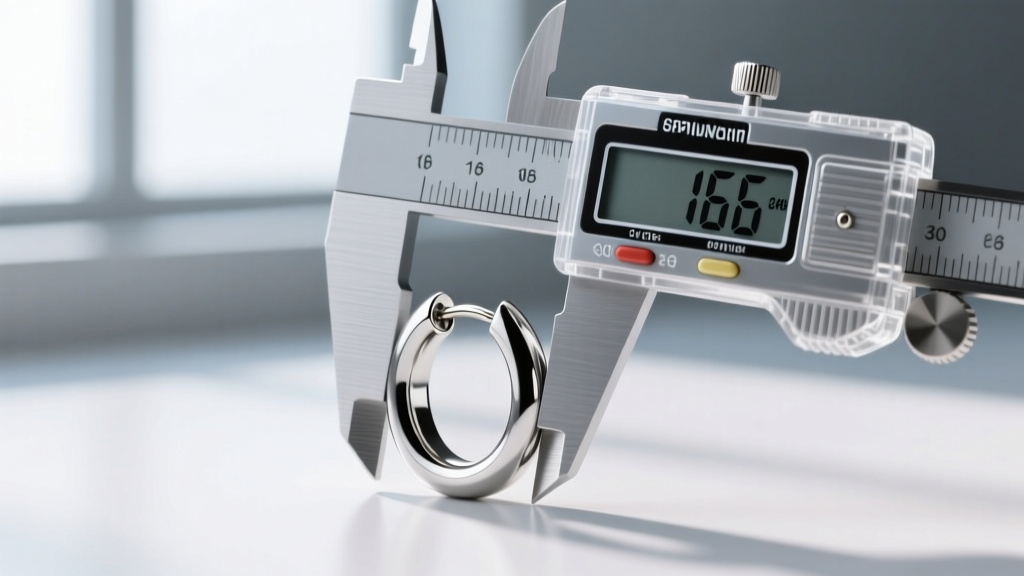
- Invest in Digital Calipers: A basic pair of digital calipers will give you exact millimeter and gauge readings.
- Measure the OD: Clamp the calipers on the absolute outside edges of the hoop.
- Measure the Wire: Clamp the calipers directly on the metal wire to determine the thickness.
- Calculate the ID: Subtract the wire thickness (x2) from the OD to find your true clearance space.
Final Styling Verdict
Mastering the hoop earring size guide is about understanding the interplay between your anatomy and the jewelry's engineering. By respecting inner diameters for cartilage health, balancing outer diameters with your face shape, and leveraging modern hollow-tube construction for larger statement pieces, you can build a versatile, comfortable, and fiercely stylish earring wardrobe that transitions seamlessly from day to night.