The Ultimate 2026 Hoop Earring Sizing Chart & Fit Guide
Master your jewelry fit with our comprehensive hoop earring sizing chart. Learn inner diameter, gauge, and placement rules for perfect 2026 styling.

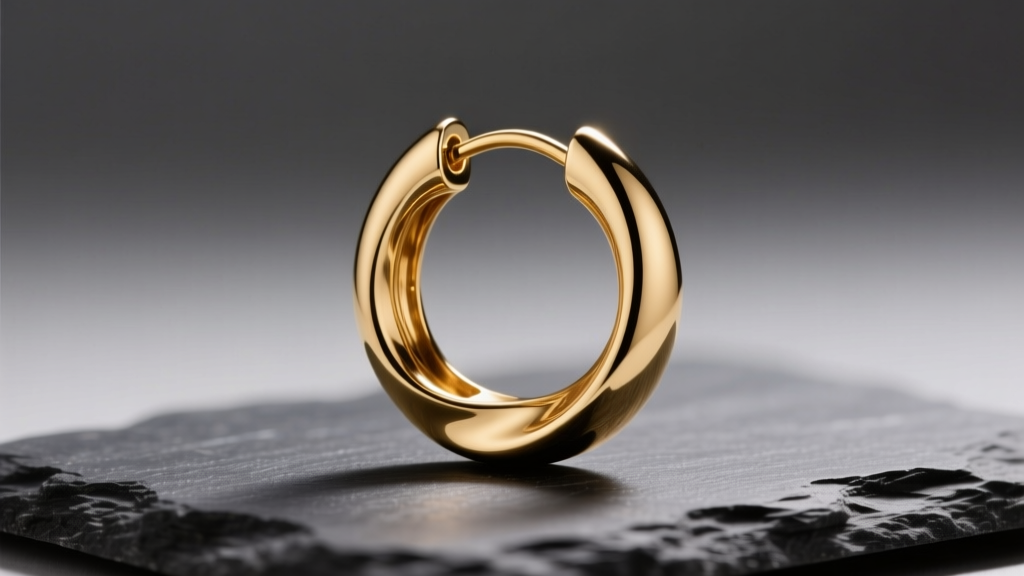
Buying hoop earrings online often feels like a gamble. You order what the website describes as 'medium everyday hoops,' only to open the box and discover a pair of tiny huggies that barely clear your earlobe, or massive statement rings that catch on every sweater you own. As we move through 2026, the trend landscape has shifted heavily toward curated, multi-piercing ear stacks and precise anatomical styling. To achieve this, you must abandon vague size descriptors and rely on exact millimeter measurements.
This comprehensive hoop earring sizing chart and buying guide will teach you how to measure your unique anatomy, decode the critical difference between inner and outer diameters, and avoid the structural failure modes that ruin piercings over time.
The Golden Rule: Inner Diameter vs. Outer Diameter
The most common mistake consumers make when shopping for hoops is confusing Outer Diameter (OD) with Inner Diameter (ID). Understanding this distinction is the foundation of proper earring fit.
- Outer Diameter (OD): The total footprint of the earring from one outside edge to the other. This is the measurement you see when the hoop is resting on a table.
- Inner Diameter (ID): The empty space inside the hoop. This is the actual functional space your ear tissue will occupy.
The mathematical relationship between the two is dictated by the thickness of the metal wire or tube. The formula is: OD = ID + (2 × wire thickness).
Consider a popular '20mm hoop' advertised online. If that hoop is made from a thick 3mm tubular wire, the actual Inner Diameter is only 14mm. If your earlobe measures 12mm from the piercing hole to the outer edge, a 14mm ID will hug the lobe tightly like a huggie, rather than dangling freely as the 20mm OD might suggest.
Always check the product specifications for the Inner Diameter (ID) when determining how a hoop will sit on your specific piercing placement.
The Ultimate Hoop Earring Sizing Chart
Use the chart below to map your specific piercing placements to their ideal Inner Diameter (ID) ranges. These measurements ensure the hoop clears the tissue without leaving excessive gaps that invite snagging.
| Piercing Placement | Ideal Inner Diameter (ID) | Recommended Hoop Style |
|---|---|---|
| Standard Lobe (Huggie Fit) | 8mm - 11mm | Thick Tube Huggies, Micro Clickers |
| Standard Lobe (Dangle Fit) | 12mm - 20mm | Continuous Hoops, Hinged Snap Hoops |
| Upper Lobe / Second Hole | 6mm - 9mm | Seamless Rings, Tiny Huggies |
| Helix (Outer Cartilage) | 8mm - 10mm | Cartilage Clickers, Segment Rings |
| Conch (Inner Cup) | 12mm - 16mm | Large Clickers, Seamless Continuous |
| Daith (Innermost Fold) | 10mm - 12mm | Specialized Daith Clickers (Recessed Hinge) |
| Tragus | 5mm - 7mm | Micro Seamless Rings |
Wire Gauge and the 'Cheese-Cutter' Failure Mode
Size is only half the equation; thickness (gauge) dictates the long-term health of your piercing. In jewelry, the lower the gauge number, the thicker the metal. Standard lobe piercings are typically done at 20G (0.8mm) or 18G (1.0mm), while cartilage piercings are usually 16G (1.2mm) or 14G (1.6mm).
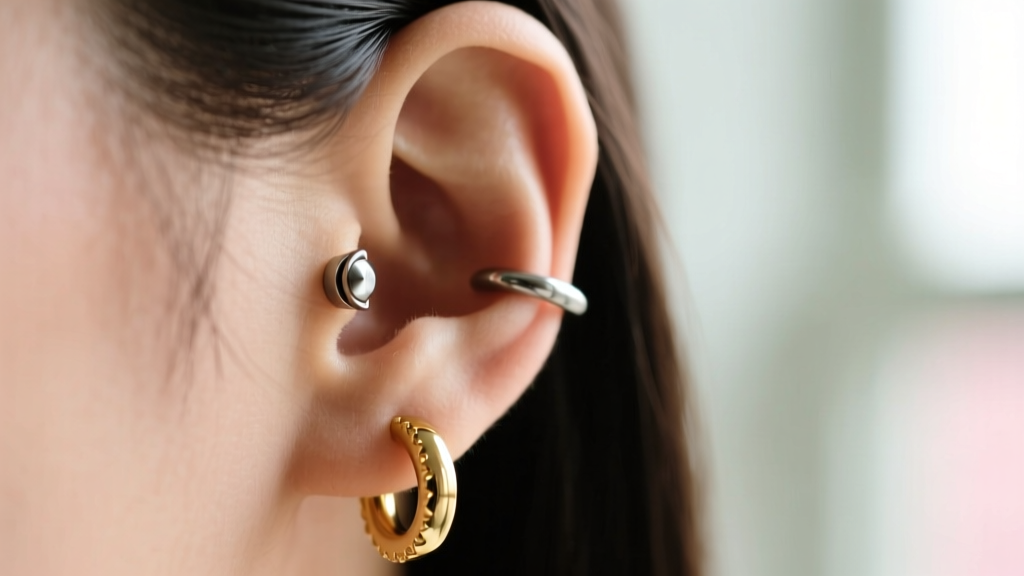
According to guidelines published by the Association of Professional Piercers (APP), wearing heavy, oversized hoops on thin-gauge wires leads to a well-documented tissue failure known as the 'cheese-cutter effect.' Physics dictates that pressure equals force divided by area. A heavy 30mm statement hoop resting on a thin 20G (0.8mm) wire concentrates massive downward pressure on the microscopic fistula (piercing channel) at the bottom of the lobe. Over months and years, this wire slowly migrates downward through the tissue, permanently elongating the hole and causing irreversible splitting.
Actionable Gauge Rules for 2026:
- For Hoops under 15mm ID: 20G or 18G is perfectly safe for standard lobes.
- For Hoops 15mm to 25mm ID: Never go thinner than 18G. Opt for 16G if the metal is solid rather than hollow tubing.
- For Statement Hoops over 25mm ID: You must use 14G or 16G wire. If your piercing cannot accommodate 14G, abandon the hoop entirely and use a flat-back labret post with a hanging charm attachment to distribute the weight across the backing plate rather than the bottom of the hole.
Clasp Mechanics: Choosing the Right Closure
The closure mechanism dictates both the security of your jewelry and its suitability for different anatomical zones. Here is how the three primary clasp types perform in real-world scenarios.
1. Continuous (Seamless) Hoops
These feature a single piece of metal with a tiny slit that allows one end to snap into the other. Pros: They have no hinge bumps, making them the absolute best choice for healing piercings or tight spaces like the tragus and helix. Cons: They require significant finger dexterity to open and close, and repeated bending can weaken the metal over time.
2. Clicker Hinges
Clickers feature a hinged segment that snaps into a receiving groove with an audible 'click.' Pros: Extremely secure and easy to insert. They are the gold standard for cartilage stacks in 2026. Cons: The hinge block creates a small protrusion. If used in a daith piercing, this protruding hinge can press into the conch bowl, causing pressure necrosis or irritation bumps. Always buy 'recessed hinge' clickers specifically designed for the daith.
3. Hinged Snap Closures
Common in classic lobe hoops, the wire snaps into a hollow tube latch. Pros: Very easy to use and provides a seamless look when closed. Cons: If the thin latch wire bends, the hoop will constantly pop open. Avoid these for active lifestyles or sleeping.
Proportion and Face Shape Styling
Beyond anatomical fit, the visual proportion of your hoops should complement your facial structure. Use these styling frameworks to balance your features:

- Round Faces: Avoid perfectly circular, wide hoops that emphasize facial width. Instead, opt for elongated drop hoops or oval-shaped hoops with an ID of 35mm or larger. The vertical lines draw the eye downward, creating a lengthening illusion.
- Square Faces: Angular jawlines are beautifully softened by medium-sized, perfectly round hoops (20mm to 30mm ID). Avoid sharp, geometric shapes or stiff rectangular drops.
- Heart-Shaped Faces: Teardrop hoops or bottom-heavy designs work exceptionally well, as they add visual weight to the narrower lower half of the face, balancing a wider forehead.
- Oval Faces: The universal canvas. You can pull off anything from microscopic 6mm tragus rings to massive 50mm runway-style statement hoops.
Material Grades and Allergy Prevention
The final pillar of buying hoops is material safety. The GIA Gem Encyclopedia and dermatological standards warn against the vague marketing term 'surgical steel.' Most commercial surgical steel is 316L stainless steel, which contains 8% to 10% nickel. When trapped in a warm, moist piercing channel, nickel leaches out and triggers contact dermatitis in a significant portion of the population.
For fresh piercings, or if you have sensitive skin, your hoop earring sizing chart is useless if the metal causes rejection. Demand ASTM F136 Implant-Grade Titanium. It is entirely nickel-free, lightweight (reducing the cheese-cutter effect), and highly polished to prevent bacterial adhesion. For fine jewelry investments, stick to 14k or 18k solid yellow or white gold, ensuring the alloy is explicitly nickel-free (often alloyed with palladium or silver instead).
By mastering inner diameters, respecting gauge physics, and selecting the correct clasp for your specific cartilage or lobe placement, you can curate a flawless, comfortable ear stack that lasts a lifetime.


