Hoop Snake Earrings: 2026 Trend Analysis & Styling Guide
Discover why hoop snake earrings are the defining jewelry trend of 2026. Explore material grades, gauge sizing, and styling frameworks for serpent hoops.

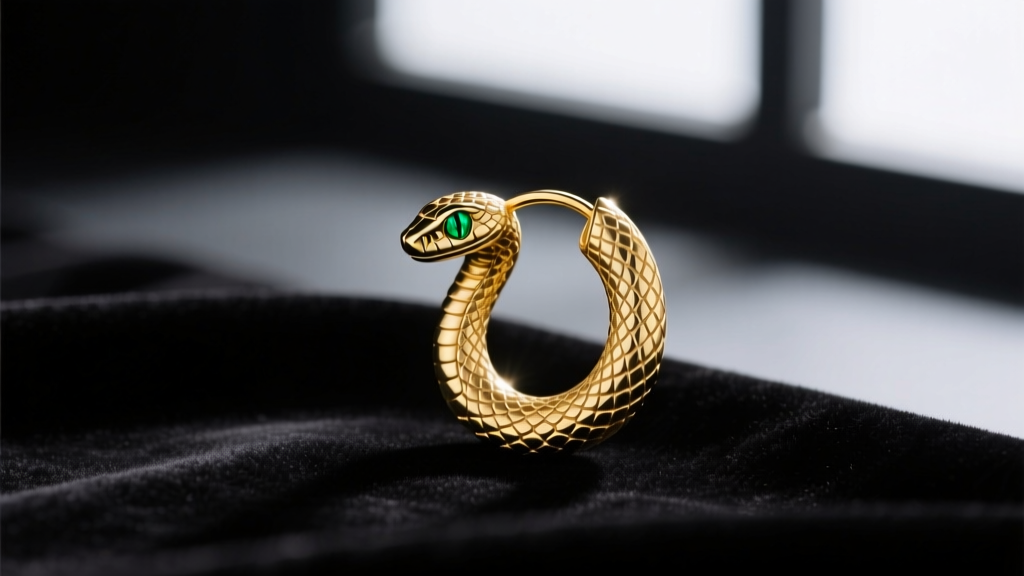
The jewelry landscape of 2026 has decisively pivoted from ultra-minimalism to narrative-driven maximalism. At the forefront of this shift are hoop snake earrings, a design that marries the everyday versatility of the classic hoop with the ancient, mythological weight of the serpent motif. No longer confined to niche gothic subcultures or vintage estate collections, the serpent hoop has been reimagined by contemporary designers as a staple of 'Mythological Luxury.' Whether featuring a subtle Ouroboros clasp or an intricately scaled viper wrapping around a cartilage helix, these pieces demand a closer look at both their cultural resonance and their structural engineering.
The 2026 Resurgence: Why Serpent Hoops are Dominating
To understand the current dominance of hoop snake earrings, we must look at the broader cultural fascination with protective and transformative symbolism. The serpent has been a staple of adornment for millennia. As noted by The Metropolitan Museum of Art, snake motifs in ancient Roman and Hellenistic jewelry represented eternity, rebirth, and protection. In 2026, this translates into the 'Medusa-core' and dark academia aesthetics evolving into high-end, wearable luxury. Consumers are seeking jewelry that acts as a personal talisman. The hoop provides the familiar, face-framing geometry that suits modern styling, while the snake introduces an element of danger, edge, and historical depth. Furthermore, the rise of asymmetrical ear curation has made the serpent hoop a popular choice for a 'statement piece' on one ear, balanced by simpler studs on the other.
Material Grades and the Enamel Dilemma
When investing in serpent-themed jewelry, the material dictates not just the price, but the longevity of the intricate details. Snake scales are often highlighted using enamel or oxidation, both of which present unique failure modes if the base metal is not properly chosen.
| Material | Base / Plating | Price Range | Durability & Risk |
|---|---|---|---|
| Gold Vermeil | Sterling Silver / 2.5µm 14k Gold | $85 - $180 | Prone to friction wear on the raised snake scales; requires careful storage. |
| Solid 14k Gold | Alloyed Gold (58.5% pure) | $450 - $1,200 | Excellent structural integrity; will not tarnish; ideal for daily wear and scale detailing. |
| Oxidized Silver | Sterling Silver / Sulfur treatment | $120 - $350 | Highlights scale texture beautifully but can rub off on high-friction areas over time. |
| Enamel Accents | Vitreous (Hot) vs. Epoxy (Cold) | $200 - $800+ | Cold enamel chips easily if dropped; vitreous enamel is fused and highly durable. |
For the gemstone eyes—a hallmark of premium hoop snake earrings—designers are increasingly moving away from synthetic cubic zirconia. According to the GIA Gem Encyclopedia, tsavorite garnets and ethically sourced emeralds are the preferred choices for 2026, offering a vivid, natural green that complements both yellow gold and oxidized silver without the artificial brilliance of lab-grown diamonds.
Structural Integrity: Gauge Sizing and Clasp Mechanics
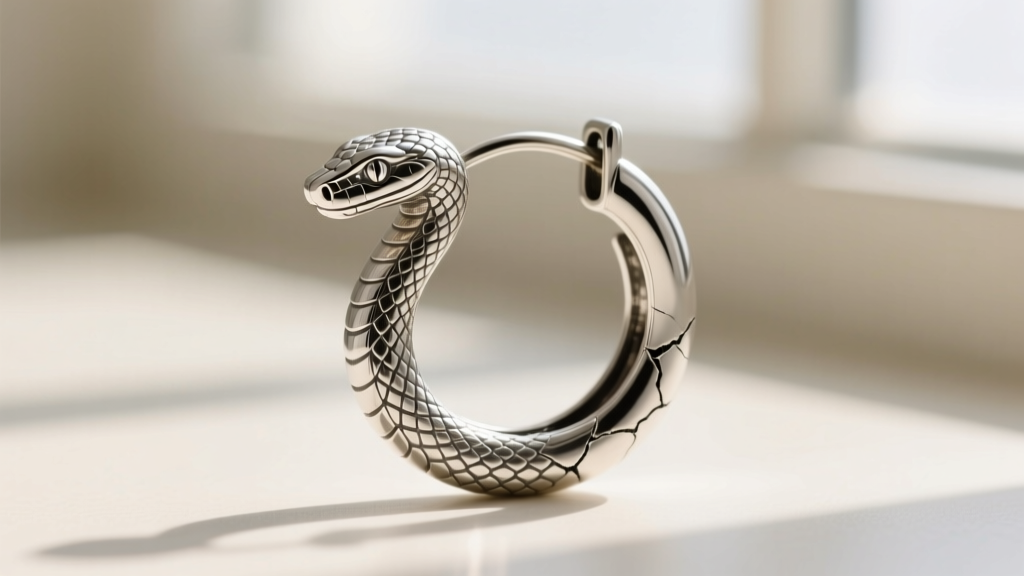
The most common point of failure in hoop snake earrings is structural. A standard fashion hoop is crafted from 20-gauge (0.81mm) wire and weighs roughly 1.5 grams. However, adding a detailed, solid-metal snake head can increase the weight to 4 or 5 grams. This asymmetric weight distribution creates a pendulum effect, causing the earring to constantly flip forward, exposing the clasp and sitting awkwardly on the lobe.
The Gauge Solution
To counteract this, expert jewelers recommend a minimum of 16-gauge (1.29mm) wire for lobe hoops featuring heavy serpent motifs, and 14-gauge (1.63mm) for cartilage placements. The thicker wire provides the necessary rigidity to keep the hoop perfectly circular, ensuring the snake head rests exactly where the designer intended.
Clasp Fatigue and Torque
Hinged snap-back clasps rely on a tiny metal tab clicking into a groove. The lateral torque exerted by a heavy snake head can bend the microscopic hinge pin over 6 to 12 months of daily wear, resulting in a clasp that no longer stays shut. For 2026 collections, look for latch-back closures (where a post clicks into a hinged saddle) or continuous endless hoops with a friction-fit post, which completely eliminates the hinge weak point.
Styling Framework: Proportions and Face Shapes
Styling hoop snake earrings requires balancing the visual weight of the serpent against your natural features. The snake head acts as a focal point, drawing the eye precisely to where it rests.
- Round Face Shapes: Opt for elongated, teardrop-shaped hoops where the snake wraps vertically. This creates an optical illusion of length, drawing the eye downward and slimming the jawline. Avoid perfectly circular, wide hoops with massive snake heads at the bottom, as they will widen the face.
- Angular and Square Face Shapes: Choose medium-sized circular hoops (20mm-25mm) where the snake wraps along the curve of the metal. The rounded geometry softens sharp jawlines and prominent cheekbones.
- Heart-Shaped Faces: Look for 'Ouroboros' designs—where the snake eats its own tail to form the entire hoop. This distributes the visual weight evenly around the ear, balancing a narrower chin.
Cartilage vs. Lobe: Placement Strategies
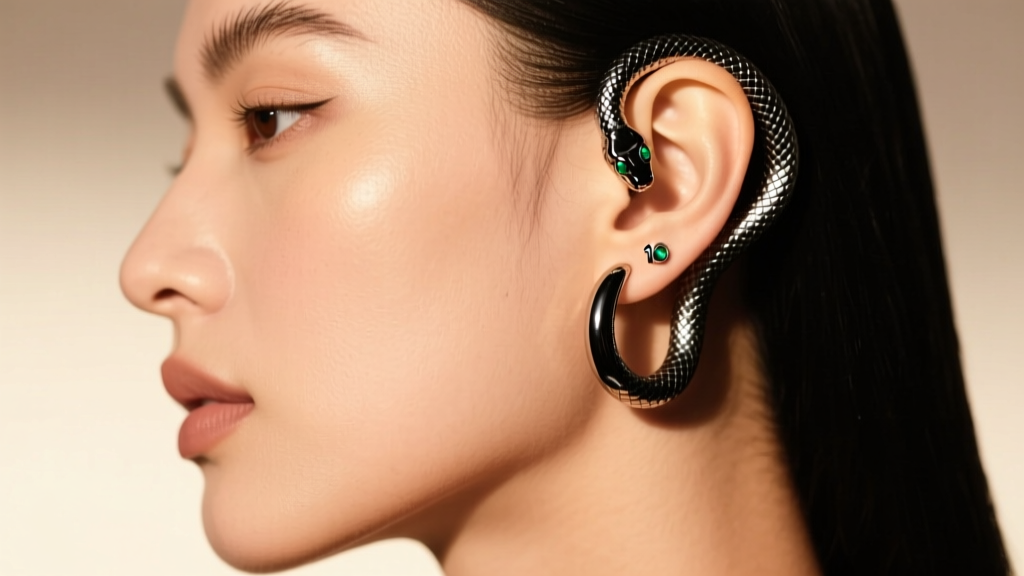
While standard lobe piercings are the default, the 2026 trend heavily favors cartilage placements for serpent hoops. A 10mm to 12mm 'huggie' style snake hoop placed in the upper helix or tragus creates a fierce, armor-like aesthetic. However, cartilage is thicker and less pliable than the earlobe. If you are buying hoop snake earrings for a healed helix piercing, ensure the inner diameter is at least 10mm to accommodate the natural swelling and curvature of the upper ear, and verify that the post is 16-gauge to prevent the 'cheese-cutter effect' where thin wire migrates through the piercing channel.
'The serpent is not merely an decoration; it is an architectural element that changes how the ear interacts with light and shadow.' — 2026 Demi-Fine Jewelry Trend Report
Market Tiers: Where to Invest
The market for hoop snake earrings is distinctly segmented. Fast-fashion retailers offer $15 to $40 brass or zinc-alloy options, but these suffer from rapid tarnishing and poorly cast scales that lack definition. The sweet spot for most consumers is the demi-fine tier ($85 to $250), where brands utilize heavy gold vermeil and recycled sterling silver, offering excellent detail and longevity with proper care. For heirloom-quality pieces, the fine jewelry tier ($800 to $3,500+) offers solid 18k gold, hand-set tsavorite eyes, and vitreous guilloché enamel that will outlast the wearer. Ultimately, the hoop snake earring is a masterclass in combining ancient symbolism with modern structural design, making it the most compelling ear trend of the year.


