Hot Air Balloon Earrings: Best Materials for Lightweight Dangles
Discover the best materials for hot air balloon earrings. Compare weight, durability, and hypoallergenic properties for comfortable dangles.

The Engineering Challenge of Whimsical Dangles
In the landscape of 2026 novelty jewelry, hot air balloon earrings remain a beloved staple for their whimsical silhouette and intricate detailing. However, translating a voluminous balloon envelope and a dangling basket into a wearable ear piece presents a unique engineering challenge. Unlike standard studs or huggies, dangle earrings are subject to kinetic stress, gravitational pull, and pendulum-like motion. When designing or purchasing hot air balloon drops, the choice of material dictates not only the aesthetic appeal but the center of gravity, lobe fatigue, and long-term structural integrity.
The human earlobe can comfortably support approximately 7 to 10 grams of static weight before tissue fatigue and stretching occur over a full day of wear. Because hot air balloon designs are inherently top-heavy—featuring a wide upper canopy and a narrow lower basket—poor material selection can cause the earring to tilt forward, pulling the piercing channel at an uncomfortable angle. Understanding the metallurgical and synthetic properties of common earring materials is essential for balancing visual impact with ergonomic comfort.
Material Breakdown: Enamel vs. Polymer Clay vs. Acrylic
Cloisonné and Champlevé Enamel on Metal Bases
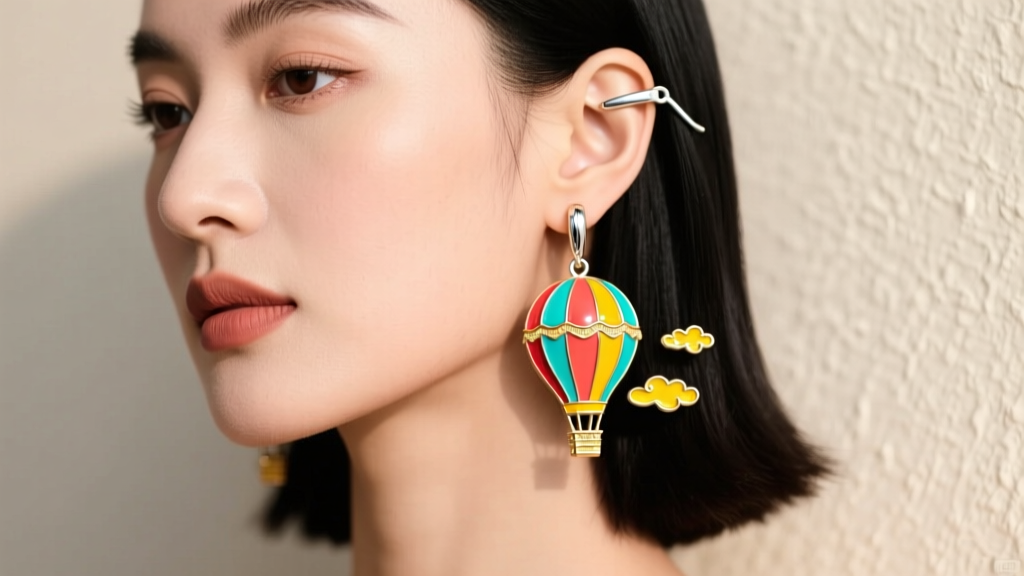
Traditional hot air balloon earrings often utilize cloisonné or champlevé enamel techniques to achieve vibrant, multi-colored panels that mimic the fabric segments of a real balloon. The durability and weight of these pieces depend entirely on the base metal. Brass and copper bases are common in budget-friendly options ($15–$30), but they add significant mass, often pushing a single earring past the 6-gram mark. Furthermore, cheap brass alloys frequently contain nickel, a known contact allergen. Premium versions utilize 925 sterling silver or gold vermeil bases ($65–$140). While silver reduces the risk of allergic reactions, it is a relatively soft metal; a drop onto a hard surface can dent the silver cells, causing the glass-like enamel to crack or pop out—a catastrophic failure mode for this material.
Polymer Clay (Sculpey and Fimo)
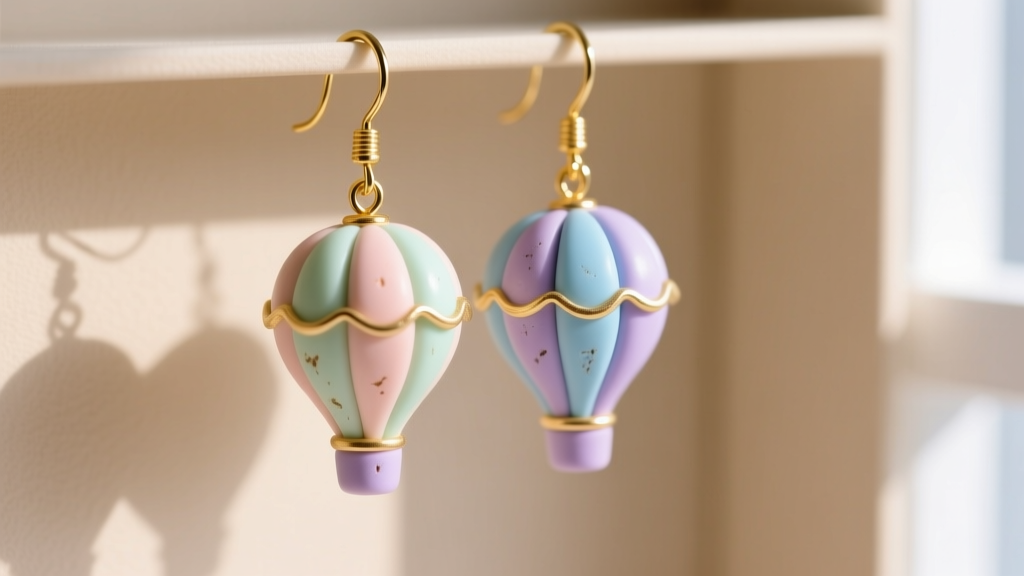
For ultra-lightweight dangles, polymer clay is the undisputed champion. Artisans use brands like Sculpey Premo or Fimo Professional to sculpt miniature balloon envelopes. Cured polymer clay is remarkably light, with a finished hot air balloon earring typically weighing between 1.2 and 2.5 grams per pair. However, polymer clay has low tensile strength. The primary failure mode occurs at the jump ring connecting the balloon to the ear wire. If the clay is not reinforced with a flexible UV resin coating or a baked-in metal armature, the constant swinging motion can cause the clay to tear around the drill hole. When properly sealed, polymer clay offers excellent water resistance and vibrant, matte coloration that requires zero polishing.
Laser-Cut Cast Acrylic (PMMA)
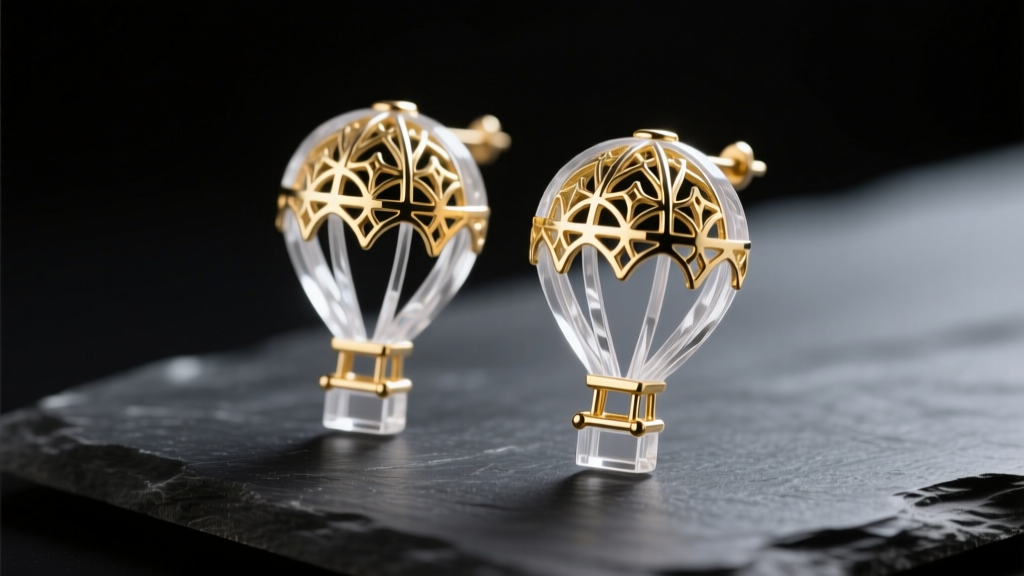
Acrylic provides a modern, graphic take on the hot air balloon motif. Using CO2 lasers, manufacturers cut precise balloon silhouettes from 2mm or 3mm cast acrylic sheets, often adding metallic foil layering for the basket. Acrylic sits in the mid-weight category (2.5 to 4 grams per pair). The critical vulnerability of laser-cut acrylic is stress concentration at the piercing holes. If the laser cuts too close to the edge of the acrylic sheet without adequate clearance, a simple snag on a sweater can snap the earring in half. Additionally, cheaper extruded acrylics are prone to UV yellowing over time, whereas high-grade cast PMMA maintains optical clarity and color stability for years.
Weight & Wearability: A Data-Driven Comparison
When selecting hot air balloon earrings, balancing your aesthetic preference with your lobe's weight tolerance is crucial. The following matrix compares the physical properties of the three dominant materials used in 2026 novelty dangles.
| Material | Avg Weight (Pair) | Base Metal / Post | Price Range | Primary Failure Mode |
|---|---|---|---|---|
| Cloisonné Enamel (Brass) | 8.0g - 12.0g | Brass / Ni-Plated | $15 - $35 | Enamel chipping, nickel dermatitis |
| Champlevé Enamel (Silver) | 6.0g - 9.0g | 925 Sterling Silver | $65 - $140 | Silver denting, cell wall bending |
| Polymer Clay | 1.2g - 2.5g | Titanium / Niobium | $20 - $45 | Tearing at the jump ring hole |
| Cast Acrylic (PMMA) | 2.5g - 4.0g | Surgical Steel | $12 - $28 | Snapping at stress concentration points |
Hardware: Gauge Sizes and Ear Wire Mechanics
The material of the balloon itself is only half the equation; the hardware connecting it to the ear dictates the wearing experience. Standard ear piercings are typically done at 20-gauge (0.81mm) or 18-gauge (1.02mm). For lightweight polymer clay or acrylic hot air balloon earrings, a 20-gauge French hook wire is perfectly adequate and minimizes friction in the piercing channel.
However, if you opt for heavier enamel drops exceeding 5 grams per earring, an 18-gauge or even 16-gauge (1.29mm) wire is highly recommended to prevent the metal from bending under the pendulum stress. Furthermore, the style of the ear wire matters immensely. French hooks (fishhooks) are easy to insert but offer zero security against the upward pull that can occur when removing a sweater or brushing hair. For heavier, valuable hot air balloon dangles, a leverback closure or a locking French hook is essential. Leverbacks feature a hinged clasp that snaps securely into place, distributing the weight more evenly across the lower curve of the earlobe rather than concentrating it solely on the piercing channel.
Hypoallergenic Standards and Base Metal Transparency
Novelty jewelry is notorious for obscuring base metal compositions, leading to severe contact dermatitis. According to the American Academy of Dermatology, nickel allergy is the most common cause of allergic contact dermatitis, affecting a significant percentage of the population. Many mass-produced enamel hot air balloon earrings use a zinc alloy or brass base that is flash-plated with a microscopic layer of silver or gold. Once this plating wears off at the friction points near the ear wire, the underlying nickel is exposed to the skin's moisture and oils.
To ensure biocompatibility, always verify the exact metal grade. Look for ASTM F138 implant-grade stainless steel, commercially pure titanium (Grade 1 or 2), or niobium for the ear wires. The Federal Trade Commission's Jewelry Guides strictly mandate that marketers must not misrepresent the metal content of jewelry. If a product is labeled simply as "silver-toned" or "hypoallergenic" without specifying the exact elemental breakdown or karat weight, it is highly likely to contain nickel or cobalt. For hot air balloon earrings where the post passes directly through the vascularized earlobe tissue, insisting on verified, nickel-free materials is non-negotiable for long-term piercing health.
Final Thoughts on Material Selection
Choosing the right hot air balloon earrings requires looking past the whimsical design to evaluate the structural reality of the piece. If your priority is all-day comfort and vibrant, customizable colors, polymer clay paired with a titanium wire is the superior choice. If you prefer a vintage, heirloom-quality aesthetic and don't mind a slightly heavier drop, sterling silver champlevé enamel offers unmatched prestige—provided you utilize a secure leverback closure. By understanding the specific gravity, tensile strength, and allergen profiles of these materials, you can curate a novelty jewelry collection that is as comfortable as it is captivating.