How to Style and Wear Hoop Star Earrings for Every Piercing
Learn how to choose, insert, and style hoop star earrings for any piercing. Expert guide on gauges, metals, and face-shape styling tips.

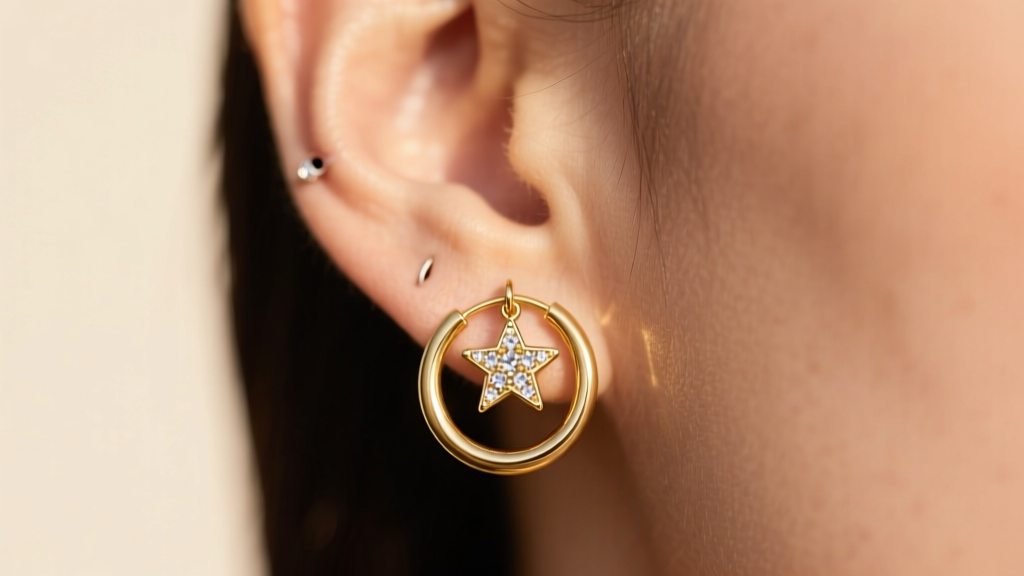
The Renaissance of Celestial Ear Styling
Celestial motifs have dominated jewelry trends for years, but the specific integration of astral charms into continuous rings has created a micro-category of its own. Hoop star earrings—whether they feature a dangling star charm, a star-shaped continuous hoop, or a huggie with an integrated celestial silhouette—offer a versatile blend of edge and elegance. However, styling them correctly requires more than just picking a pretty design. The weight of the star charm, the gauge of the wire, and the inner diameter of the hoop all dictate whether the earring will sit beautifully or cause piercing irritation.
This comprehensive, step-by-step guide will teach you how to select, insert, and style hoop star earrings for every ear anatomy, ensuring your celestial stack is both anatomically sound and visually striking.
Step 1: Match the Gauge, Diameter, and Anatomy
The most common failure mode when wearing hoop star earrings is selecting a hoop with an incorrect inner diameter or wire thickness. A hoop that is too tight will cause the star charm to press into the skin, leading to moisture trapping and contact dermatitis. A wire that is too thin for a cartilage piercing can cause the "cheese-cutter effect," where the jewelry slowly migrates through the tissue.
According to the Association of Professional Piercers (APP), matching your jewelry to the specific anatomical location is critical for long-term tissue health. Below is a structural framework for pairing hoop star earrings with your specific piercings.
| Piercing Location | Standard Wire Gauge | Minimum Inner Diameter | Max Star Charm Weight |
|---|---|---|---|
| Standard Lobe | 20g (0.8mm) - 18g (1.0mm) | 10mm - 15mm | Up to 3.5 grams |
| Helix / Cartilage | 16g (1.2mm) - 18g (1.0mm) | 12mm - 16mm | Up to 1.5 grams |
| Tragus | 16g (1.2mm) | 8mm - 10mm | Up to 1.0 grams |
| Conch | 16g (1.2mm) - 14g (1.6mm) | 14mm - 22mm | Up to 4.0 grams |
Understanding Charm Weight Limits
Star charms, especially those paved with cubic zirconia or diamonds, add localized weight. If a heavy star charm hangs from a thin 20-gauge lobe hoop, it will pull the piercing channel downward, eventually causing the lobe to stretch or tear. For heavy celestial charms, always opt for an 18-gauge or 16-gauge hoop to distribute the tension across a wider surface area of the fistula.
Step 2: Select the Appropriate Metal Grade
Because hoop star earrings move frequently—swinging with your head movements and brushing against hair—the metal must be highly polished and biocompatible to avoid micro-abrasions inside the piercing channel.
- Implant-Grade Titanium (ASTM F-136): The absolute gold standard for fresh piercings or hyper-sensitive ears. Titanium is lightweight, meaning a titanium hoop with a star charm will exert less gravitational pull on the lobe than steel or silver. It is also entirely nickel-free.
- 14k or 18k Solid Gold: Ideal for healed piercings. The Gemological Institute of America (GIA) notes that 14k and 18k gold offer the best balance of purity and structural durability. Avoid gold-plated or gold-vermeil hoops for cartilage, as the friction from the hoop rotating can wear away the plating, exposing base metals that cause allergic reactions.
- Sterling Silver: Generally discouraged for long-term wear in cartilage or unhealed piercings. Silver oxidizes and tarnishes when exposed to moisture and sebum, which can lead to localized staining of the skin (argyria) and irritation bumps.
Step 3: Master the Insertion Technique
Hoop star earrings typically come in two mechanical styles: hinged clickers and seamless continuous hoops. Inserting them incorrectly can warp the metal or damage the threading.
How to Insert a Hinged Clicker Hoop
Hinged clickers feature a microscopic latch that snaps into place. Do not use jewelry pliers to open them. Pliers will scratch the gold or titanium and bend the delicate hinge pin. Instead, use your thumb and index finger to gently pull the hoop apart at the seam opposite the hinge. Once the post is through the piercing, push the two ends together until you hear a distinct, tactile "click." If it doesn't click, the post is misaligned; do not force it.
How to Insert a Seamless Continuous Hoop
Seamless hoops rely on tension. The most common mistake is pulling the ends apart laterally (like opening a book). This warps the circle into an oval, making it impossible to close flush. Instead, twist the ends vertically in opposite directions (one toward you, one away from you). Slide the hoop through the piercing, then twist them back into alignment until the ends meet perfectly flush.
Step 4: Styling for Face Shapes and Ear Stacks
Hoop star earrings are not just anatomical accessories; they are framing devices for your face. The diameter of the hoop and the placement of the star charm can subtly alter your facial proportions.
The Proportion Rule: The larger the hoop, the more it widens the visual profile of the face. The longer the dangling charm, the more it elongates the jawline.
Styling by Face Shape
- Round Faces: Opt for standard-sized hoops (20mm-30mm) with elongated, dangling star charms. The vertical drop of the star draws the eye downward, creating the illusion of a longer, more angular jawline. Avoid thick, chunky huggie hoops that add horizontal width.
- Angular / Square Faces: Choose smaller, rounder huggie hoops (8mm-12mm) where the star is integrated directly into the curve of the metal rather than dangling. This softens sharp jawlines without adding harsh vertical lines.
- Heart-Shaped Faces: Teardrop-shaped hoops or hoops where the star charm sits at the very bottom center work beautifully, balancing a wider forehead with a delicate focal point near the chin.
Building a Celestial Ear Stack
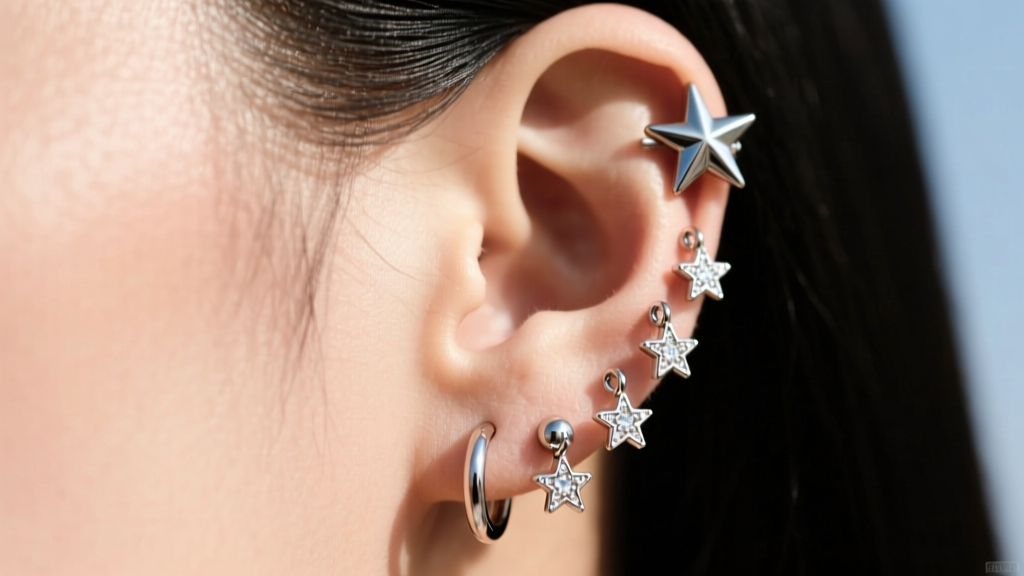
When building a stack around your hoop star earrings, establish a hierarchy. If your lobe features a statement 25mm hoop with a large pavé star charm, your upper helix and tragus piercings should feature minimalist, tiny star studs or plain titanium huggies. Competing focal points will make the ear look cluttered rather than curated.
Troubleshooting Common Hoop Star Issues
Even with perfect sizing, hoop star earrings present unique mechanical challenges. Here is how to troubleshoot the most frequent complaints.
Issue: The Star Charm Keeps Snagging on Hair and Knitwear
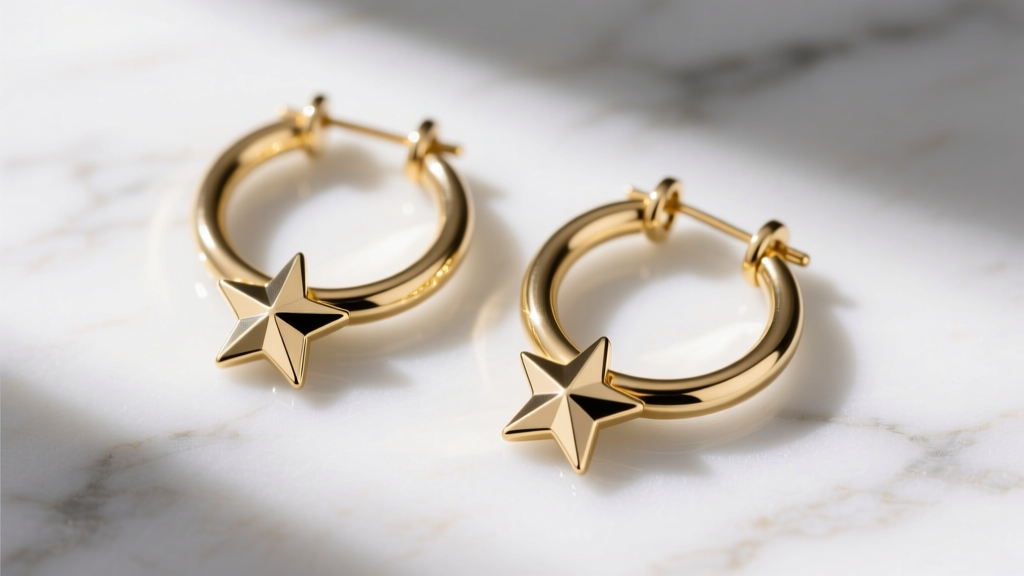
The Cause: Prong-set gemstones on the star charm act like microscopic hooks. The Fix: Switch to bezel-set star charms or solid cast-metal stars without stones. If you must wear prong-set stars during the winter, wear your hair in an updo or opt for hoops where the star charm is fixed (soldered) to the bottom of the hoop, preventing it from flipping upward into your hair.
Issue: The Hoop Rotates, Hiding the Star Charm Behind the Ear
The Cause: The hoop is too lightweight or the inner diameter is too large, allowing it to spin freely on the earlobe. The Fix: Use a slightly smaller inner diameter so the hoop hugs the lobe more snugly. Alternatively, you can apply a tiny, transparent silicone O-ring (available at piercing studios) to the back of the hoop wire to create friction and lock the star charm in the forward-facing position.
Issue: Irritation Bumps on the Helix
The Cause: The star charm is too heavy, causing the hoop to swing and strike the side of the head, creating blunt-force trauma to the healing cartilage. The Fix: Downsize to a smaller, lighter star charm, or switch to a 16-gauge titanium huggie where the star is flush against the hoop, eliminating the pendulum effect entirely.
Final Thoughts on Celestial Curation
Mastering the art of wearing hoop star earrings requires a balance of aesthetic vision and anatomical respect. By prioritizing correct gauge sizes, selecting biocompatible metals like ASTM F-136 titanium or solid 14k gold, and understanding the physics of charm weight, you can wear your celestial jewelry comfortably every day. Whether you are curating a minimalist tragus stack or making a bold statement with elongated lobe hoops, the stars will align perfectly when the mechanics are right.


