Beginner's Guide to Styling Pink Heart Earrings for Any Piercing
Discover how to choose, style, and care for pink heart earrings. Learn about hypoallergenic metals, gauge sizes, and face-shape pairing in our guide.

Why Pink Heart Earrings Are a Timeless Wardrobe Staple
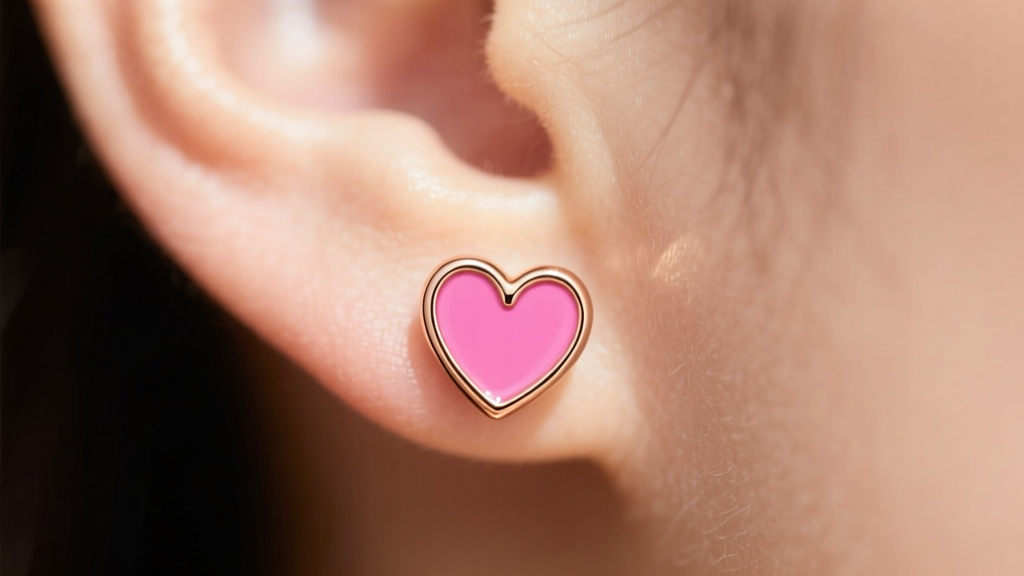
Pink heart earrings have successfully transcended their Y2K nostalgia roots to become a sophisticated, versatile staple in modern jewelry wardrobes. Whether you are navigating your first curated ear project, looking for a hypoallergenic option for sensitive lobes, or simply wanting to add a touch of warmth to your daily rotation, the pink heart motif offers endless adaptability. However, as with any jewelry purchase, the difference between a piece that lasts a lifetime and one that turns your skin green lies entirely in the metallurgy, gemstone quality, and structural design.
In this comprehensive beginner's guide, we will break down the exact material grades, gauge sizes, and styling frameworks you need to make an informed purchase. We will move past generic fashion advice and dive into the specific data points that professional piercers and jewelers use when evaluating heart-shaped earrings for both lobe and cartilage placements.
Decoding Materials: What Actually Touches Your Skin?
The term 'pink' in jewelry can refer to the metal itself, an enamel coating, or a set gemstone. Understanding the material composition is critical, especially if you have a history of contact dermatitis or metal sensitivities.
The Metallurgy of Rose Gold
True pink metal in fine jewelry is achieved through rose gold alloys. Pure 24k gold is naturally yellow. To create a pink hue, jewelers alloy pure gold with copper. The exact ratio dictates the depth of the color:
- 14k Rose Gold: Contains 58.5% pure gold and a higher copper content. This results in a vibrant, distinctly pink hue that is highly durable and resistant to scratching, making it ideal for everyday heart studs.
- 18k Rose Gold: Contains 75% pure gold. Because there is less copper, the color is a softer, more subtle peach-pink. It is more hypoallergenic but slightly softer, meaning intricate heart prong settings may require more careful handling.
Gemstones vs. Enamel
If your pink heart earrings feature a solid pink material rather than metal, you are likely looking at one of three options:
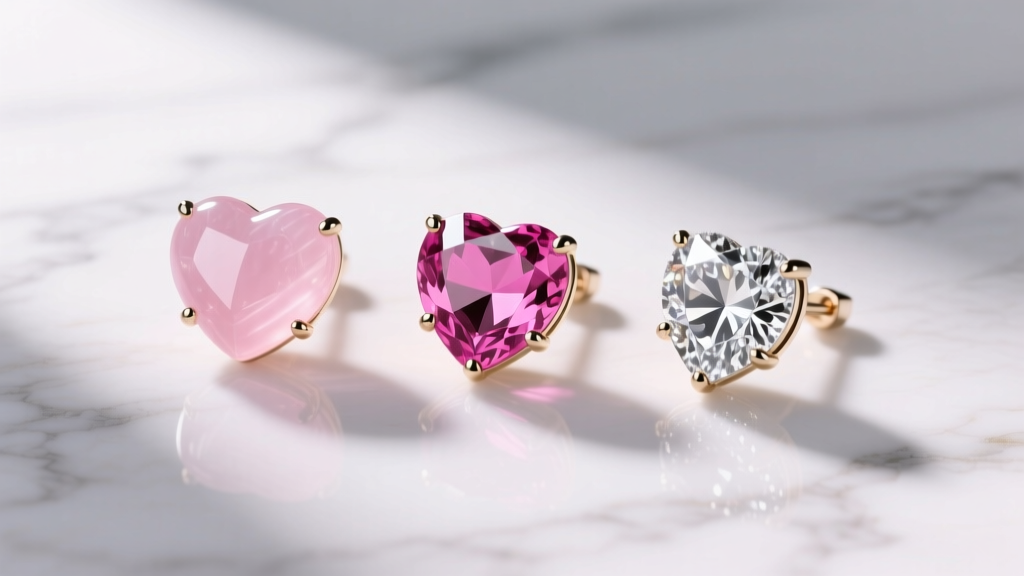
- Rose Quartz: A natural stone with a Mohs hardness of 7. It offers a beautiful, translucent blush pink but is prone to chipping if dropped on hard surfaces. It also contains natural inclusions that can fracture in ultrasonic cleaners.
- Pink Sapphire: With a Mohs hardness of 9, pink sapphires (often lab-grown for affordability) are exceptionally durable and brilliant, making them the premier choice for heirloom-quality heart earrings.
- Vitreous Enamel: Unlike cheap cold enamel (which is essentially painted epoxy resin that yellows and chips), vitreous enamel is glass powder fired onto metal at over 1400°F. It provides a rich, opaque pink that will not degrade from UV exposure or perfume contact.
Gauge Sizes and Piercing Placement Framework
One of the most common mistakes beginners make is ignoring the wire thickness (gauge) of the earring post or hoop. Wearing the wrong gauge can lead to migration, rejection, or the dreaded 'cheese cutter effect,' where a thin wire slowly slices through the earlobe tissue under the weight of a dangle.
| Piercing Placement | Standard Gauge Size | Best Pink Heart Earring Style | Crucial Warning |
|---|---|---|---|
| Standard Earlobe | 20g (0.81mm) or 18g (1.02mm) | Studs, small huggies, lightweight drops | Avoid heavy dangles on 20g wires to prevent lobe stretching. |
| Cartilage / Helix | 16g (1.29mm) or 18g (1.02mm) | Flat-back heart studs, seamless clickers | Never use butterfly backs on cartilage; use internally threaded flat-backs. |
| Tragus / Conch | 16g (1.29mm) | Mini heart bezel-set studs | Ensure the heart face is under 6mm to avoid catching on headphones. |
According to the Association of Professional Piercers, initial piercings should only be fitted with implant-grade titanium (ASTM F136) or niobium. If you are buying pink heart earrings for a fresh piercing, ensure the base metal is ASTM F136 titanium, even if it is PVD-coated with a rose gold finish.
Matching Heart Shapes to Your Face Shape
The geometry of a heart shape—wide at the top and tapering to a point at the bottom—naturally draws the eye downward. How you leverage this depends on your facial structure.
- Round Faces: Opt for elongated, dangling pink heart earrings. The vertical drop helps create the illusion of length, balancing the width of the cheekbones. Avoid wide, chunky heart studs that add horizontal volume.
- Square Faces: Look for hearts with softened, rounded edges or bezel-set pink sapphires without harsh geometric prongs. The curves of the jewelry will soften a strong, angular jawline.
- Heart-Shaped Faces: Since your chin already tapers to a point, wearing bottom-heavy heart drops can exaggerate this feature. Instead, choose balanced pink heart huggies or perfectly symmetrical studs that sit snugly on the lobe.
- Oval Faces: You have the most versatility. You can effortlessly pull off oversized pink enamel heart hoops or asymmetric mismatched sets (e.g., a solid rose quartz heart on one side, and a diamond-accented pink sapphire heart on the other).

Real-World Troubleshooting & Care Protocols
Even high-quality pink heart earrings require specific maintenance to preserve their color and structural integrity. Here are the most common failure modes and how to avoid them:
The Perfume Degradation Rule: Never spray aerosol perfumes or hairsprays directly onto your earrings. The alcohol and chemical solvents in these products will rapidly break down the epoxy in cold-enamel pink hearts, causing them to peel and lose their luster within weeks.
Preventing the 'Cheese Cutter' Effect
If you love heavy, oversized pink gemstone heart dangles, you must ensure the ear wire is sufficiently thick. A heavy stone weighing more than 4 grams suspended on a flimsy 20-gauge (0.8mm) French wire will act like a pendulum. Over time, the gravity and motion will stretch the piercing hole, eventually migrating it downward. If you are buying heavy drops, look for 18-gauge or 16-gauge lever-back closures, which distribute the weight more evenly across the lobe.
Cleaning Rose Quartz vs. Sapphire
The American Academy of Dermatology frequently warns about the buildup of sebum and dead skin cells behind earring posts, which can cause localized infections. While you should clean your posts weekly with warm water and antibacterial soap, be careful with the pink stones. You can safely use an ultrasonic jewelry cleaner for pink sapphires and cubic zirconia. However, never put rose quartz in an ultrasonic cleaner; the high-frequency vibrations will exploit natural microscopic inclusions in the stone, causing it to fracture or cloud permanently. Clean rose quartz gently with a microfiber cloth and mild soap.
2026 Pricing Tiers: What Should You Spend?
Understanding the market pricing for pink heart earrings will help you avoid overpaying for plated metals or underestimating the cost of fine gemstones.
- Fashion / Costume ($15 - $40): Expect brass or zinc alloy bases with cold enamel or pink cubic zirconia. These are fine for occasional wear but will oxidize and cause reactions in sensitive ears. Look for surgical steel posts at minimum.
- Demi-Fine ($60 - $180): This is the sweet spot for everyday wear. You will find 14k gold-plated sterling silver (vermeil) with high-quality vitreous enamel or lab-created pink sapphires. Ensure the plating is at least 2.5 microns thick for longevity.
- Fine Jewelry ($350 - $1,500+): Solid 14k or 18k rose gold featuring natural or lab-grown pink sapphires, or hand-carved rose quartz. These pieces are designed for lifelong daily wear, retain intrinsic metal value, and are entirely hypoallergenic.
By prioritizing implant-grade metals, understanding the geometry of your face shape, and respecting the physical properties of pink gemstones, you can curate a collection of pink heart earrings that are as technically sound as they are aesthetically striking.


