Rinus Gerritsen Golden Earring: Material & Art Analysis
Explore the metallurgy, alloy properties, and structural design behind the conceptual Rinus Gerritsen golden earring and contemporary art jewelry.

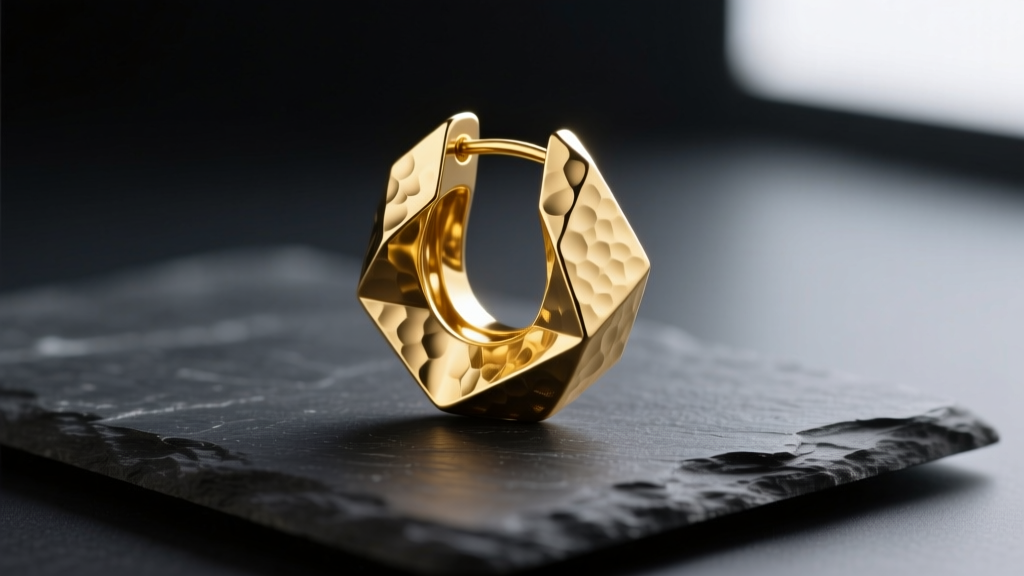
The Intersection of Conceptual Art and Metallurgy
When contemporary jewelry scholars and collectors discuss the Rinus Gerritsen golden earring, they are engaging with a masterclass in material-driven design. In the realm of Dutch contemporary jewelry, the medium is never merely a vehicle for aesthetics; it is the core message. A conceptual golden earring pushes the boundaries of traditional goldsmithing, forcing a dialogue between the artistic vision and the unyielding laws of physics and metallurgy. Unlike commercial mass-produced studs or hoops, avant-garde ear pieces require a profound understanding of metal behavior, structural engineering, and human anatomy.
To truly appreciate the material properties that define high-end art jewelry, we must deconstruct the gold itself. How does an artist manipulate a metal with a specific gravity of 19.32 g/cm³ to create sweeping, gravity-defying forms that remain wearable? The answer lies in a meticulous selection of alloys, work-hardening techniques, and structural innovations that transform raw elemental gold into a resilient, wearable sculpture.
Decoding Gold Alloys: Hardness vs. Malleability
Pure 24-karat gold is exceptionally malleable, boasting a Vickers Hardness (HV) of merely 25 to 30. While this makes it ideal for intricate granulation or hammering, it is structurally catastrophic for an earring post or a load-bearing sculptural arm. If a conceptual piece were crafted in pure gold, the sheer weight of the design would cause the wire to bend, warp, and eventually snap under the stress of daily movement.
To achieve the necessary tensile strength, contemporary jewelers alloy gold with metals like copper, silver, zinc, and occasionally palladium. The Gemological Institute of America (GIA) notes that the precise ratio of these alloying metals dictates not only the color but the crystalline lattice structure of the final metal. For a piece that demands both a rich, warm hue and structural integrity, 18-karat gold (75% pure gold) is often the baseline, but it must be carefully work-hardened.
| Gold Karat | Purity (%) | Primary Alloy Metals | Vickers Hardness (HV) | Best Earring Application |
|---|---|---|---|---|
| 24K | 99.9% | None | 25 - 30 HV | Surface inlay, non-structural accents |
| 22K | 91.6% | Copper, Silver | 60 - 90 HV | Heavy hammered drops, ear cuffs |
| 18K | 75.0% | Copper, Silver, Zinc | 130 - 150 HV | Sculptural hoops, structural wire forms |
| 14K | 58.3% | Copper, Silver, Zinc | 160 - 180 HV | Earring posts, high-stress clasps |
By manipulating the copper-to-silver ratio, an artist can control the metal's 'springiness.' A higher copper content increases the shear strength, making it ideal for the crucial earring post that must withstand lateral forces without permanently deforming.
Structural Engineering for the Earlobe
The human earlobe is primarily composed of adipose (fat) tissue and skin, entirely lacking the rigid cartilage found in the upper ear. This makes it highly susceptible to elongation and tearing under sustained weight. When designing an oversized, avant-garde piece, the artist must act as a biomechanical engineer.
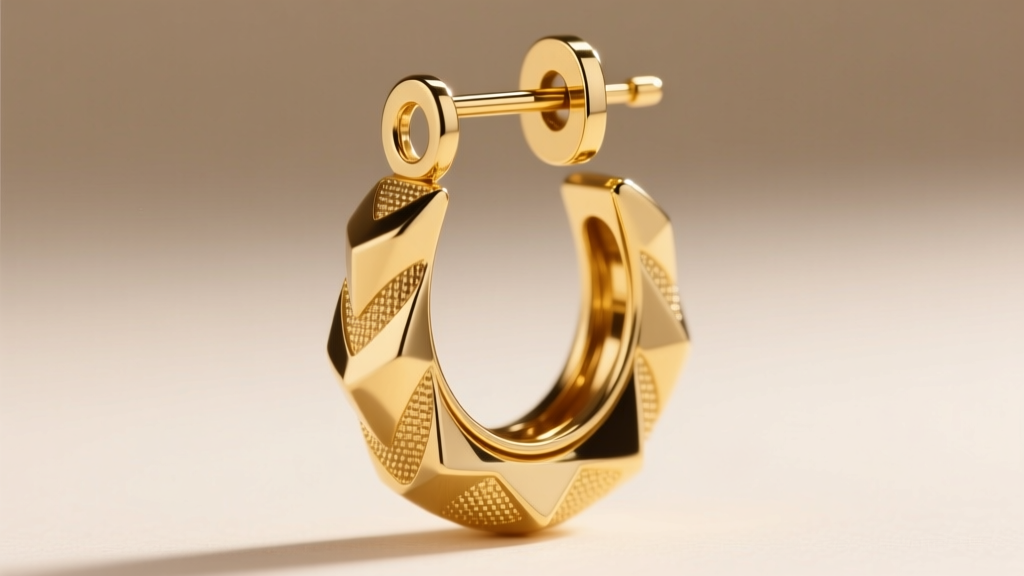
Gauge Thickness and Shear Strength
Standard commercial earrings typically utilize 20-gauge (0.81mm) or 18-gauge (1.02mm) wire. However, a substantial contemporary golden earring requires a minimum of 16-gauge (1.29mm) or even 14-gauge (1.63mm) wire for the post or ear wire. This exponential increase in cross-sectional area dramatically raises the wire's resistance to bending moments.
Furthermore, the backing mechanism is critical. Standard friction 'butterfly' clutches concentrate stress on a single point of the earlobe and frequently fail to support heavy art pieces. Instead, master jewelers employ custom-fitted omega clips or lever-backs that distribute the gravitational load across a wider surface area of the ear's posterior, preventing the 'earlobe droop' associated with heavy metal wear.
Surface Treatments: Rejecting the Commercial Polish
In the commercial jewelry sector, a flawless mirror polish is the standard of luxury. In contemporary art jewelry, however, surface texture is a narrative tool. The conceptual approach to a golden earring often involves deliberately obscuring the metal's natural reflectivity to emphasize form over flash.
- Sandblasting: Using high-pressure aluminum oxide to create a uniform, velvety matte finish that absorbs light and highlights the earring's geometric shadows.
- Planishing: A traditional hammering technique that leaves a faceted, organic surface. This not only adds visual texture but also introduces a layer of compressive stress on the surface, slightly increasing the metal's fatigue resistance.
- Chemical Patination: While gold itself is highly noble and resistant to oxidation, the alloying metals (like copper and silver) can be selectively oxidized using liver of sulfur or potassium sulfide. This creates deep, antique-looking recesses that provide stark contrast against the unoxidized high points of the sculpture.
According to archives at the CODA Museum, a leading institution for contemporary jewelry in the Netherlands, the rejection of high polish is a hallmark of the Dutch conceptual movement, forcing the viewer to engage with the object's physical volume rather than its superficial shine.
The Weight Factor: Specific Gravity and Electroforming
Gold is extraordinarily dense. A solid gold sphere measuring just 2 centimeters in diameter weighs nearly 80 grams—far too heavy for a single earlobe to support comfortably. When an artist envisions a massive, volumetric golden earring, traditional solid casting is physically unviable. This is where advanced metallurgical techniques like electroforming become essential.

Electroforming allows the jeweler to build up a microscopic layer of gold (often just 0.2mm to 0.5mm thick) over a wax or conductive resin mandrel. Once the desired thickness is achieved, the mandrel is melted or burned out, leaving behind a hollow, seamless gold shell. This process retains the exact visual mass and presence of a solid object while reducing the physical weight by up to 85%. It is this mastery over specific gravity that allows contemporary golden earrings to achieve monumental scales without causing physical trauma to the wearer.
Conclusion: The Mastery of Material
Analyzing the material properties behind a conceptual piece reveals that true luxury in art jewelry is not defined by the mere presence of precious metal, but by the artist's mastery over it. From selecting the precise 18-karat alloy to ensure structural memory, to engineering 16-gauge posts and utilizing electroforming for volumetric lightness, the creation of a high-concept golden earring is a triumph of applied science. As the World Gold Council continues to track the evolution of gold in technology and art, it remains clear that the most profound jewelry designs are those that respect, challenge, and ultimately transcend the physical limits of the metal itself.


