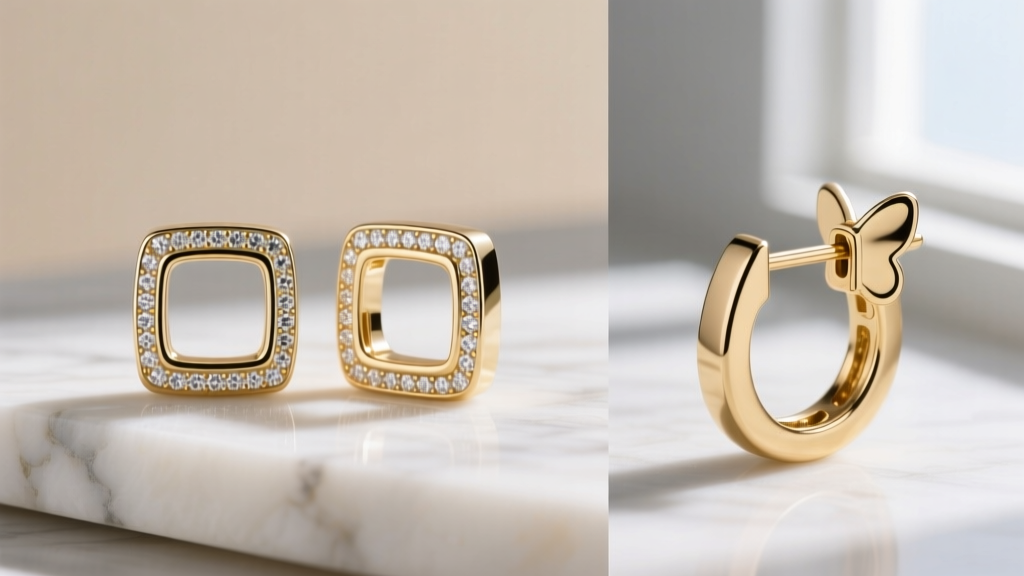
How to Style Loop Earrings: Gauge, Materials & Stacks
Learn how to style loop earrings with our expert technical guide. Discover gauge sizing, metal grades, and advanced cartilage stacking techniques.

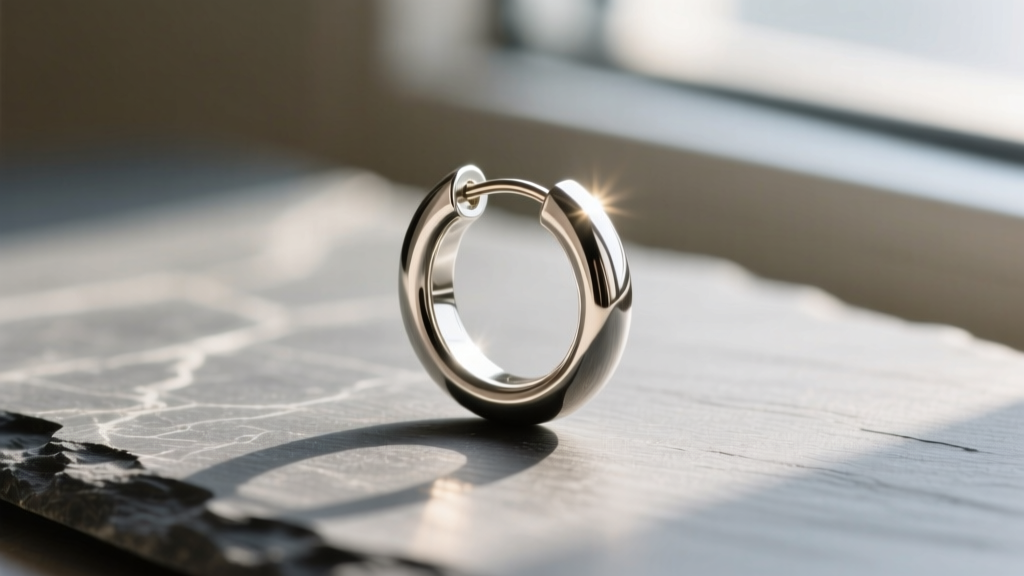
When learning how to style loop earrings for complex cartilage configurations or curated lobe stacks, understanding the physics and metallurgy of your jewelry is just as critical as the aesthetic. In the professional piercing and high-end body jewelry industry, a "loop" is not merely a circular shape; it encompasses a highly engineered spectrum of continuous hoops, segment rings, clickers, and seam rings. Each mechanism dictates how the metal interacts with your unique ear anatomy, healing fistulas, and daily mechanical stress.
This expert deep dive bypasses generic fashion advice to explore the technical frameworks required to style, size, and maintain loop earrings in 2026. Whether you are configuring a dual-hole orbital, selecting the correct inner diameter for a daith, or evaluating wire temper for a seamless helix hoop, mastering these variables ensures both structural longevity and tissue health.
The Mechanics of Loop Construction and Wire Temper
Not all loops are manufactured equally. The way a loop closes determines its structural integrity, snag resistance, and suitability for specific piercings. Understanding wire temper—the degree of hardness introduced to the metal during the drawing and annealing process—is essential for styling loops that maintain their shape.
- Continuous (Seamless) Hoops: Crafted from dead-soft or half-hard wire, these loops rely on lateral tension. The two ends meet perfectly flush when twisted into place. They are ideal for healed lobes and standard helixes but require careful manipulation to avoid warping the circular geometry.
- Segment Rings: Featuring a removable O-ring or a precision-machined metal segment that snaps into the tube, these offer superior security. They are the gold standard for active individuals or those styling loops in high-friction areas like the tragus or rook.
- Clickers (Hinged Loops): Utilizing a micro-machined hinge and a snap-lock clasp, clickers provide the easiest insertion mechanism. High-end clickers feature a flush closure that is virtually invisible, making them perfect for intricate daith or conch styling where visual continuity is paramount.
When styling a stack, mixing closure types can create visual rhythm. Pairing a highly polished, seamless continuous hoop in the upper helix with a textured, gem-set clicker in the mid-helix creates a sophisticated contrast in both light reflection and mechanical design.
Metallurgical Standards: What Actually Touches Your Piercing
The aesthetic appeal of a loop earring is irrelevant if the metallurgy triggers contact dermatitis or galvanic corrosion. The Association of Professional Piercers (APP) strictly outlines biocompatible materials for body jewelry. When curating a multi-loop stack, ensuring uniform metallurgical grades prevents micro-galvanic reactions caused by dissimilar metals interacting with saline and skin oils.
| Material Grade | ASTM Standard | Nickel Content | Best Application |
|---|---|---|---|
| Implant-Grade Titanium | ASTM F136 / F67 | 0% (Nickel-Free) | Fresh piercings, hypersensitive skin, daith/orbital loops |
| Niobium | Unalloyed / Reactive | 0% (Nickel-Free) | Custom anodized colors, seamless continuous hoops |
| 14k/18k Solid Gold | N/A (Alloy Dependent) | Varies (Palladium alloys preferred) | Healed luxury stacks, clickers, threadless loop ends |
| Surgical Steel (316L) | ASTM F138 | 8% - 10.5% | Healed lobes only; avoid for cartilage or fresh tissue |
Brands like BVLA (Body Vision Los Angeles) utilize nickel-free gold alloys specifically formulated for long-term implantation, ensuring that luxury loop styling does not compromise tissue health. Always verify that gold loops are solid, not plated, as the friction of insertion will rapidly degrade gold plating, exposing reactive base metals beneath.
Sizing Frameworks: Inner Diameter vs. Outer Diameter
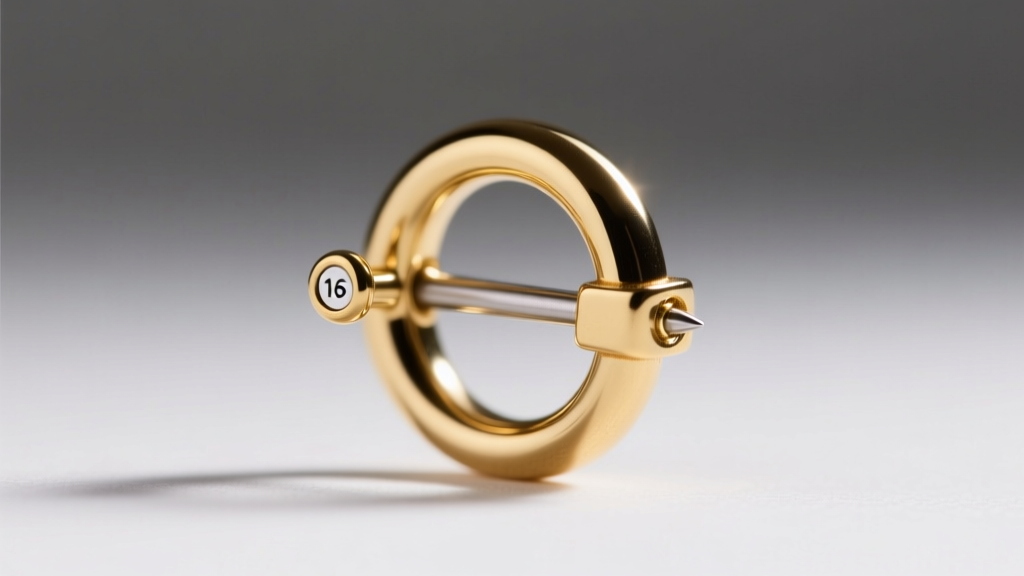
The most common failure in loop styling is confusing Inner Diameter (ID) with Outer Diameter (OD). For cartilage piercings, the ID is the only metric that matters, as it dictates the clearance between the metal and your ear anatomy. A loop with too small an ID will cause pressure necrosis (the "cheese wire effect"), where the jewelry slowly migrates through the tissue. A loop with too large an ID will snag on hair and clothing, leading to traumatic tearing.
The Cartilage Sizing Matrix
Use digital calipers to measure your specific anatomy. While ear shapes vary, these baseline IDs serve as the technical starting point for professional styling:
- Standard Lobe: 8mm - 10mm ID (Allows for natural swelling and gravity-induced movement).
- Helix / Mid-Helix: 6mm - 8mm ID (Snug fit prevents catching on over-ear headphones).
- Tragus: 6mm - 7mm ID (Must clear the tragal plate without pressing into the ear canal).
- Daith: 10mm - 11mm ID (Requires precise curvature to navigate the crus of the helix).
- Conch: 10mm - 14mm ID (Depends heavily on the depth of the conch bowl).
When styling adjacent loops, such as a double helix stack, vary the IDs by 1mm (e.g., a 7mm top hoop and an 8mm bottom hoop) to create a cascading visual effect that follows the natural curve of the auricle.
Advanced Styling: Orbitals, Threadless Ends, and Snag Mitigation
Modern loop styling extends far beyond simple circles. The integration of modular jewelry systems has revolutionized how we approach ear curation. NeoMetal and similar manufacturers have popularized threadless (press-fit) technology, allowing for seamless integration of decorative ends onto loop-based shafts.
The Orbital Configuration
An orbital piercing consists of two distinct fistulas connected by a single continuous loop. Styling an orbital requires absolute precision in both gauge and diameter. A 16-gauge or 14-gauge wire is mandatory; anything thinner (like 18g or 20g) will act like a blade under tension, slicing through the tissue bridge between the two holes. The loop must have enough ID to allow for a full 360-degree rotation during cleaning without pulling on either puncture site.
Threadless Loop Modifications
For those seeking to style a continuous loop with a focal gemstone, threadless snap-in ends offer a secure alternative to traditional prong settings. By utilizing a slightly bent titanium pin that creates tension inside a hollow loop tube, these ends eliminate the risk of threaded caps unscrewing and falling out in the shower or during sleep.
Troubleshooting Common Loop Failures
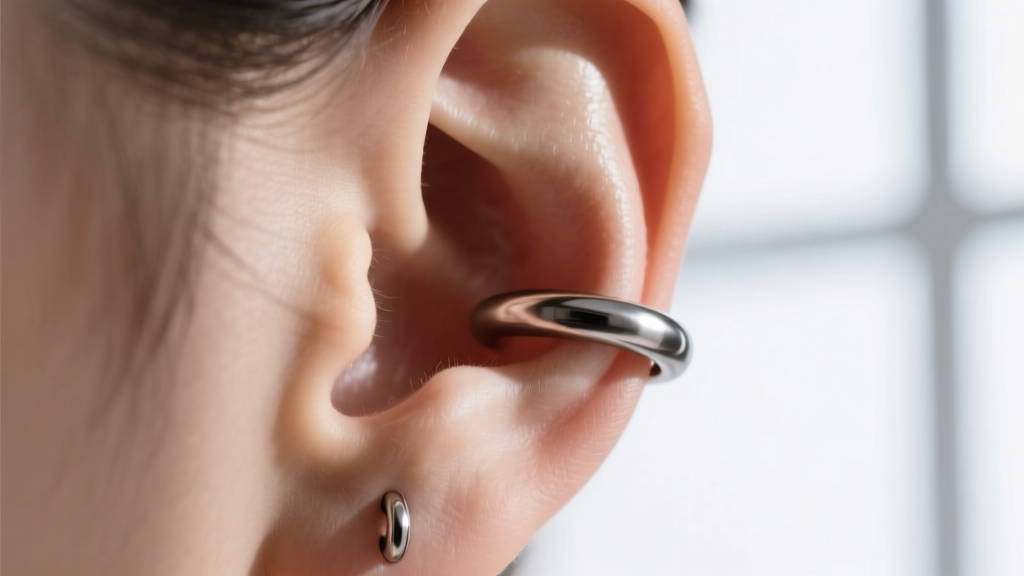
Even with perfect sizing and premium metallurgy, loop earrings are subject to mechanical wear. Recognizing and troubleshooting these failure modes is a hallmark of expert jewelry maintenance.
Metal Fatigue and Warping
Continuous seamless hoops are particularly susceptible to metal fatigue. Repeatedly bending the loop open and closed by pulling the ends apart laterally will eventually weaken the crystalline structure of the titanium or gold, leading to a warped circle that no longer closes flush. The correct technique: Always twist the ends in opposite directions (one toward you, one away) to open and close the ring, preserving the circular geometry and structural temper.
Galvanic Corrosion in Mixed Stacks
If you style a stack mixing 316L surgical steel and implant-grade titanium, the presence of sweat (an electrolyte) can trigger a micro-galvanic cell. The less noble metal will begin to corrode at an accelerated rate, leading to pitting, discoloration, and localized skin irritation. Maintain metallurgical homogeneity across your entire ear stack to prevent this electrochemical degradation.
The Snag-and-Tear Vector
Loops with decorative charms or dangling elements introduce a high snag risk. If styling a drop-loop or charm-hoop in the upper cartilage, ensure the clasp mechanism is a secure clicker rather than a tension-based latch. A sudden snag on a sweater can easily rip a tension-latch open, resulting in immediate trauma to the delicate cartilage fistula.
Conclusion
Mastering how to style loop earrings requires a synthesis of anatomical awareness, metallurgical knowledge, and mechanical respect for the jewelry itself. By prioritizing ASTM-certified implant grades, meticulously measuring inner diameters with calipers, and utilizing proper twisting techniques to preserve wire temper, you elevate your ear curation from a mere fashion choice to a masterclass in structural body modification. Whether you are installing a micro-clicker in a snug rook or configuring a dual-hole titanium orbital, the technical details are what ultimately define the elegance and longevity of your stack.