How to Style and Maintain White Drop Earrings Flawlessly
Master the art of styling white drop earrings. Learn step-by-step pairing techniques for face shapes, skin undertones, and material-specific cleaning tips.


White drop earrings occupy a unique space in fine jewelry: they are simultaneously stark enough to make a modern statement and classic enough to anchor a vintage-inspired wardrobe. However, the term 'white' encompasses a vast array of materials—from high-tech ceramic and guilloché enamel to white mother-of-pearl (MOP) and rhodium-plated white gold. Each material interacts differently with light, skin undertones, and environmental wear.
This comprehensive, step-by-step guide moves beyond generic styling advice. We will break down the exact hardware specifications, material-specific maintenance protocols, and structural pairing frameworks you need to wear and care for white drop earrings with absolute precision.
The Anatomy of White Drop Earrings: Hardware and Gauges
Before styling, you must understand the structural integrity of your earrings. Drop earrings, by definition, suspend weight below the earlobe. If the hardware is improperly matched to the material's weight, you risk lobe stretching or hardware failure.
- Wire Gauge: The industry standard for lightweight drop earrings is 20-gauge (0.81mm). For heavier drops (over 6 grams), jewelers should step up to 18-gauge (1.02mm) to prevent the wire from bending. Avoid 22-gauge or thinner wires for any drop style, as they will warp when taking them on and off.
- Closure Mechanisms: For drops under 4 grams, a standard French fishhook wire is sufficient. For drops between 4 and 10 grams, an 18k white gold leverback or a locking french wire is mandatory to prevent loss. If your white drops feature heavy ceramic or solid enamel pavers, ensure the jump ring connecting the drop to the wire is soldered shut, not merely pinched.
- Weight Distribution: A well-crafted white drop earring should sit flush against the lobe before the drop begins. If the top stud or hook is too small to counterbalance the bottom drop, the earring will perpetually tilt forward, hiding the design and stressing the piercing.
Material Breakdown: Choosing Your 'White'
Not all white jewelry materials are created equal. The Mohs hardness scale and material porosity dictate how your earrings will age and how they should be cleaned.
| Material | Mohs Hardness | Visual Profile | Price Range (Fine) | Primary Vulnerability |
|---|---|---|---|---|
| White Enamel | 5.5 - 6.5 | Opaque, glossy, stark white | $250 - $1,200 | Chipping from impact, thermal shock |
| Mother-of-Pearl | 2.5 - 4.5 | Iridescent, creamy, translucent | $150 - $800 | Acid etching, scratching, dehydration |
| High-Tech Ceramic | 8.0 - 9.0 | Matte or polished, pure white | $500 - $2,500+ | Shattering under extreme pressure |
| White Gold (Rhodium) | 4.0 (Alloy) / 6.0 (Plating) | Metallic, reflective, cool white | $300 - $1,500 | Rhodium wear revealing yellowish alloy |
Step-by-Step: Matching White Drops to Undertones and Face Shapes
Step 1: Calibrate to Your Skin Undertone
The biggest mistake consumers make is assuming all white jewelry suits all skin tones. You must match the temperature of the white to your undertone.

- Cool Undertones (Pink/Blue base): Opt for stark, optic whites. High-tech ceramic, bright white guilloché enamel, and heavily rhodium-plated white gold will complement the natural coolness of your skin without washing you out.
- Warm Undertones (Yellow/Peach base): Avoid clinical, stark whites, which can look harsh and disjointed against warm skin. Instead, choose creamy white MOP, ivory enamel, or white gold that has been plated with a slightly warmer 'champagne' rhodium or left unplated to show its natural, subtle yellow warmth.
- Neutral Undertones: You have the versatility to wear both, but mixed-media drops (e.g., a white gold frame with a mother-of-pearl inlay) will provide the best visual bridge.
Step 2: Select the Drop Length for Your Face Shape
Drop earrings alter the perceived geometry of your face. Use this framework to select the correct millimeter drop length:
- Round Faces: Choose elongated, linear white drops (40mm to 60mm). The vertical line of a stark white enamel bar drop creates an optical illusion that lengthens the jawline and cheekbones. Avoid short, wide teardrops.
- Square Faces: Opt for curved, medium-length drops (25mm to 40mm) featuring white MOP or rounded ceramic. The organic curves and iridescent sheen soften strong jawlines and angular cheekbones.
- Heart-Shaped Faces: Select chandelier or multi-tiered white drops that are wider at the bottom than the top. This adds visual weight to the lower half of the face, balancing a narrower chin.
- Oval Faces: Proportionally balanced, allowing you to wear virtually any style. To highlight the natural symmetry, try geometric white ceramic drops that sit exactly at the jawline (approx. 35mm).
Neckline Pairing Framework: A Visual Guide
White drop earrings command attention due to their high contrast against most clothing and skin. The neckline of your garment dictates the maximum volume and length of the earring.
- Strapless & Off-the-Shoulder: This is the prime real estate for statement white drops. Pair with 50mm+ enamel or ceramic drops. The bare skin provides a high-contrast canvas that allows the intricate details of the white material to pop.
- V-Neck: Follow the geometry of the shirt. Wear tapered white drops that mimic the V-shape. Ensure the bottom of the earring sits at least two inches above the apex of the V-neck to avoid visual clutter.
- Crew Neck & Turtleneck: Keep the drops short and structural (under 25mm). A small, architectural white ceramic drop resting just below the lobe provides a sharp, modern contrast against the heavy fabric of a turtleneck.
- Halter Neck: Avoid long drops entirely. The straps of a halter compete for the same visual space as long earrings. Opt for white drop studs (a stud with a very short, 10mm articulated drop) to maintain elegance without overcrowding.
Step-by-Step Cleaning & Restoration Guide
Maintaining the pristine look of white jewelry requires strict adherence to material-specific protocols. According to the Gemological Institute of America (GIA), organic gems like pearls and MOP are highly sensitive to standard jewelry cleaning chemicals. Furthermore, Jewelers of America warns against using ultrasonic cleaners on any plated or enameled jewelry.
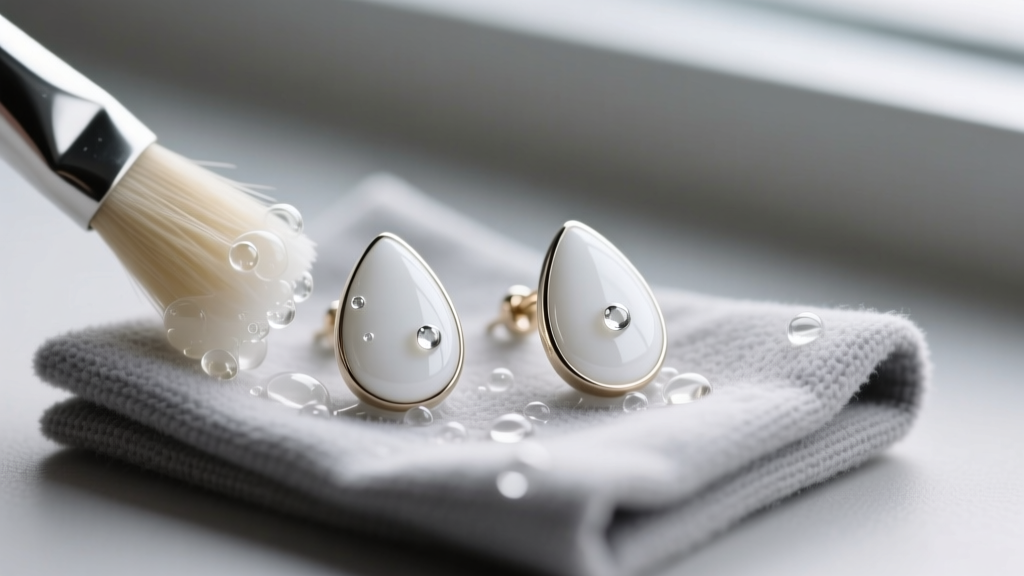
Protocol A: Enamel and Ceramic Care
- Preparation: Mix three drops of pH-neutral dish soap (like Dawn) into a bowl of lukewarm distilled water. Tap water contains minerals that can leave microscopic white water spots on dark enamel backing or ceramic.
- Agitation: Dip a baby toothbrush (extra soft bristles) into the solution. Gently brush the crevices where the white enamel meets the metal setting.
- Rinsing: Rinse quickly under a gentle stream of distilled water. Do not soak enamel, especially if it is champlevé or cloisonné, as water can seep under microscopic fractures and cause the metal base to oxidize, pushing the enamel out.
- Drying: Pat dry immediately with a lint-free microfiber cloth. Use a hairdryer on the 'cool' setting to blast water out of the jump rings.
Protocol B: White Mother-of-Pearl (MOP) Care
- Wipe Down: After every wear, wipe MOP earrings with a slightly damp, soft cotton cloth to remove skin oils and sweat. The natural acidity in human sweat can etch the nacre over time, dulling the iridescence.
- Deep Clean: Never submerge MOP. Dampen a cotton swab with a tiny amount of mineral oil and gently rub the surface of the MOP to restore its luster and rehydrate the organic material.
- Storage: Store MOP drops in a soft pouch with a slightly damp cotton ball (placed in the pouch, not touching the jewelry) to prevent the nacre from drying out and cracking in arid environments.
Troubleshooting Common White Earring Failures
Even with meticulous care, white jewelry presents unique aging challenges. Here is how to diagnose and fix the most common issues:
- White Gold Turning Yellow: White gold is naturally a pale yellow alloy. It is plated with rhodium (a platinum-group metal) to achieve a stark white finish. This plating is typically 0.75 to 1.0 microns thick and wears off in 12 to 24 months with daily use. Fix: Take the earrings to a jeweler for a 'rhodium flash' (replating). This costs between $35 and $75 and restores the factory-white finish.
- Enamel Micro-Fractures: If you notice hairline cracks in white enamel, it is usually due to thermal shock (e.g., wearing them in a hot sauna, then stepping into cold air). Fix: Stop wearing them immediately. A master enameler can sometimes fill and fire the cracks, but standard jewelers cannot repair this. Prevent this by removing enamel drops before extreme temperature changes.
- MOP Cloudiness: If your mother-of-pearl drops look cloudy and matte, the nacre has been chemically etched by perfume or hairspray. Fix: A lapidary can sometimes lightly buff the top layer of nacre to reveal fresh material beneath, but this is risky on thin MOP inlays. Always apply aerosols 15 minutes before putting on your earrings.
Conclusion
White drop earrings are a masterclass in contrast and elegance, but they demand an informed wearer. By respecting the gauge requirements of the hardware, matching the specific hue of white to your skin's undertone, and adhering to strict, material-specific cleaning protocols, you ensure that your drops remain as striking as the day you acquired them. Treat your white enamel, ceramic, and MOP not just as accessories, but as delicate architectural pieces that require precision care.


