Recognizing Infected Earring Symptoms: A Step-by-Step Guide
Learn to identify infected earring symptoms early. Follow our step-by-step guide to treat lobe and cartilage piercing infections safely at home.

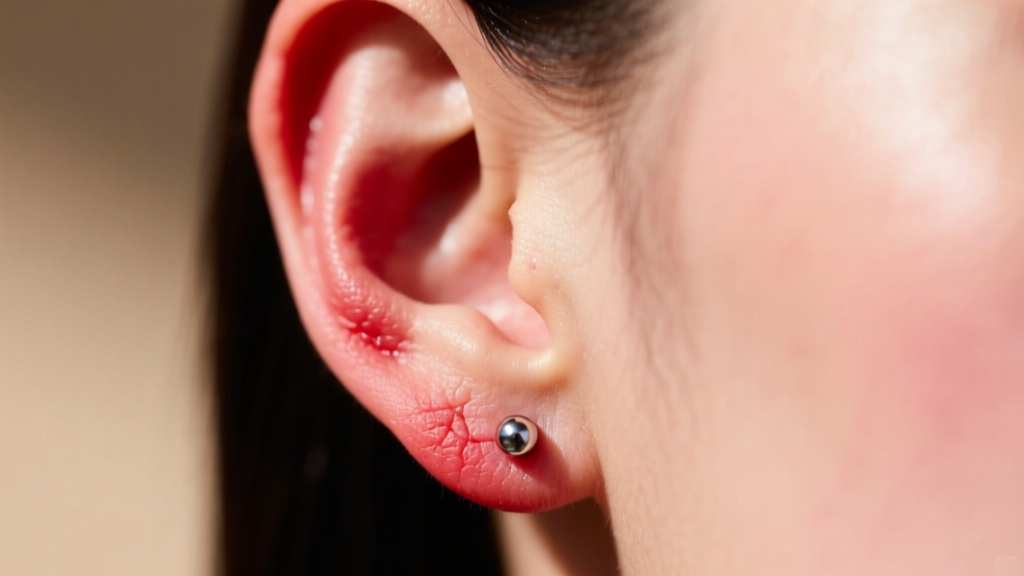
Getting a new piercing or changing out your jewelry should be exciting, but it can quickly turn into a painful ordeal if bacteria infiltrate the fistula (the piercing channel). Recognizing infected earring symptoms early is the difference between a minor at-home course correction and a severe medical complication. In this step-by-step guide, we break down the exact biological markers of an infection, how to differentiate them from standard irritation bumps, and the precise material upgrades you need to prevent recurrence.
Decoding the Signs: Normal Healing vs. Infected Earring Symptoms
Many people mistake contact dermatitis or mechanical irritation for a bacterial infection. To accurately identify infected earring symptoms, you must understand the baseline of the inflammatory healing phase. When a needle punctures the tissue, macrophages rush to the site, causing localized warmth and mild erythema (redness). This is normal. An infection, however, involves active bacterial colonization—most commonly Staphylococcus aureus or Pseudomonas aeruginosa.
| Symptom | Normal Healing / Irritation | Active Bacterial Infection |
|---|---|---|
| Exudate (Discharge) | Clear, whitish, or pale yellow lymph fluid that crusts | Thick, opaque yellow, green, or brown pus |
| Odor | Mild, metallic, or sebum buildup | Foul, distinctly rotten, or sweet-smelling |
| Pain Level | Tender to the touch, dull ache | Throbbing, sharp, radiating pain |
| Temperature | Slightly warm immediately after piercing | Hot to the touch, radiating heat continuously |
| Systemic Signs | None | Fever, chills, swollen lymph nodes in the neck |
Step-by-Step Triage: What to Do When You Spot Infection
If you have confirmed the presence of infected earring symptoms using the matrix above, follow this exact triage protocol to mitigate tissue damage and encourage proper drainage.
Step 1: Leave the Jewelry In (The Abscess Trap)
The most common mistake is immediately removing the earring. If you pull the jewelry out while an active infection is present, the surface tissue can heal over and seal the bacteria inside the fistula. This creates an abscess—a localized collection of pus that requires surgical lancing. Keep a flat-back, internally threaded titanium labret or straight post in the channel to maintain a drainage pathway.
Step 2: Implement the 0.9% Saline Protocol
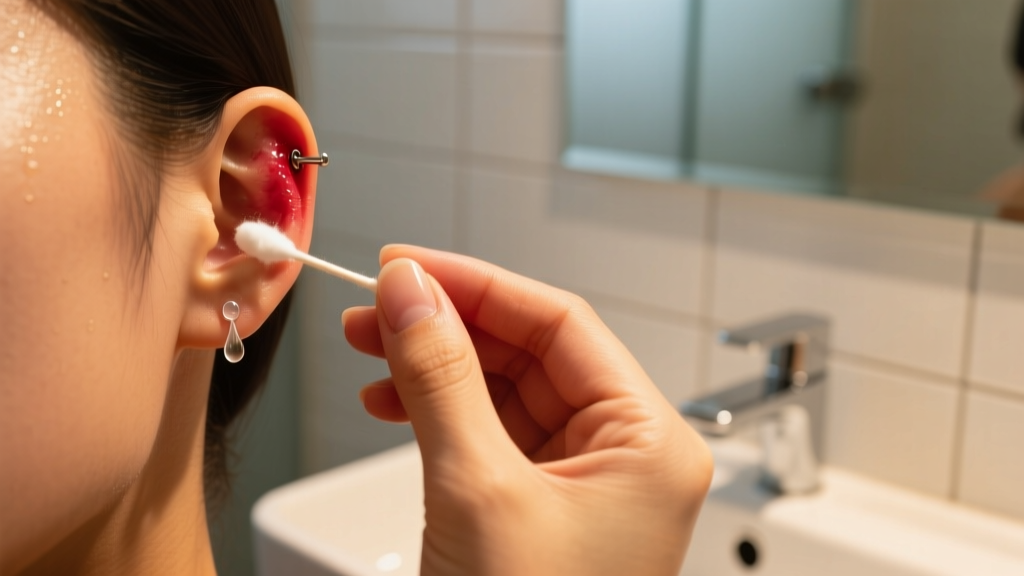
Discard rubbing alcohol, hydrogen peroxide, and tea tree oil. These harsh astringents destroy fibroblasts—the very cells your body needs to rebuild the fistula wall. Instead, use a sterile 0.9% sodium chloride wound wash. Spray it directly onto the entry and exit points twice daily. Allow it to air dry or gently pat with non-woven gauze. Avoid cotton balls entirely, as they leave microscopic fibers that can embed in the wound and cause foreign-body granulomas.
Material Failure Modes: Why Your Earrings Triggered a Reaction
Often, what appears to be an infection is actually a severe allergic reaction or galvanic corrosion causing tissue breakdown, which then becomes secondarily infected by opportunistic skin flora.
The 'Surgical Steel' Myth and Nickel Allergies
'Surgical steel' is an unregulated marketing term. Many cheap alloys labeled as such contain up to 10-14% nickel. When nickel ions leach into the moist environment of a healing fistula, they trigger allergic contact dermatitis. The resulting weeping, swelling, and crusting perfectly mimic infected earring symptoms. To eliminate this variable, you must upgrade to Implant-Grade Titanium (ASTM F136) or Niobium. These metals are entirely nickel-free and highly biocompatible.
Gauge Friction and Threading Micro-Tearing
Earring gauges dictate the thickness of the post. Standard lobe piercings are usually 20g (0.8mm) or 18g (1.0mm), while cartilage piercings are typically 16g (1.2mm) or 14g (1.6mm). If you force a thick 16g earring into a delicate 18g lobe hole, you cause micro-tears in the epithelial lining. Furthermore, externally threaded jewelry acts like a microscopic cheese grater, scraping the fistula wall during insertion. These microscopic fissures become breeding grounds for staph bacteria. Always verify your exact gauge size with digital calipers and opt for internally threaded or threadless jewelry to protect the tissue barrier.
Cartilage vs. Lobe: The Perichondritis Danger Zone
The anatomical location of your earring drastically alters the risk profile of an infection. Earlobes are highly vascularized, meaning they have a robust blood supply that delivers white blood cells to fight off pathogens quickly. Cartilage, however, is avascular. It relies on the perichondrium (the connective tissue covering it) for blood supply and immune response.
If bacteria breach a cartilage piercing (like a helix, conch, or daith), it can lead to perichondritis—a severe infection of the cartilage membrane. If left untreated, this can progress to chondritis, where the cartilage itself necrotizes, leading to permanent structural deformity. Cartilage infections rarely resolve with topical saline alone and almost always require oral antibiotics, specifically fluoroquinolones like ciprofloxacin, which penetrate cartilage tissue effectively.
When to Escalate to Medical Intervention
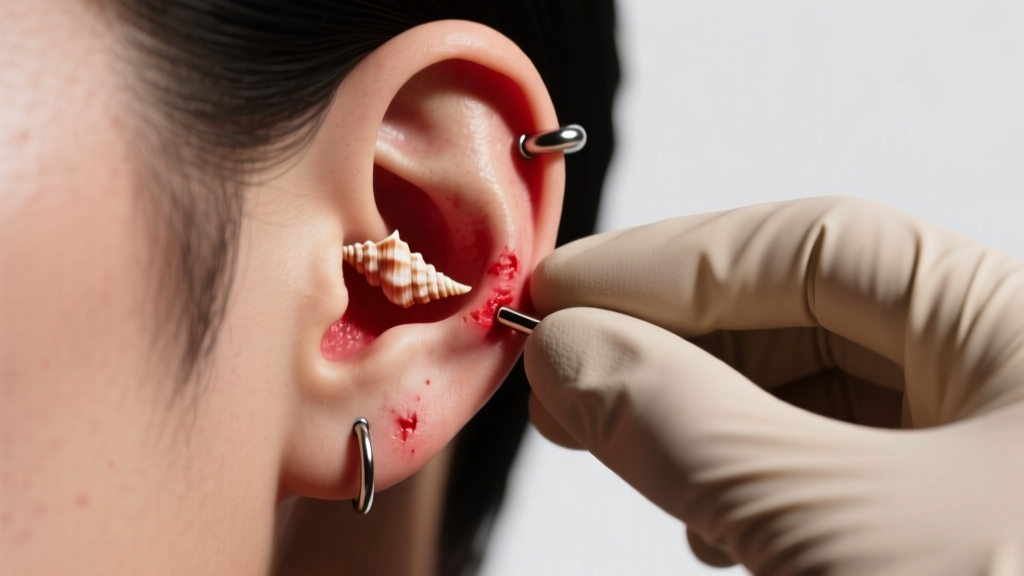
While mild lobe infections can often be managed with strict sterile saline aftercare and downsizing to titanium jewelry, you must seek immediate medical attention if you observe any of the following red flags:
- Red streaks radiating outward from the piercing site (lymphangitis).
- The earring is physically embedded or swallowed by the swelling tissue.
- Systemic symptoms such as a fever exceeding 100.4°F (38°C), chills, or nausea.
- The infection is located in the cartilage and shows no improvement after 48 hours of sterile care.
According to the Mayo Clinic, piercing infections that spread beyond the immediate localized area require professional medical evaluation to prevent systemic sepsis or permanent tissue damage. Additionally, the Cleveland Clinic emphasizes that attempting to drain an abscess at home using unsterilized needles can introduce aggressive secondary pathogens like MRSA, complicating the treatment timeline significantly.
Long-Term Prevention: Building a Biocompatible Jewelry Wardrobe
Once your fistula has fully healed and the infected earring symptoms have completely resolved, your focus must shift to prevention. Avoid porous materials like acrylic, wood, or bone in unhealed or easily irritated piercings, as their microscopic surface holes harbor bacterial biofilms that cannot be cleaned with standard saline. Stick to high-polish, mirror-finish jewelry made from ASTM F136 titanium, solid 14k/18k gold (ensure it is nickel-free and alloyed with copper/silver, not zinc), or borosilicate glass. Matte or textured finishes, while aesthetically pleasing, trap dead skin cells and sebum, creating a micro-environment for bacterial overgrowth. By understanding the exact material grades, surface finishes, and anatomical vulnerabilities of your piercings, you can maintain a healthy, thriving jewelry collection without the fear of recurring infections.


