The Janet Jackson Key Earring: Authentication & Lobe Support
Discover how to authenticate, source, and comfortably wear the iconic Janet Jackson key earring without stretching your earlobes. Expert troubleshooting.

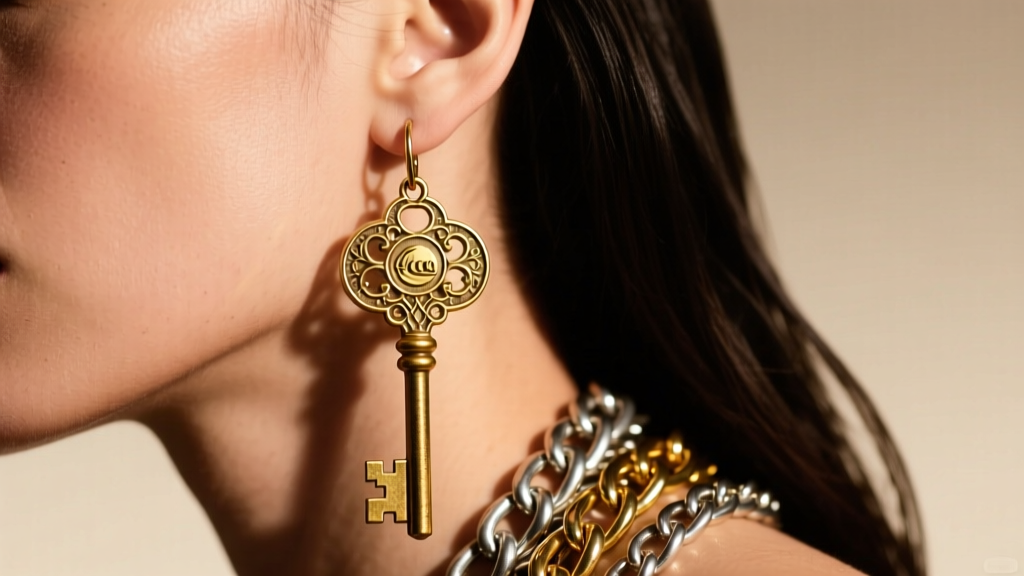
The 1990s remains one of the most influential decades for statement jewelry, and few pieces capture the era's bold, asymmetrical aesthetic quite like the iconic Janet Jackson key earring. Popularized during her groundbreaking 1993 'If' music video era and subsequent world tours, the oversized, ornate gold key worn as a single statement earring became a symbol of empowerment, mystery, and unapologetic style. Today, vintage enthusiasts and modern trendsetters alike are hunting down these pieces to recreate that legendary look.
However, sourcing and wearing a vintage janet jackson key earring presents a unique set of mechanical and metallurgical challenges. Unlike lightweight modern studs, these substantial 90s costume pieces were often cast from heavy brass alloys, leading to severe earlobe strain, hardware failure, and rapid tarnishing. As jewelry experts, we frequently troubleshoot the physical toll these statement pieces take on piercings. This comprehensive guide will walk you through authenticating vintage originals, upgrading the hardware for secure wear, and solving the dreaded 'sagging lobe' problem associated with heavy asymmetrical earrings.
The Physics of Asymmetrical Statement Earrings
To understand the troubleshooting required for a heavy key earring, we must first look at the physics of how it interacts with the earlobe. A standard 14k gold ball stud weighs approximately 0.5 to 1 gram. In contrast, a vintage 3-inch cast brass key earring from the 1990s can weigh anywhere from 18 to 28 grams. When suspended from a standard lobe piercing, this weight creates a continuous downward lever effect.
The fistula (the piercing hole) acts as a fulcrum. Over time, the relentless gravitational pull on the bottom edge of the piercing causes the tissue to stretch, thin, and eventually migrate downward—a condition known in the body modification community as 'cheese-cutter migration.' Furthermore, the torque placed on the earring post itself often causes standard 20-gauge metal posts to bend, warp, or snap entirely under the stress of daily movement.
Troubleshooting Lobe Strain and Migration
If you have secured a vintage janet jackson key earring and find it pulling uncomfortably on your lobe, do not attempt to wear it for extended periods without structural support. The goal is to distribute the weight across a wider surface area of the ear, rather than concentrating it on the delicate fistula tissue.
Silicone Support Patches
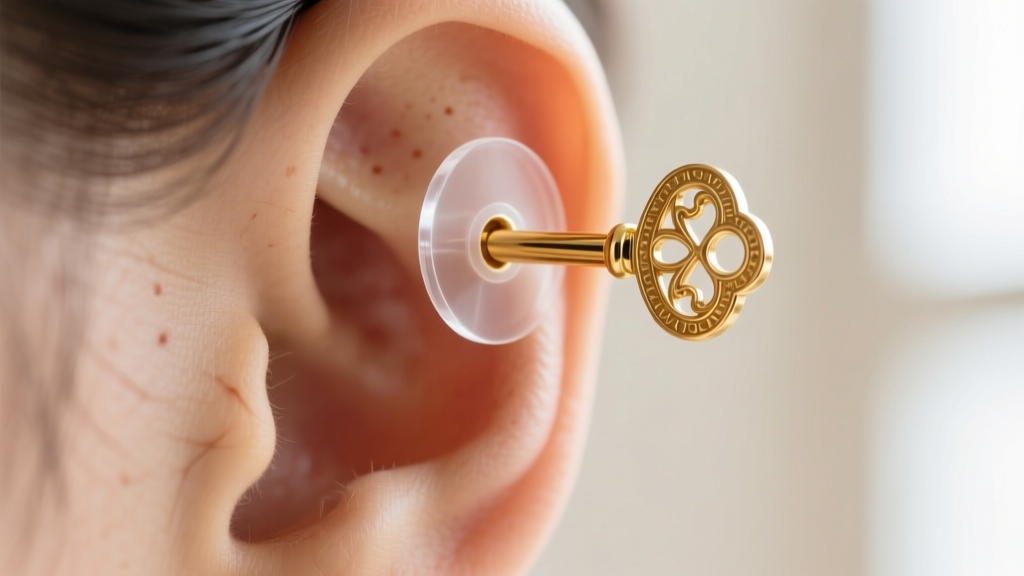
The most immediate and cost-effective solution is the use of adhesive silicone earring support patches (commonly known by brand names like Lobe Wonder). These self-adhesive, medical-grade silicone discs feature a small slit that slides over the earring post. When secured against the back of the earlobe with the friction back, the patch distributes the 20+ gram weight of the key across a 1-centimeter radius of skin, virtually eliminating downward drag and preventing the earring from drooping forward.
Post Gauge Upgrades
Most 90s costume jewelry utilizes a 20-gauge (0.81mm) or 22-gauge (0.64mm) post, which is far too thin to support a heavy key motif. According to the Rio Grande jewelry manufacturing standards, any earring exceeding 10 grams should ideally be supported by an 18-gauge (1.02mm) or 16-gauge (1.29mm) wire. If your vintage key features a thin, bending post, take it to a local bench jeweler to have the post laser-welded or soldered to a thicker, hypoallergenic titanium or surgical steel wire. This simple $20-$40 upgrade will save your earlobe from tearing and prevent the loss of the piece.
Authentication Guide: 90s Vintage vs. Modern Replicas
The secondary market is flooded with modern, cheaply manufactured '90s style' key earrings. Distinguishing a genuine vintage piece from a modern fast-fashion replica requires a close examination of the metallurgy, casting quality, and hardware. Here is a troubleshooting matrix to help you authenticate your find.
| Feature | Genuine 90s Vintage Key | Modern Fast-Fashion Replica |
|---|---|---|
| Material Base | Cast brass, pewter, or bronze alloy | Hollow stamped aluminum or zinc alloy |
| Weight | Heavy (18g - 28g) | Extremely light (3g - 8g) |
| Plating Quality | Thick gold electroplate, may show brass wear at high-contact points | Thin flash plating, often peeling or flaking in sheets |
| Clasp / Post | Often a thick French wire or a sturdy, soldered post with a wide clutch | Thin, glued-in butterfly post, frequently crooked |
| Detailing | Deep, hand-finished filigree with rounded, tumbled edges | Shallow, machine-stamped details with sharp, unfinished seams |
| Price Range | $65 - $180+ (depending on provenance) | $8 - $25 |
When shopping on platforms like Etsy or eBay, always request a macro photo of the earring's edge seam and the post attachment point. Genuine vintage castings will have a solid, three-dimensional depth, whereas modern replicas often feature a flat back to save on manufacturing costs.
Hardware Upgrades and Clasp Security
Losing a heavy, expensive vintage earring to a faulty clasp is a common tragedy we see in the vintage community. The standard 'butterfly' friction back is entirely inadequate for a heavy key earring; the sheer weight of the dangling key will slowly push the friction back off the post throughout the day.
The Screw-Back Conversion
For posts, the ultimate security upgrade is a screw-back mechanism. A bench jeweler can thread the end of an upgraded 18-gauge post and provide a threaded clutch. This mechanically locks the earring in place, making it impossible for the earring to fall off during movement, dancing, or wardrobe changes.
Leverback and French Wire Stopper
If your janet jackson key earring is already mounted on a curved French wire (fishhook), you must use a silicone or rubber 'earring stopper' behind the lobe to prevent it from sliding out. Alternatively, you can purchase 14k gold-filled leverback findings and have the key loop soldered to the leverback. The leverback's hinged, snapping closure provides a secure, closed loop that a standard French wire simply cannot match.
Combating Verdigris on Vintage Brass
Because authentic 90s key earrings are predominantly crafted from brass (an alloy of copper and zinc), they are highly susceptible to verdigris—the green, crusty tarnish that forms when copper reacts with the acids, salts, and moisture found in human sweat and sebum. Not only is verdigris unsightly, but it can also cause severe contact dermatitis and skin discoloration.
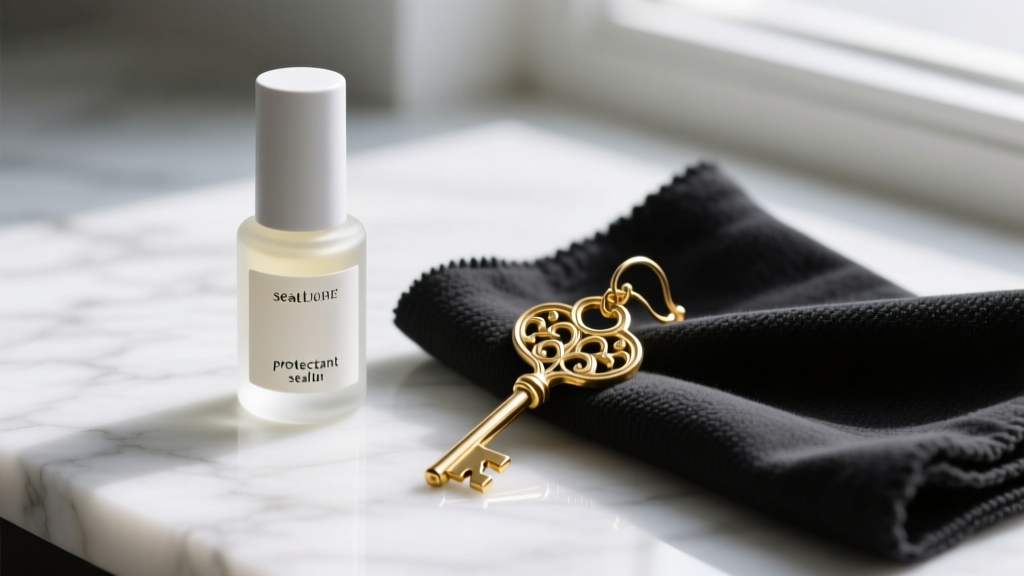
To troubleshoot and prevent this, avoid the outdated 'clear nail polish' hack, which eventually yellows, chips, and traps moisture against the metal, accelerating corrosion. Instead, follow the conservation guidelines recommended by institutions like the Gemological Institute of America (GIA) for maintaining costume jewelry:
- Clean the Base: Use a soft microfiber cloth and a mild, ammonia-free jewelry cleaner to remove all existing oils and green oxidation. A soft-bristled toothbrush can gently clean the deep filigree of the key's bow.
- Dehydrate: Wipe the earring down with a small amount of isopropyl alcohol to ensure the metal is completely free of moisture and oils before sealing.
- Apply a Polyurethane Sealant: Coat the post and the back of the earring (the parts that touch your skin) with a specialized jewelry sealant like Everbrite ProtectaClear. This forms a micro-thin, invisible, and hypoallergenic barrier that completely blocks the copper from reacting with your skin's pH.
Sourcing and Final Styling Tips
If you are unable to locate a genuine vintage piece, consider commissioning a custom reproduction. Many independent jewelers on platforms like Instagram and Etsy specialize in 3D modeling and casting 90s archival pieces. By requesting a custom cast in solid 14k gold vermeil (a thick layer of 14k gold over sterling silver) rather than brass, you eliminate the risk of verdigris entirely while maintaining the luxurious, heavy drape required for the authentic Janet Jackson aesthetic.
When styling the janet jackson key earring, remember the golden rule of asymmetrical balance: keep the opposite ear relatively minimal. A simple, flush-set diamond or pearl stud on the contralateral ear allows the heavy, ornate key to serve as the undisputed focal point of your look, honoring the revolutionary 90s styling that made it a cultural touchstone in the first place.


