Jellyfish Earrings Buying Guide: Materials, Gauges & Fit
Discover how to choose the perfect jellyfish earrings. Our expert buying guide covers implant-grade metals, gauge sizing, weight limits, and secure fits.

The Anatomy of a Jellyfish Earring: Bell vs. Tentacles
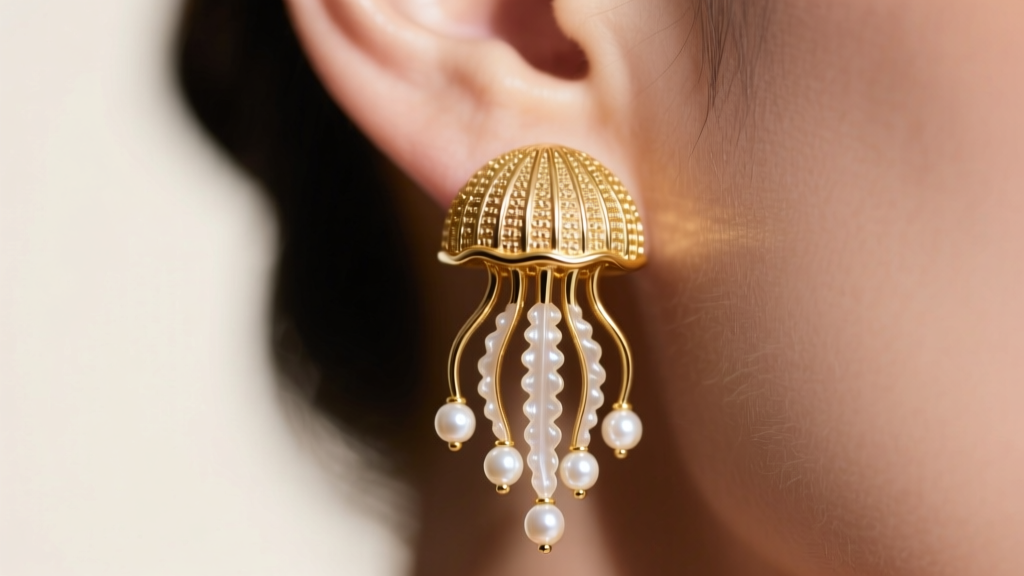
Jellyfish earrings have dominated oceanic jewelry trends, transitioning from niche indie designs to mainstream luxury staples. The defining silhouette features a central dome (the "medusa" or bell) with multiple dangling elements (the "tentacles") that mimic the creature's fluid movement. While visually striking, this specific architecture introduces unique mechanical challenges regarding weight distribution, snagging, and piercing stress.
When evaluating a pair, you must assess the bell and the tentacles as two separate structural components. The bell acts as the anchor and primary visual weight, while the tentacles introduce kinetic drag. A poorly designed jellyfish earring will pull heavily on the lobe or cartilage as the tentacles swing, leading to stretching or migration. In this 2026 buying guide, we break down the exact metallurgy, gauge requirements, and structural mechanics you need to look for before making a purchase.
Material Grades: What to Demand for Cartilage vs. Lobe
Because jellyfish earrings are frequently worn as cartilage cuffs, helix climbers, or lobe dangles, material biocompatibility is non-negotiable. The dangling chains trap moisture and hair products against the skin, increasing the risk of contact dermatitis if base metals are used.
| Material | Best For | Nickel Risk | Price Tier |
|---|---|---|---|
| Brass / Zinc Alloy | Unpierced ear cuffs only | High | $15 - $35 |
| Sterling Silver (925) | Healed lobes only | Low (but tarnishes) | $40 - $80 |
| Gold Vermeil | Healed lobes, short-term wear | Medium (if base is brass) | $60 - $120 |
| Solid 14k / 18k Gold | Lobes, healed cartilage | Very Low | $250 - $800+ |
| ASTM F136 Titanium | Fresh & healed cartilage/lobes | Zero | $80 - $200 |
Why ASTM F136 Titanium is Non-Negotiable for Cartilage
If you are buying a jellyfish ear cuff that pinches the cartilage, or a helix climber that passes through a cartilage piercing, you must seek out implant-grade titanium (ASTM F136). According to the Association of Professional Piercers, this specific alloy is completely nickel-free and possesses a mirror-finish polish that prevents bacterial adhesion. Sterling silver, while popular for tentacle chains, contains copper and can oxidize when exposed to the friction and sweat trapped by the dangling elements, making it unsuitable for tight cartilage fittings.
Weight Distribution & Gauge Sizing
The most common failure mode of jellyfish earrings is "lobe droop" or "cartilage migration" caused by excessive kinetic weight. The tentacles act as a pendulum; every time you turn your head, the momentum multiplies the static weight of the earring.
Calculating the Safe Weight Limit
For all-day comfort, a jellyfish earring should not exceed 6 grams for standard lobe piercings, and 4 grams for cartilage piercings. To achieve the jellyfish look without the weight penalty, look for designers who use:
- Hollow-cast bells: Utilizes 3D printing or electroforming to create a voluminous dome that weighs less than 2 grams.
- Aluminum or Niobium chains: Alternative tentacle materials that offer metallic luster at a fraction of the density of brass or silver.
- Freshwater pearl accents: Small (2mm-3mm) pearls add the "bioluminescent" jellyfish aesthetic without the heavy drag of large glass or quartz beads.
Matching the Gauge to the Piercing
Cartilage piercings (helix, forward helix, tragus) are typically pierced at 16G (1.29mm) or 18G (1.02mm). If you buy a jellyfish dangle with a standard 20G (0.81mm) post and wear it in a 16G cartilage hole, the post will shift and bend under the weight of the tentacles, causing severe irritation. Always verify the post thickness matches your specific piercing gauge.
Securing the "Tentacles": Cuffs, Climbers, and Dangles
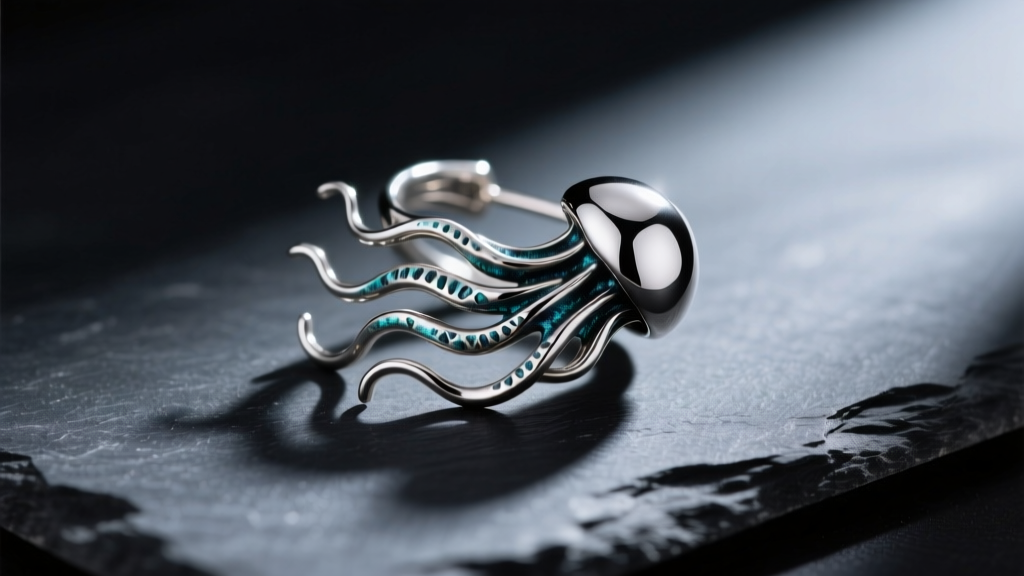
How the earring attaches to your ear dictates both its security and its comfort profile. Jellyfish designs generally fall into three structural categories:
1. Tension Ear Cuffs (No Piercing Required)
These wrap around the outer helix. The primary concern here is tension fatigue. Cheaper brass cuffs will lose their grip over time, leading to lost jewelry. Look for cuffs with an adjustable tension band and a silicone grip pad on the interior curve to prevent slipping on the cartilage ridge.
2. Cartilage Climbers (Single Piercing)
These feature a curved wire that threads through a single hole and climbs up the ear, with the jellyfish bell resting at the top. They require a secure friction backing or a threaded labret stud base. Because the tentacles hang from the top, the backing must be wide enough to counterbalance the downward pull.
3. Multi-Hole Constellations
For those with curated ear projects, some luxury jellyfish earrings require two or three piercings (e.g., a lobe and a mid-helix) connected by a delicate chain. These offer the best weight distribution but require precise anatomical alignment by a professional piercer before purchase.
Face Shape Styling: Elongating vs. Widening
The jellyfish silhouette is highly versatile but must be scaled to your face shape. The width of the bell and the length of the tentacles create distinct optical illusions.
- Round Faces: Opt for a small, tight bell (under 8mm) with long, linear tentacles that extend past the jawline. This draws the eye vertically, elongating the face.
- Long/Oval Faces: Choose a wider, more flared bell with shorter, voluminous tentacles that cluster around the earlobe. This adds horizontal width and balances facial proportions.
- Square Faces: Look for organic, asymmetrical tentacle lengths and curved bell shapes to soften strong jawlines. Avoid rigid, geometric chain structures.
Pricing Tiers: What You Actually Get for Your Money
When shopping in 2026, expect pricing to reflect both the metallurgy and the labor required to assemble micro-chains.
- $20 - $50 (Fast Fashion): Usually zinc alloy with a thin silver plating. The tentacles are often glued rather than soldered to the bell. Expect a lifespan of 3-6 months before tarnishing or chain breakage.
- $80 - $180 (Independent Jewelers): Solid sterling silver or heavy gold vermeil. Chains are soldered. You will find genuine freshwater pearls integrated into the tentacles. (Note: Verify the base metal if you have a nickel allergy; the American Academy of Dermatology warns that vermeil over brass can still cause reactions if the plating wears thin).
- $300 - $900+ (Fine Jewelry): Solid 14k or 18k gold, sometimes featuring micro-pavé diamonds on the bell and high-luster Akoya pearls on the tentacles. These are heirloom-quality pieces with lifetime structural integrity.
Care and Maintenance: Preventing Tangled Chains
The "tentacle" chains are notorious for tangling with each other, catching on hair, or snagging on knitwear. To maintain the structural integrity of the chains:
- Storage: Never throw jellyfish earrings loose into a jewelry box. Store them hanging from a dedicated rack, or lay them completely flat in a felt-lined tray with the tentacles combed straight.
- Cleaning: Do not use ultrasonic cleaners on jellyfish earrings if they feature glued pearls or porous gemstones. Instead, use a soft-bristled baby toothbrush with warm water and a drop of mild dish soap to gently sweep between the chains.
- Hair Management: If you wear your hair down, opt for jellyfish earrings with thicker "rolo" or "box" chains rather than fine "cable" chains, which are far more likely to weave into hair strands and snap under tension.
By prioritizing implant-grade materials, respecting weight limits, and choosing the correct gauge for your specific anatomy, you can comfortably wear this striking oceanic motif from morning to night without compromising your piercing health.


