Kpop Earrings 2026: Technical Guide To Idol Ear Mapping
Master the technical art of kpop earrings. Explore idol ear mapping, cartilage gauge limits, implant-grade metals, and stage-proof weight distribution.

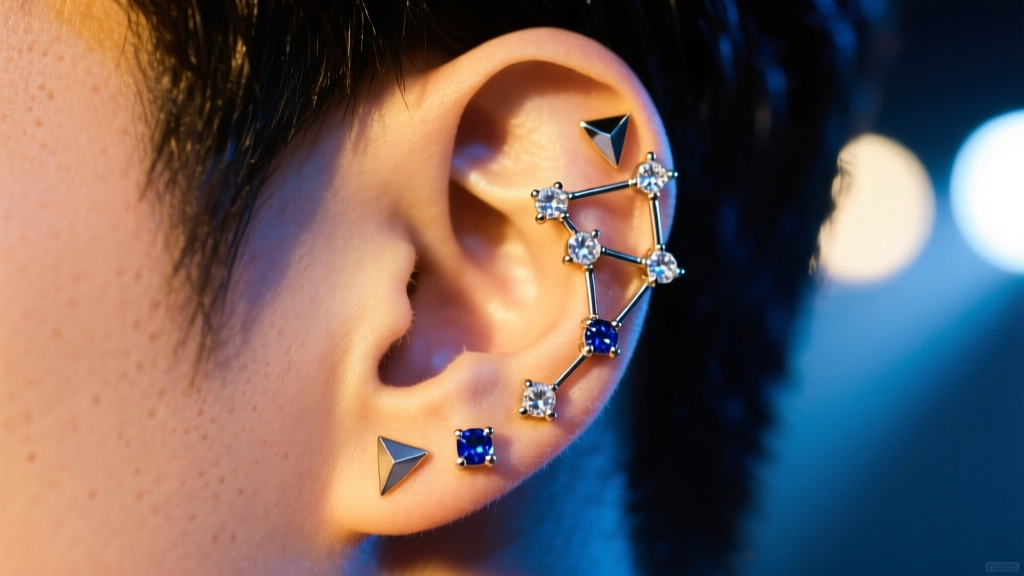
The global phenomenon of K-pop has not only redefined music and choreography but has also established a highly specialized sub-genre of body modification: the "Idol Ear." When styling kpop earrings for high-stakes stage performances, stylists and professional piercers must look far beyond simple aesthetics. Curating an ear capable of withstanding intense choreography, heavy stage sweat, and the physical interference of in-ear monitors (IEMs) requires a deep understanding of biomechanics, metallurgy, and spatial ergonomics. This technical deep dive explores the exact specifications, material grades, and structural mapping required to execute a stage-proof ear curation in 2026.
The Biomechanics of the "Idol Ear"
The auricular cartilage is an avascular structure, meaning it lacks a direct blood supply and relies on perichondrium diffusion for healing and structural integrity. When an idol undergoes a multi-piercing curation—often featuring 8 to 12 distinct placements per ear—the cumulative trauma and subsequent load-bearing stress on the cartilage matrix must be carefully managed.
A heavy, poorly balanced conch hoop or an improperly angled industrial barbell can cause continuous micro-trauma. Over time, this leads to cartilage thinning, piercing migration, or hypertrophic scarring. For stage performers, the G-force generated during rapid head-whipping choreography multiplies the effective weight of the jewelry. A 4-gram decorative end in a standard 16-gauge rook piercing can exert over 12 grams of lateral force during a sharp dance break. Therefore, the foundational rule of idol ear styling is strict weight distribution: utilizing low-profile, bezel-set gemstones and avoiding suspended dangles in upper-cartilage placements like the daith or forward helix.
Metallurgy for High-Output Stage Environments
Stage environments are highly corrosive to substandard metals. Performers are exposed to intense heat, profuse sweating, aerosolized hairsprays, and theatrical pyrotechnics. Human sweat contains lactic acid and urea, which lower the skin's pH and accelerate galvanic corrosion in alloyed metals. Furthermore, the National Center for Biotechnology Information (NCBI) notes that prolonged exposure to nickel leaching from lower-grade jewelry is a primary trigger for severe contact dermatitis, which can force an idol to cancel performances.
To mitigate these risks, professional stylists exclusively source kpop earrings crafted from specific, highly stable metallurgical grades. The Association of Professional Piercers (APP) strictly recommends implant-grade materials for any jewelry subjected to high-stress or high-moisture environments.
| Material Grade | Composition & Standards | Stage Viability | Sweat/Corrosion Resistance |
|---|---|---|---|
| Implant-Grade Titanium | ASTM F-136 (Ti-6Al-4V-ELI) | Exceptional (Industry Standard) | Complete immunity to lactic acid corrosion; zero nickel. |
| Niobium | Elemental Niobium (Unalloyed) | Excellent (Ideal for anodized colors) | Highly inert; forms a protective oxide layer instantly. |
| 14k/18k Gold | Nickel-free Palladium or Silver alloys | Good (Requires strict polishing) | Vulnerable to micro-scratching; can tarnish with heavy sulfur/sweat exposure. |
| 316L Surgical Steel | Iron, Chromium, Nickel, Molybdenum | Poor (Banned in professional curations) | Leaches nickel under acidic sweat conditions; high rejection rate. |
Gauge Sizing, Post Lengths, and Threading Mechanics
The structural foundation of any cartilage piercing relies on the precise pairing of gauge thickness and post length. While standard lobe piercings are often executed at 18-gauge (1.0mm) or 16-gauge (1.2mm), the intricate folds of the inner ear (rook, daith, conch) require a minimum of 16-gauge to prevent the "cheese-cutter effect," where a thin wire slowly migrates through the cartilage under tension.
The Superiority of Threadless (Press-Fit) Mechanics
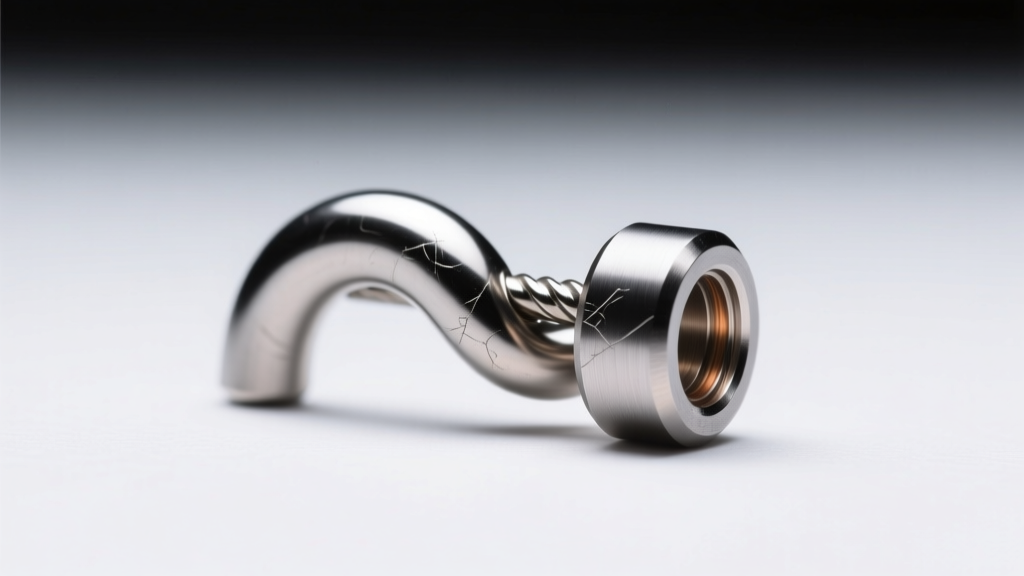
For kpop earrings subjected to rigorous choreography, traditional threading is a critical failure point. Externally threaded jewelry strips the delicate tissue upon insertion, while internally threaded jewelry—though vastly superior for healing—can slowly unscrew due to the continuous friction and vibration of stage performances.
The industry standard for stage-proofing is the threadless (push-pin) system. This mechanism utilizes a hollow 16-gauge post and a solid pin attached to the decorative end. The piercer bends the pin at a precise 5 to 10-degree angle before inserting it into the post. The natural spring tension of the titanium or gold pin pressing against the inner wall of the post creates a friction lock that is virtually impossible to dislodge without deliberate, dual-directional pulling. This ensures that even if an idol's hair or costume catches on the jewelry mid-performance, the end will not detach and become lost on stage.
Post Length and the Downsizing Protocol
Cartilage swells significantly post-piercing, requiring initial post lengths of 5/16" (8mm) or 3/8" (10mm). However, performing with protruding posts is a hazard. Stylists must ensure the idol undergoes a strict "downsizing" protocol 4 to 8 weeks post-piercing, swapping to a 1/4" (6mm) or even 5/32" (4mm) flat-back post. This ensures the jewelry sits flush against the anatomy, eliminating snag risks and reducing the lever-arm force applied to the fistula.
In-Ear Monitor (IEM) Clearance and Ergonomics
A unique constraint in styling kpop earrings is the mandatory use of custom-molded In-Ear Monitors (IEMs). These acrylic or silicone molds are injected deep into the concha bowl and ear canal to provide acoustic isolation and stage audio feeds.
If a tragus or conch piercing features a post that is even 1mm too long, the rigid IEM shell will press the jewelry directly into the cartilage. Over a 3-hour concert, this localized pressure causes ischemia (restricted blood flow), leading to severe pain, cartilage necrosis, and piercing rejection. Therefore, tragus and inner-conch placements must utilize ultra-low-profile bezel settings and absolute minimum-length flat-back posts. Many stylists opt to leave the tragus unpierced on the idol's "mic-side" ear to guarantee an unbroken acoustic seal for the audio engineers.
2026 Ear Mapping: Asymmetry and Axis Alignment
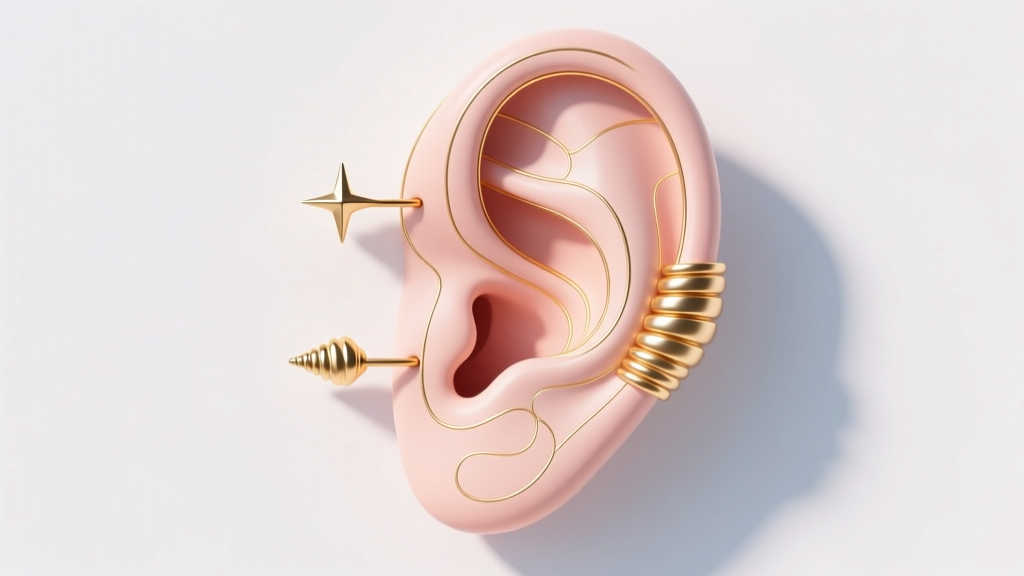
The visual language of kpop earrings in 2026 has shifted away from chaotic clustering toward deliberate, architectural ear mapping. The goal is to create a cohesive "constellation" that guides the eye along the natural ridges of the auricle.
The T-Zone and Constellation Setups
Top-tier stylists utilize the ear's "T-Zone"—an imaginary axis running from the helix root down through the conch, and intersecting horizontally across the tragus and anti-tragus. By placing high-refractive gemstones (like Moissanite or precision-cut sapphires) along this axis, the ear catches stage lighting dynamically as the performer turns their head.
Asymmetry remains a dominant styling technique. A common 2026 configuration features an heavy, structural industrial barbell on the left ear to convey an edgy, avant-garde silhouette, balanced by a delicate, multi-point stacked lobe and rook constellation on the right ear to maintain a high-fashion, elegant profile for camera close-ups.
Sourcing and Maintenance Protocol
Executing this level of curation requires bypassing commercial mall kiosks and sourcing directly from high-end, CNC-machined jewelry manufacturers such as Body Vision Los Angeles (BVLA), Maria Tasha, and LeRoi. These brands offer the precise tolerances required for threadless tension fits and utilize genuine, prong-set gemstones rather than glued-in synthetic crystals that cloud under stage heat.
Maintenance is equally rigorous. Idols are instructed to clean their curations using only sterile, preservative-free 0.9% sodium chloride saline sprays. Ultrasonic cleaners are used exclusively on the removed jewelry pieces to dissolve aerosolized stage makeup and hairspray buildup from the gemstone settings, ensuring maximum light refraction for every broadcast and stadium tour.
Expert Takeaway: The art of kpop earrings is an exercise in structural engineering. By prioritizing ASTM F-136 titanium, threadless tension mechanics, and IEM-compatible post lengths, stylists can create iconic, gravity-defying ear curations that survive the physical demands of global stadium tours.


