Labradorite Stud Earrings: 2026 Trend & Style Guide
Explore the 2026 trend of labradorite stud earrings. Our expert guide covers gem grading, bezel settings, gauge sizes, and cartilage styling.

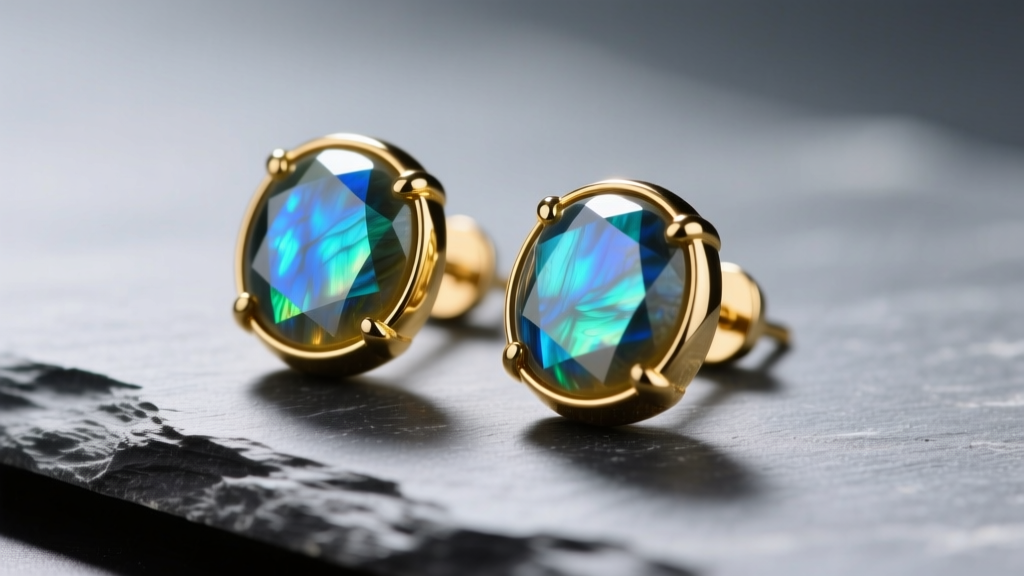
The jewelry landscape in 2026 has decisively pivoted away from the hyper-sparkly, diamond-dominated minimalism of the early 2020s. In its place, a demand for moody, earthy, and deeply personal gemstones has taken root at the top of the trend cycle. Leading this charge are labradorite stud earrings, a versatile staple that bridges the gap between quiet luxury and mystical self-expression. Whether you are curating a stacked cartilage constellation or seeking a single, striking lobe statement, understanding the gemological and structural nuances of labradorite is critical for making an informed purchase.
The 2026 Trend Shift: Earthy Mysticism and Quiet Luxury
Why are labradorite stud earrings dominating the current market? The answer lies in the cultural shift toward 'earthy mysticism.' Consumers are increasingly drawn to jewelry that feels grounded and unique, moving away from mass-produced, perfectly uniform stones. Labradorite, with its signature optical phenomenon, offers a bespoke experience; no two stones flash in the exact same pattern. Furthermore, the muted grey-to-black base color of the stone aligns perfectly with the 'quiet luxury' aesthetic, allowing the iridescent flashes to serve as a subtle, sophisticated pop of color rather than an ostentatious display of wealth.
Gemological Deep Dive: Grading the Schiller Effect
To evaluate labradorite stud earrings like an industry insider, you must understand labradorescence. According to the Gemological Institute of America (GIA), this optical phenomenon is caused by light interference within microscopic twinning lamellae inside the feldspar crystal lattice. When shopping, you are not just buying a grey stone; you are buying the quality of the flash.
- Standard Labradorite: Predominantly displays blue and green flashes. This is the most common and affordable variety, perfect for everyday wear.
- Spectrolite: A rare, premium variety originally sourced from Finland (though now used as a trade term for high-grade material globally). Spectrolite exhibits the full color spectrum, including vivid oranges, purples, and yellows, commanding significantly higher price points.
- Flash Coverage: Top-tier stones exhibit a 'full-face' flash, meaning the iridescence is visible from a direct, top-down viewing angle. Commercial-grade stones often only flash from extreme side angles, which defeats the purpose of a stud earring.
Structural Integrity: Setting Architecture for a 6.5 Mohs Stone
One of the most common failure modes in gemstone jewelry is ignoring the Mohs hardness scale and cleavage planes. Labradorite ranks between 6 and 6.5 on the Mohs scale, making it softer than quartz and far softer than sapphire or diamond. More importantly, as noted by mineralogical databases like Mindat, labradorite possesses two directions of perfect cleavage. This means a sharp impact can cause the stone to split cleanly along its internal crystal lattice.
Why Bezel Settings Are Non-Negotiable
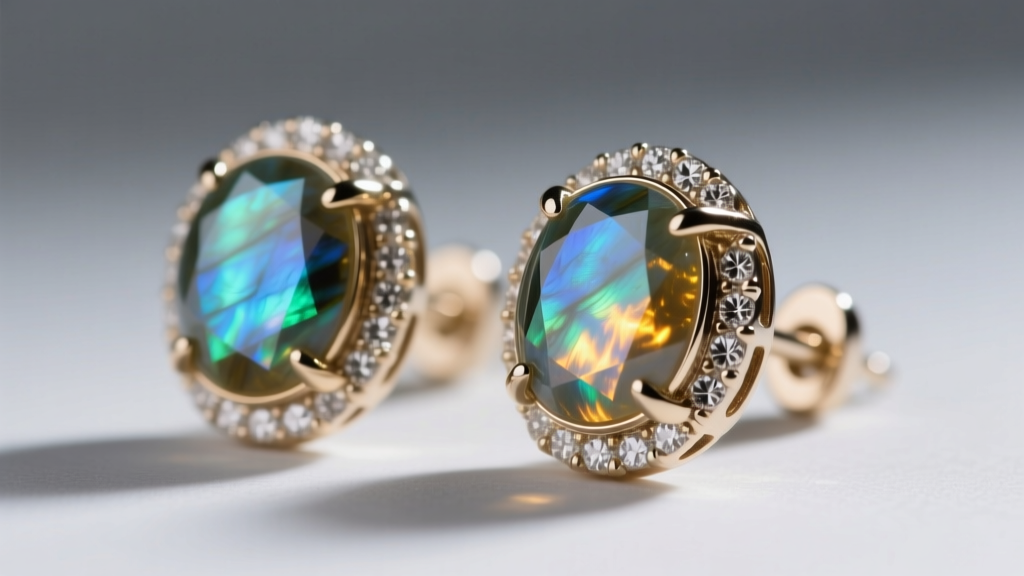
For daily-wear labradorite stud earrings, bezel or semi-bezel settings are structurally superior. Prong settings leave the girdle (the outer edge of the stone) exposed. If a prong-set labradorite stud catches on a heavy knit sweater or takes a direct hit, the stone is highly likely to chip or cleave. A full bezel setting wraps a continuous rim of metal around the entire girdle, absorbing impact and securing the stone against lateral movement. While prong settings allow more light to enter the stone, the risk of catastrophic failure makes them a poor choice for this specific feldspar.
The Metal Matrix: Gauge Sizes and Hypoallergenic Pairings
The metal you choose for your labradorite studs dictates both the aesthetic contrast and the biocompatibility of the piercing. Because labradorite has a dark base, it pairs exceptionally well with high-polish yellow gold, which warms the stone's blue flashes, or white gold/platinum, which amplifies the cool, icy tones.
| Metal Type | Best For | Standard Gauge | Avg. Price Range |
|---|---|---|---|
| ASTM F136 Titanium | Fresh piercings, hyper-sensitive ears, cartilage | 16g (1.2mm) or 18g (1.0mm) | $45 - $90 |
| 14k Solid Yellow Gold | Healed lobes, luxury everyday wear, warm skin tones | 18g (1.0mm) or 20g (0.8mm) | $120 - $350 |
| Sterling Silver (925) | Budget-conscious buyers, healed standard lobes | 20g (0.8mm) | $25 - $60 |
Expert Note on Gauges: Never wear 20-gauge posts in cartilage piercings (like the helix or tragus). The thin wire creates a 'cheese-cutter' effect, where the weight of the stone and the pressure of the jewelry can slowly slice through the tissue, leading to migration or rejection. Always opt for 16-gauge or 18-gauge posts for any cartilage placement.
Curated Ear Styling: Lobe vs. Cartilage Placements
Labradorite stud earrings are incredibly adaptable, but their sizing and post length must be calibrated to the specific anatomy of the piercing.
The Standard Lobe
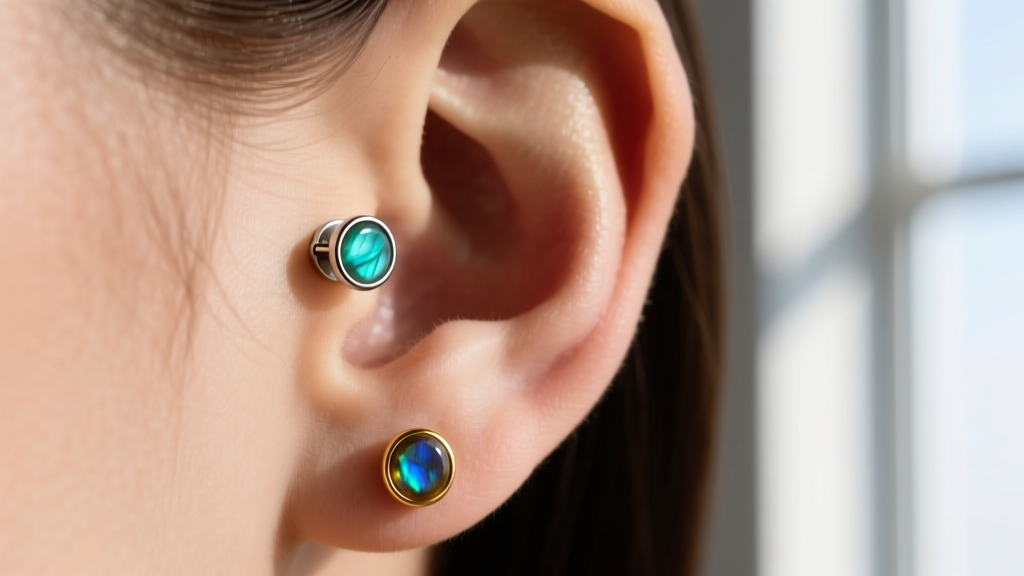
For the standard earlobe, a 6mm to 8mm post length is ideal to accommodate the natural thickness of the tissue. A stone diameter between 6mm and 9mm provides a substantial, elegant presence without overwhelming the facial features. Because the lobe is highly vascular and heals easily, you have the freedom to experiment with heavier 14k gold settings.
The Helix and Flat Piercings
Cartilage requires meticulous precision. A labradorite stud intended for a helix or flat piercing must feature a shorter post, typically 4mm to 5mm. If the post is too long, it will catch on hair, headphones, and pillows, causing irritation bumps (hypertrophic scarring). Furthermore, the stone size should be kept under 6mm to prevent the jewelry from pressing against the adjacent folds of the ear cartilage.
'When styling a curated ear, use labradorite as your anchor piece. Its dark base recedes visually, allowing the iridescent flash to act as a bridge between brighter gemstones like moonstone or opal placed in adjacent piercings.' — Senior Piercer & Jewelry Curator
Market Pricing & Authenticity Verification
As the popularity of labradorite stud earrings has surged, so has the market for imitations. Here is how to navigate the pricing tiers and ensure you are buying genuine feldspar:
- Commercial Tier ($20 - $50): Usually set in sterling silver or gold vermeil. The stones will have a predominantly grey base with patchy, weak blue flash. Often cut into uniform, machine-calibrated sizes.
- Fine Jewelry Tier ($80 - $250): Set in solid 14k gold or implant-grade titanium. Stones are hand-selected for top-down flash coverage and feature custom bezel settings.
- Spectrolite / Collector Tier ($300+): Features rare purple, orange, or magenta flashes. These are often custom-cut to maximize the specific color banding of the rough material.
Red Flags: If the 'labradorite' is perfectly uniform in color, completely transparent, or lacks the characteristic dark, opaque base, it is likely dyed howlite, glass, or synthetic spinel. Genuine labradorite will always have a dark, somewhat opaque body color when viewed away from the light source.
Care Protocols: Preserving the Labradorescence
Because of its 6-6.5 Mohs hardness and perfect cleavage, labradorite requires specific maintenance routines to prevent permanent damage to the stone's surface and optical properties.
- Ban Ultrasonic Cleaners: Never place labradorite in an ultrasonic jewelry cleaner. The high-frequency vibrations will exploit the stone's natural cleavage planes, causing internal fracturing and completely destroying the schiller effect.
- Avoid Steam Cleaning: Sudden thermal shock can also cause the feldspar to crack.
- The Soapy Soak: Clean your studs using warm water, a drop of mild, non-detergent soap (like Castile soap), and a soft-bristled baby toothbrush. Gently brush the back of the setting where sebum and skin cells accumulate.
- Storage: Store labradorite studs in a separate soft pouch. If tossed into a jewelry box with diamonds or sapphires, the harder stones will easily scratch the labradorite's surface, creating a cloudy, matte finish that dulls the flash.
By prioritizing structural security through bezel settings, selecting the correct gauge for your specific piercing anatomy, and adhering to strict gemological care protocols, your labradorite stud earrings will remain a captivating, iridescent staple in your collection for years to come.


