Labyrinth Door Knocker Earrings: An Engineering Deep Dive
Explore the structural engineering, weight distribution, and metallurgy behind intricate labyrinth door knocker earrings for lasting lobe health.

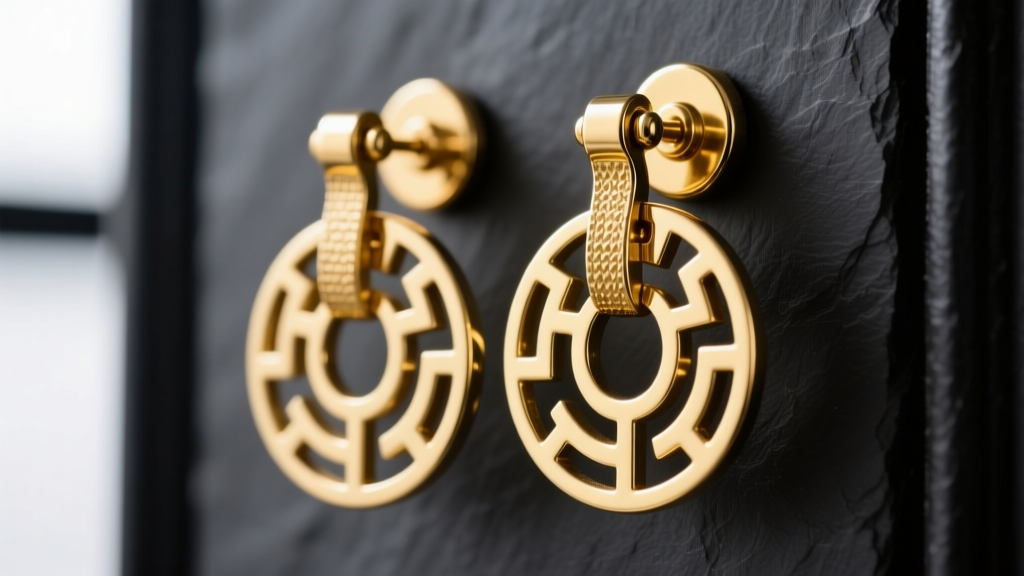
The Structural Anatomy of Door Knocker Earrings
Door knocker earrings represent a fascinating intersection of kinetic jewelry design and structural engineering. Unlike static studs or continuous hoops, the door knocker silhouette features a primary anchor—either a rigid post or a hinged hoop—that suspends a secondary geometric plate. This suspended plate swings freely on a horizontal hinge pin, mimicking the mechanical action of an architectural door knocker. When this design is infused with a 'labyrinth' motif, the suspended plate features intricate, maze-like negative space cutouts that drastically alter the piece's center of gravity and tensile requirements.
The defining challenge of the labyrinth door knocker earring is managing kinetic stress. Every time the wearer moves their head, the suspended labyrinth plate acts as a pendulum. This generates rotational torque on the hinge pin and sheer stress on the earlobe piercing. To prevent catastrophic mechanical failure or tissue damage, master jewelers must meticulously calculate the hinge tolerance, the gauge of the anchor, and the structural integrity of the labyrinth's outer frame.
Engineering the Labyrinth: Cutout Techniques and Tolerances
The labyrinth motif relies on complex, interlocking geometric channels that create a maze-like visual effect. Achieving this without compromising the structural rigidity of the earring requires advanced manufacturing techniques. Historically, these patterns were achieved through hand-pierced filigree or lost-wax casting. However, modern labyrinth door knocker earrings are predominantly engineered using CAD (Computer-Aided Design) and precision fiber laser cutting.
Laser Kerf and Structural Webbing
When utilizing a fiber laser to cut the labyrinth pattern into a solid sheet of metal, engineers must account for the 'kerf'—the width of material removed by the laser beam. For high-precision jewelry lasers, the kerf width typically ranges between 0.10mm and 0.15mm. If the labyrinth channels are cut too close together, the remaining metal webbing becomes too thin to withstand the kinetic swinging of the door knocker mechanism.
- Minimum Webbing Thickness: For 14k gold alloys, the structural webbing between labyrinth channels must never drop below 0.8mm to prevent warping under stress.
- Outer Frame Gauge: The perimeter frame of the suspended plate must be at least 1.5mm thick and 2.0mm wide to act as a rigid chassis for the internal maze.
- Corner Radii: Internal labyrinth corners must feature a minimum radius of 0.2mm to prevent stress concentration points where micro-fractures can initiate.

Metallurgical Density and the Center of Gravity
The material chosen for labyrinth door knocker earrings directly dictates their weight, which in turn affects both the swing dynamics and the long-term health of the earlobe. The labyrinth cutouts remove a significant percentage of the metal's mass (often 30% to 45% of the total surface area), but the remaining metal must possess high tensile strength. According to the Gemological Institute of America (GIA), the specific alloying metals used in gold jewelry drastically alter both the Vickers hardness and the specific gravity of the final piece.
| Material Grade | Density (g/cm³) | Vickers Hardness (HV) | Engineering Suitability for Labyrinth Knockers |
|---|---|---|---|
| 14k Yellow Gold | 13.0 - 14.0 | 120 - 140 | Excellent balance of weight and malleability; standard for hinged components. |
| 18k Palladium White Gold | 15.0 - 16.0 | 130 - 150 | High density increases swing momentum; requires reinforced 12g anchors. |
| Grade 23 Titanium (Ti-6Al-4V) | 4.43 | 340 - 360 | Ultra-lightweight and incredibly strong; ideal for oversized labyrinth designs to prevent lobe tearing. |
| Platinum (950 Pt/Ru) | 21.45 | 135 - 145 | Extremely heavy; generally avoided for large door knockers due to severe tissue migration risks. |
Biomechanics: Gauge Thickness and Lobe Preservation
The most critical point of failure in any heavy, kinetic earring is the interface between the metal anchor and the human tissue. The Association of Professional Piercers (APP) frequently warns against the 'cheese-cutter effect'—a phenomenon where thin, heavy jewelry slowly migrates through the earlobe tissue due to constant gravitational pull and kinetic momentum.
Because labyrinth door knocker earrings feature a suspended weight that swings, the dynamic load on the piercing is significantly higher than its static weight. When the earring swings forward and abruptly stops at the limit of the hinge, it creates a momentary spike in sheer force.
Anchor Gauge Requirements
To counteract this dynamic load, the anchor post or hoop must be substantially thicker than standard fashion earrings. While standard studs utilize 20-gauge (0.81mm) or 18-gauge (1.02mm) posts, a properly engineered labyrinth door knocker earring demands a minimum of 14-gauge (1.6mm) for the anchor. For larger labyrinth plates exceeding 15 grams in total weight, a 12-gauge (2.0mm) or even 10-gauge (2.5mm) anchor is mandatory to distribute the sheer force across a wider surface area of the fistula (the piercing channel), thereby preserving the structural integrity of the earlobe.
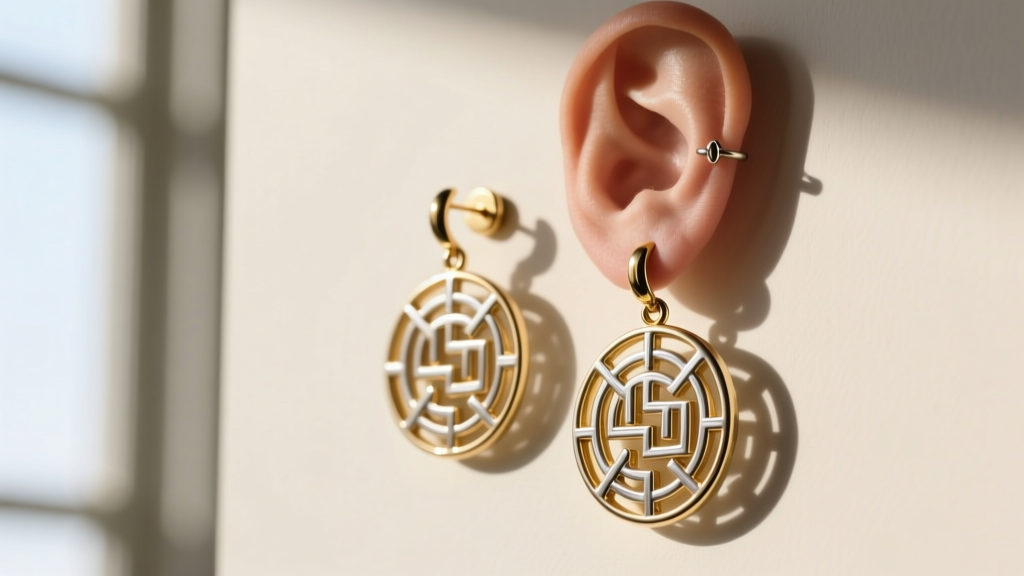
CAD and Center of Mass Calculation
Before a labyrinth door knocker earring is ever cast or cut, it must undergo rigorous digital prototyping. Using advanced jewelry CAD software like MatrixGold or Rhino 3D, engineers calculate the exact Center of Mass (CoM) of the suspended labyrinth plate. If the CoM is positioned too low, the earring will swing excessively and aggressively, causing wearer fatigue and increasing the risk of the earring catching on clothing. If the CoM is too high, the plate will lack the kinetic energy to hang properly, resulting in a stiff, lifeless drape.
By strategically thickening the lower geometric borders of the labyrinth maze and thinning the upper webbing near the hinge, CAD engineers can dial in the CoM to sit exactly 35% to 40% down from the hinge axis. This ensures a graceful, controlled pendulum motion that looks deliberate and feels comfortable during extended wear.
Hinge Tribology: Friction, Wear, and Maintenance
The hinge mechanism is the literal linchpin of the door knocker earring. The two most common hinge types utilized in this style are the saddle hinge and the clicker hinge. Saddle hinges rely on a simple friction pin, while clicker hinges feature a spring-loaded snap closure. For labyrinth designs, saddle hinges are generally preferred due to their lower profile and superior load-bearing capacity.
'In kinetic jewelry, the hinge pin is a high-wear component. If the pin diameter is too small relative to the suspended mass, the oscillating friction will eventually ream out the hinge barrel, leading to catastrophic detachment.' — Master Bench Jeweler Engineering Guidelines
Troubleshooting Hinge Failures
Even with precision manufacturing, labyrinth door knocker earrings require specific maintenance protocols to ensure the longevity of the moving parts:
- Pin Diameter: The hinge pin must be a minimum of 1.0mm in diameter. Pins smaller than this will bow under the weight of the labyrinth plate.
- Barrel Tolerance: The hinge barrel must be reamed to allow exactly 0.05mm of clearance around the pin. Too tight, and the earring will bind; too loose, and the plate will wobble laterally.
- Lubrication: Owners should apply a microscopic drop of synthetic watch oil (such as Moebius 9010) to the hinge barrel every six months to reduce tribological wear and prevent the accumulation of oxidized skin oils and cosmetic debris.
- Ultrasonic Cleaning Warnings: Never place hinged door knocker earrings in an ultrasonic cleaner with the hinge fully closed, as the high-frequency vibrations can micro-fracture the tension pin. Always clean them in the open position.
By respecting the strict engineering parameters of gauge thickness, metallurgical density, and kinetic balance, jewelers can create labyrinth door knocker earrings that are not only visually mesmerizing but structurally immortal. When sourcing these pieces, always verify the anchor gauge and hinge pin diameter with the manufacturer to ensure the design is built to withstand the rigors of daily kinetic wear.


