Large Cross Earrings: Technical Guide to Weight, Gauge, and Fit
Discover the technical specifications for large cross earrings. Learn about weight distribution, gauge sizing, and secure backing mechanisms.

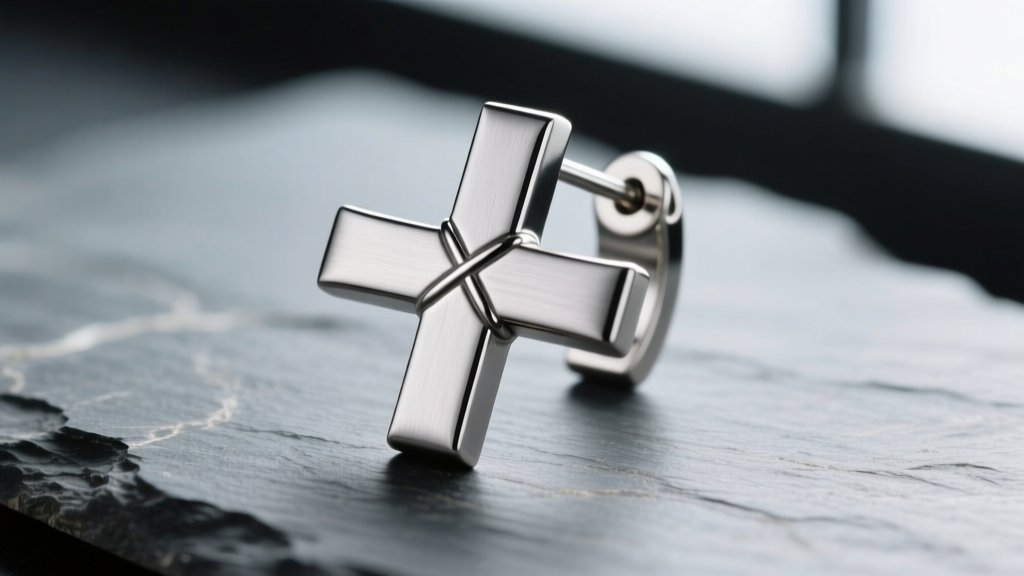
The resurgence of statement jewelry in contemporary fashion has cemented large cross earrings as a staple in both streetwear and high-end editorial styling. However, scaling up a traditional motif introduces significant biomechanical and metallurgical challenges. When an earring exceeds standard dimensions, gravity and leverage begin to compromise both the structural integrity of the metal and the health of the earlobe tissue. This expert deep dive explores the engineering principles, material science, and ergonomic specifications required to design, select, and wear heavy cross earrings safely and comfortably.
The Physics of Heavy Statement Jewelry
Standard fashion earrings typically weigh between 2 and 5 grams. Large cross earrings, particularly those crafted from solid metals or featuring intricate pavé detailing, frequently exceed 12 to 18 grams per earring. This mass creates a downward vector force that can lead to the 'cheese-cutter effect'—a phenomenon where a thin post slowly migrates downward through the earlobe tissue, causing irreversible stretching and micro-tearing.
Furthermore, the geometry of a cross introduces a secondary mechanical failure point: torque. The horizontal crossbar acts as a lever arm. When the earring swings during movement, kinetic energy transfers directly to the junction where the horizontal bar meets the vertical post. In poorly constructed pieces, this repetitive stress causes metal fatigue, ultimately resulting in a snapped solder joint. To mitigate this, high-end manufacturers utilize investment casting (lost-wax method) or CNC milling to create a single, contiguous grain structure, completely eliminating the vulnerable solder seam.
Material Science and Density Considerations
When designing or purchasing oversized drops, the density of the chosen alloy dictates the final weight. According to the Association of Professional Piercers (APP), biocompatibility is just as critical as structural strength, especially when heavy jewelry causes prolonged friction against the skin.
| Material | Alloy Grade | Density (g/cm³) | Hypoallergenic Profile | Best Use Case |
|---|---|---|---|---|
| Titanium | ASTM F136 (Grade 23) | 4.43 | Excellent (Nickel-Free) | Ultra-large, lightweight statement pieces |
| Stainless Steel | 316L Surgical | 8.00 | Poor (Contains Nickel) | Budget-friendly, moderate-sized crosses |
| Yellow Gold | 14k (58.5% Pure) | 13.20 | Good (Alloy Dependent) | Luxury pieces requiring weight distribution |
| Sterling Silver | 925 | 10.36 | Moderate (Tarnish Risk) | Intricate cast designs with oxidized detailing |
As the data illustrates, ASTM F136 Titanium is the superior choice for large cross earrings. It is approximately 45% lighter than surgical steel and nearly 70% lighter than 14k gold, drastically reducing the downward drag on the earlobe while maintaining exceptional tensile strength. Conversely, the American Academy of Dermatology warns that heavy 316L stainless steel earrings can trigger severe contact dermatitis due to nickel leaching exacerbated by the friction of heavy drops.
Gauge Sizing and Post Engineering
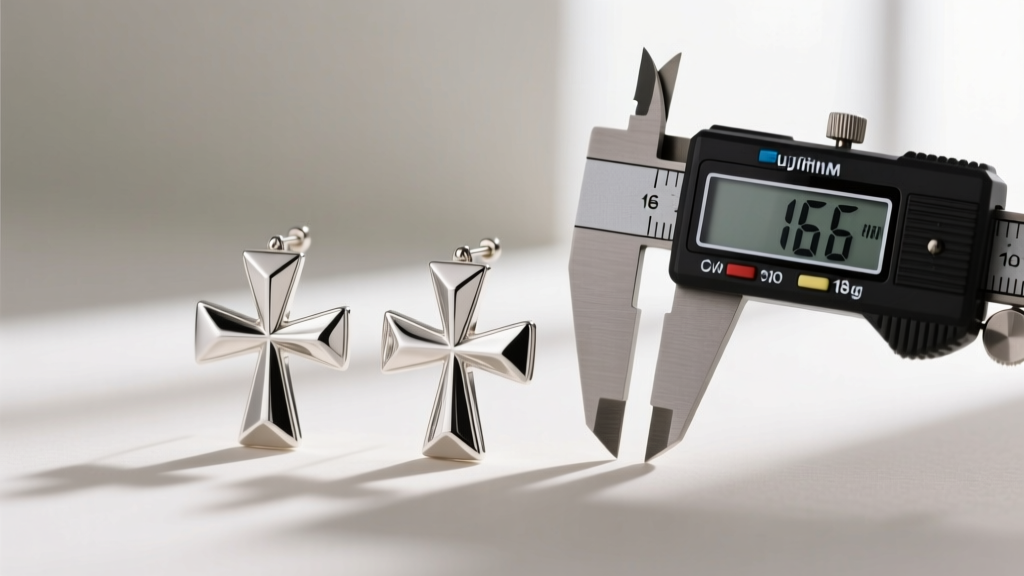
The most common technical oversight in mass-market large earrings is the use of standard 20-gauge (0.81mm) posts. A 20-gauge wire lacks the shear strength to support a 15-gram drop without bending, and its narrow surface area concentrates the downward force, accelerating tissue damage.
Optimal Gauge Specifications
- 18-Gauge (1.02mm): The minimum acceptable thickness for crosses weighing up to 10 grams. Provides adequate rigidity for standard friction backs.
- 16-Gauge (1.29mm): The professional standard for heavy statement pieces (10g - 20g). Distributes weight over a wider tissue area and resists bending under lateral torque.
- 14-Gauge (1.60mm): Reserved for extreme avant-garde pieces or stretched lobes. Requires specialized backing mechanisms.
When utilizing 16-gauge or thicker posts, internal threading is mandatory. External threads (where the screw pattern is on the post itself) act like a file, tearing the delicate fistula tissue upon insertion and removal. Internally threaded posts feature a smooth shaft with a threaded receptacle at the end, ensuring a seamless, trauma-free transition through the piercing channel.
Advanced Backing Mechanisms for Vertical Drops
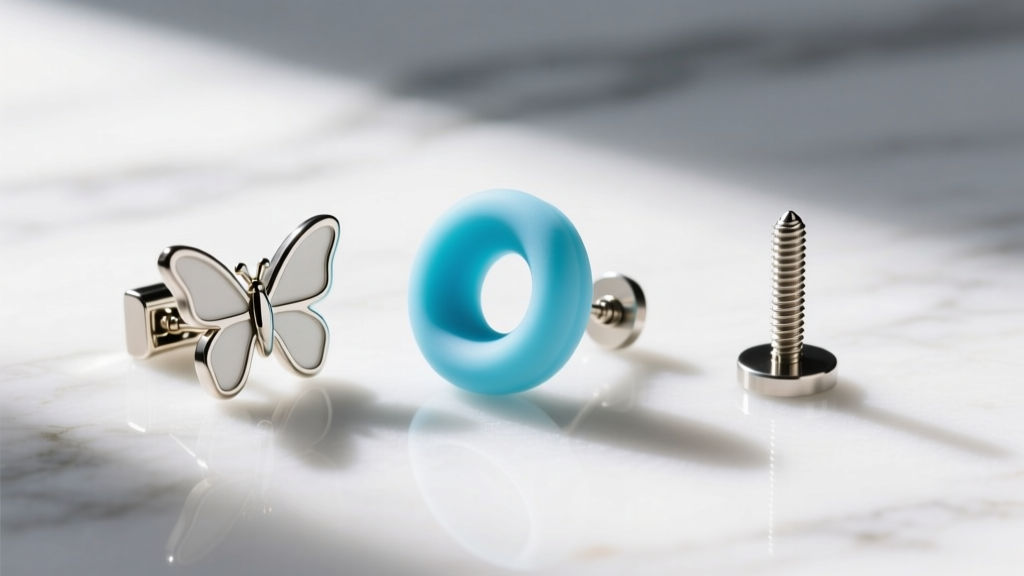
Standard butterfly clutches are fundamentally incompatible with heavy, elongated jewelry. The concentrated pressure of a heavy cross causes the earring to droop, angling the sharp tip of the post upward into the sensitive skin behind the ear. To counteract this, specialized load-bearing backings must be employed.
Load-Bearing Backing Solutions
- Silicone Support Discs (O-Rings): Placed between the earlobe and a standard friction back, these wide, flexible discs increase the surface area of the backing by 400%. This disperses the localized pressure, preventing the 'cheese-cutter' effect and keeping the cross hanging perfectly plumb.
- Flat-Back Labret Posts: Originally designed for cartilage, flat-back posts feature a wide, smooth disc that rests flush against the back of the earlobe. When paired with an internally threaded front face, they offer the most secure, comfortable, and flush fit for heavy drops, entirely eliminating the sharp post-end hazard.
- Screw-Back Tension Nuts: These feature a threaded barrel that screws onto the post, utilizing a tiny internal silicone gasket to create tension. They will not vibrate loose during movement, making them ideal for heavy, elongated crosses worn during active days.
Scaling Proportions and Facial Ergonomics
Beyond structural engineering, the visual success of large cross earrings relies on precise millimeter scaling relative to facial anatomy. A drop that is too long will visually sever the neck, while one that is too wide will clash with the jawline.
The Rule of Thirds for Drops: The ideal length of a large cross earring should not exceed one-third of the vertical distance from the bottom of the earlobe to the collarbone. For an average measurement of 45mm, the maximum drop length should cap at 15mm below the lobe to maintain facial harmony and prevent the jewelry from catching on high-collared garments.
Furthermore, the width of the horizontal crossbar should be scaled to the width of the jaw. For individuals with angular, square face shapes, a narrower, elongated Latin cross (e.g., 12mm wide by 25mm tall) introduces verticality, softening the jawline. Conversely, those with oval or elongated face shapes can carry the visual weight of a broader Caravaca or Celtic cross design, adding necessary horizontal balance to the facial silhouette.
Maintenance and Structural Auditing
Owning heavy, high-value statement pieces requires a proactive maintenance routine. Every three months, conduct a structural audit of your large cross earrings. Inspect the post-to-body junction under a jeweler's loupe for micro-fractures or metal fatigue. If the piece features gemstone pavé, check the prongs; the increased kinetic swing of a heavy earring makes it highly susceptible to snagging on textiles, which can easily bend a weakened prong and result in stone loss. By respecting the physics of weight, choosing biocompatible, low-density materials like titanium, and utilizing proper 16-gauge engineering, you can enjoy the bold aesthetic of oversized crosses without compromising your tissue health or the longevity of the jewelry.


