Large Gold Bamboo Earrings: 2026 Budget & Value Guide
Discover how to evaluate large gold bamboo earrings in 2026. Compare solid, hollow, and plated options, gram weights, and pricing to find true value.


Bamboo earrings, historically recognized as "doorknockers," remain a cornerstone of streetwear, hip-hop culture, and high-fashion jewelry. Characterized by their concentric, multi-ring tubular design, these statement pieces command attention. However, because the defining feature of bamboo earrings is their substantial volume and diameter—often ranging from 40mm to over 80mm—the cost of gold can escalate rapidly. For buyers navigating the 2026 jewelry market, distinguishing between a genuine investment piece and an overpriced fashion accessory requires a deep understanding of metallurgy, manufacturing techniques, and hardware mechanics.
This comprehensive value assessment guide breaks down exactly what you are paying for when shopping for large gold bamboo earrings, providing actionable frameworks to evaluate pricing, material integrity, and long-term wearability.
The Anatomy of Bamboo Earrings: What You Are Actually Paying For
Unlike standard continuous wire hoops, bamboo earrings are constructed from multiple interlocking or soldered tubular rings that mimic the segmented nodes of a bamboo stalk. This structural complexity means that creating a large pair (e.g., 60mm diameter) requires significantly more raw material and labor than a simple hoop of the same size.
When assessing value, you must account for three distinct cost drivers:
- Raw Material Mass: The physical weight of the gold or base metal used.
- Labor and Fabrication: The precision required to solder concentric tubes without warping the metal or leaving visible seams.
- Hardware Engineering: The clasp mechanism required to support the heavy, pendulum-like swing of a large bamboo hoop without tearing the earlobe.
Solid vs. Hollow vs. Plated: The 2026 Material Breakdown
The most critical factor in your budget assessment is the manufacturing technique used to create the earrings' volume. The visual difference between a $2,000 pair and a $40 pair can be nearly identical to the untrained eye, but the structural reality is vastly different.
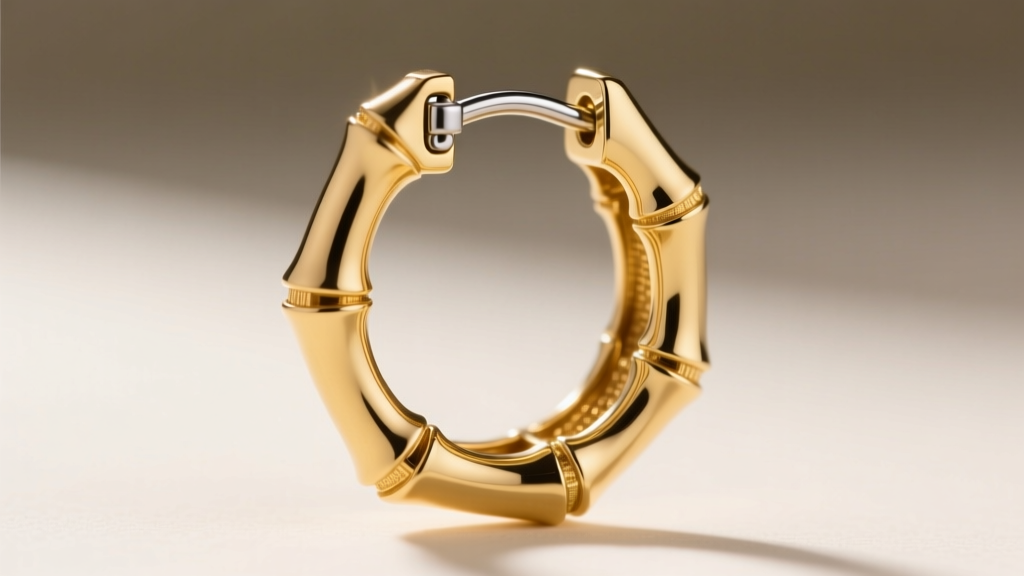
Solid Gold (10k, 14k, 18k)
Solid gold bamboo earrings are the ultimate investment tier. Because they are cast or fabricated from solid tubing, they are heavy, durable, and can be polished, soldered, and repaired indefinitely. A large 60mm pair of solid 14k gold bamboo hoops can easily weigh between 15 and 30 grams. With 14k gold containing 58.5% pure gold, the intrinsic melt value alone is substantial, meaning you are paying a premium for craftsmanship over a highly stable base asset. Expect to pay anywhere from $900 to $2,500+ depending on the exact gram weight and brand prestige.
Hollow Electroformed Gold
Electroforming is a process that deposits a thin layer of gold over a wax or resin mold, which is later melted away, leaving a hollow, lightweight gold shell. This technique allows jewelers to create massive, voluminous bamboo earrings that weigh only 3 to 6 grams, dropping the price to the $150 to $400 range. While they offer the "look" of solid gold for a fraction of the price, hollow earrings are highly susceptible to denting if dropped or squeezed. Furthermore, according to the Gemological Institute of America (GIA), hollow gold jewelry cannot be easily resized or soldered if broken, making them a depreciating fashion purchase rather than a repairable heirloom.
Gold Vermeil vs. Standard Plating
For strict budgets, gold vermeil is the undisputed champion of value. By definition, the Federal Trade Commission (FTC) requires vermeil to have a sterling silver (925) base coated with a minimum of 2.5 microns of gold (usually 14k or 18k). This thick plating ensures years of wear before the silver core is exposed. Large vermeil bamboo hoops typically cost between $80 and $160. Conversely, standard "gold-plated" or "gold-filled" earrings use a brass or copper base with a microscopic flash of gold (under 0.5 microns). Priced at $20 to $50, these will oxidize, turn your skin green, and trigger contact dermatitis within months.
Market Pricing Matrix: Large Bamboo Hoops (60mm Diameter)
| Material Type | Average Weight | 2026 Price Range | Durability & Repair | Resale Value |
|---|---|---|---|---|
| Solid 14k Gold | 18g - 28g | $1,100 - $2,200 | Excellent; fully repairable | High (Melt + Craft) |
| Solid 10k Gold | 15g - 22g | $650 - $1,100 | Excellent; highly scratch-resistant | Moderate |
| Hollow 14k Gold | 3g - 6g | $180 - $350 | Poor; dents easily, unrepairable | Low |
| Gold Vermeil (925) | 12g - 18g | $85 - $160 | Good; can be re-plated | Minimal |
| Gold Plated (Brass) | 15g - 25g | $25 - $55 | Poor; tarnishes, causes allergies | None |
Decoding Gram Weight and the "Lightweight" Trap
When shopping online or in-person, always ask for the exact gram weight of the earrings. Unscrupulous sellers will list a pair of large bamboo hoops as "14k Gold" without disclosing that they are hollow or incredibly thin-walled. If a pair of 60mm solid bamboo hoops is listed for $400, it is a mathematical impossibility for them to be solid 14k gold based on current precious metal spot prices.
Use this quick formula to assess if you are being overcharged for solid gold: Multiply the gram weight by the current daily scrap price of 14k gold (roughly $45-$55 per gram in 2026), then multiply that number by 1.5 to 2.5. This accounts for the jeweler's fabrication labor, overhead, and retail markup. If the retail price is vastly higher than this calculation, you are paying for brand hype. If it is lower, the earrings are likely hollow or mislabeled.
Hardware and Clasp Mechanics: Where Value Hides

The structural failure point of any large hoop earring is the hinge and clasp. Bamboo earrings, due to their wide, multi-ring profile, act as a lever. When the earring swings, it creates immense kinetic torque on the earlobe and the clasp mechanism.
The Importance of Gauge Thickness
The wire that passes through your ear (the post) must be thick enough to handle the leverage. For large bamboo hoops, the post should be a minimum of 12-gauge (2.0mm) or ideally 10-gauge (2.4mm). Thin 18-gauge (1.0mm) or 20-gauge (0.8mm) wires on heavy bamboo hoops will bend, warp, and eventually slice through the earlobe tissue—a painful failure mode known as "cheese-cutter syndrome."
Clasp Types Evaluated
- Omega Backs: The gold standard for heavy, solid bamboo hoops. The hinged omega clip hugs the back of the earlobe, distributing the weight across a wide surface area rather than relying solely on the piercing hole. Note: Omega clips are often made of stainless steel or spring-tempered gold alloys to maintain tension, which is perfectly normal and desirable.
- Snap/Latchbacks: Common on hollow or vermeil hoops. A hinged wire snaps into a catch. Ensure the catch has a satisfying, tight "click." If the hinge is loose out of the box, the earring will inevitably fall off and be lost.
- Screw Backs: Rare on bamboo styles, but excellent for security. They prevent the heavy earring from sliding off the post but take longer to put on.
Step-by-Step Value Assessment Checklist
Before handing over your credit card, run the earrings through this physical and visual inspection checklist to verify their true value:
- The Magnet Test: Pure gold and silver are non-magnetic. However, the internal springs in omega clasps or the steel pins in latchbacks *will* attract a magnet. If the main tubular body of the bamboo hoop sticks to a magnet, it is brass or steel with a gold flash—walk away.
- Hallmark Verification: Look for microscopic stamps near the hinge or on the inside of the innermost ring. "14k", "585", or "10k" indicates solid gold. "925" indicates sterling silver (vermeil). A stamp that simply says "18k HGE" means Heavy Gold Electroplate, not solid gold.
- The Seam Check: Inspect the joints where the concentric bamboo rings connect. Solid, high-quality fabrication will show smooth, nearly invisible solder lines. Rough, bumpy, or discolored joints indicate mass-produced, low-budget casting that will eventually snap at the stress points.
- The Tension Test: Open and close the clasp five times. The tension should remain perfectly consistent. A clasp that feels looser on the fifth try than the first indicates poor metallurgical tempering in the hinge spring.
Final Verdict: Maximizing Your Investment
Large gold bamboo earrings are a bold, cultural staple that transcends fleeting trends. If your budget allows, a solid 14k gold pair with a reinforced omega back is a generational piece that retains intrinsic melt value and can be passed down. For fashion-forward buyers who want to rotate styles frequently without committing thousands of dollars, high-quality gold vermeil over sterling silver offers the best balance of longevity, hypoallergenic safety, and visual impact. By understanding the physics of gram weight, the realities of hollow electroforming, and the vital importance of heavy-gauge hardware, you can confidently navigate the market and secure pieces that offer genuine, lasting value.


