Large Square Diamond Earrings: Best Metals & Settings
Discover the best metals, settings, and post gauges for large square diamond earrings. Compare platinum, gold, and princess vs. asscher cuts.

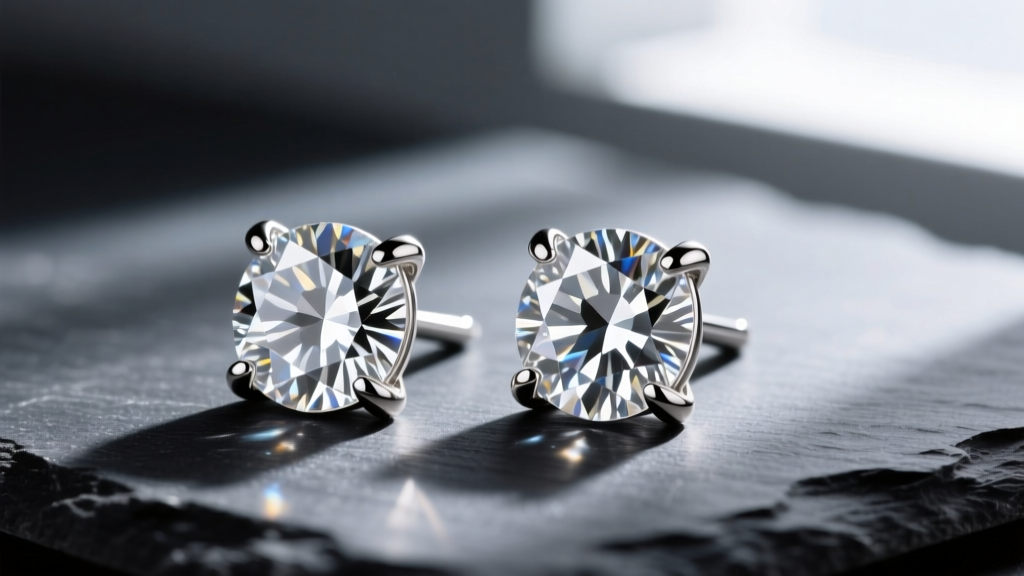
When investing in large square diamond earrings, the focus is almost exclusively on the Four Cs. However, the structural engineering of the earring itself—specifically the metallurgy of the setting, the geometry of the cut, and the gauge of the post—dictates whether the earrings will sit flush against the lobe or droop awkwardly forward. Square diamonds, primarily Princess and Asscher cuts, present unique physical challenges due to their sharp corners and high carat-weight density. This guide breaks down the material properties and structural requirements for wearing heavy square diamond studs with confidence and security.
The Metallurgy of Heavy Studs: Platinum vs. Gold Alloys
The metal chosen for large square diamond earrings must balance prong security with post rigidity. A 3.00-carat total weight (ctw) Princess cut stud exerts significant lever-action on the earlobe. The alloy composition directly impacts how the metal responds to this stress over time.
| Metal Alloy | Tensile Strength & Rigidity | Prong Security | Maintenance Profile |
|---|---|---|---|
| Platinum 950 (95% Pt, 5% Ru/Ir) | Malleable; posts may bend under heavy weight if not properly alloyed with Iridium. | Exceptional. Metal displaces rather than flakes when scratched, keeping prongs secure. | Low. No rhodium plating required; develops a natural patina. |
| 18k White Gold (75% Au) | Moderate rigidity. Softer than 14k, requiring a thicker post gauge to prevent drooping. | Good, but prongs can wear down and lose metal mass over years of friction. | High. Requires rhodium re-plating every 12-18 months to maintain bright white color. |
| 14k White Gold (58.5% Au) | High rigidity. The higher alloy content (copper, zinc, nickel) makes posts highly resistant to bending. | Very Good. Harder metal holds shape well, but can be brittle if prongs are too thin. | High. Requires rhodium plating; shows wear faster than 18k due to contrast with base metal. |
| 18k Yellow Gold (75% Au) | Moderate rigidity. Pure gold is soft; heavy stones require an 18-gauge or 16-gauge post. | Good. Malleability allows for tight prong setting, but prongs are prone to snagging. | Low. Does not require plating; scratches can be polished out easily. |
For large square stones, Platinum 950 is the superior choice for the setting head due to its prong longevity, but many master jewelers recommend a hybrid approach: a Platinum head laser-welded to a stiffer 14k White Gold or 18k White Gold post to prevent the earring from tilting forward.
Geometry and Vulnerability: Princess vs. Asscher Properties
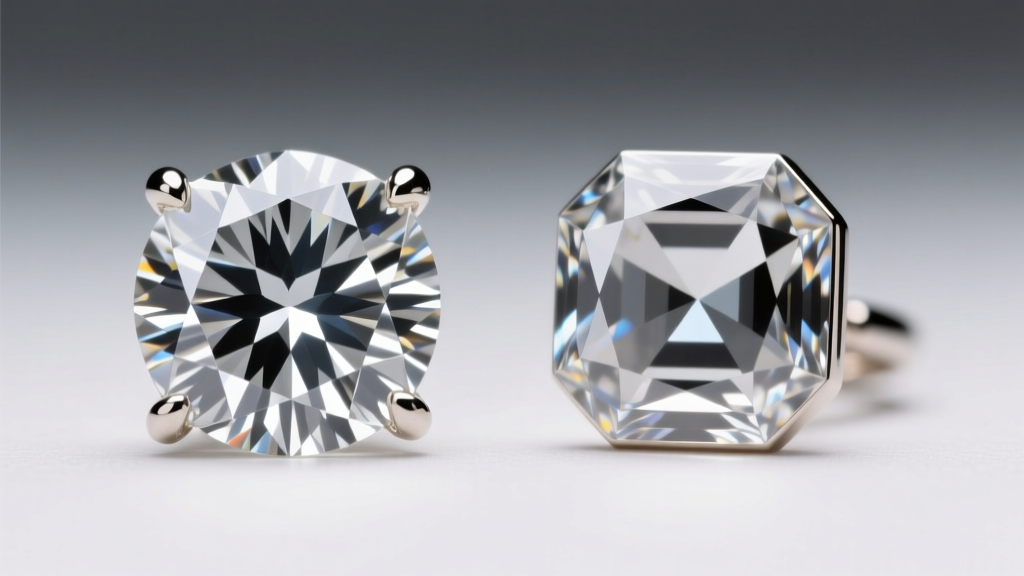
The term 'square diamond' encompasses two vastly different faceting structures, each requiring specific setting materials and prong configurations to prevent catastrophic failure (chipping).
The Princess Cut: Sharp Corners and V-Prongs
The Princess cut features 90-degree sharp corners. These corners are the most vulnerable points of the diamond, highly susceptible to chipping if struck against a hard surface. According to the Gemological Institute of America (GIA), protecting these points is paramount. Large Princess cut earrings must be set with V-prongs (chevron prongs) at all four corners. A standard round prong leaves the microscopic tip of the diamond exposed to lateral impacts.
The Asscher Cut: Cropped Corners and Step-Cut Clarity
The Asscher cut is a square step-cut with cropped (chamfered) corners. Because the sharp points are removed, standard round prongs are perfectly safe and offer a cleaner, more minimalist aesthetic. However, the step-cut faceting acts like a hall of mirrors, making inclusions highly visible. For large Asscher earrings, material purity is non-negotiable; a minimum clarity grade of VS1 is required to ensure the stone appears eye-clean, as the large, open table offers no place for flaws to hide.
Structural Engineering: Post Gauges and Backing Mechanisms
The most common complaint with large square diamond earrings is 'droop'—the earring tilts forward, showing the side profile rather than the face-up brilliance. This is a failure of structural engineering, specifically the post gauge.
- Standard 20-Gauge (0.81mm): Suitable for lightweight studs (under 1.00 ctw). Will immediately bend and droop under the weight of a 2.00+ ctw square diamond.
- Heavy-Duty 18-Gauge (1.02mm): The minimum acceptable thickness for large square diamonds. Provides the necessary rigidity to keep the setting flush against the earlobe.
- Custom 16-Gauge (1.29mm): Required for massive stones (4.00+ ctw). Note that 16-gauge posts may not fit through standard, un-stretched ear piercings without gradual tapering.
Furthermore, heavy square stones render standard friction backs (butterfly backs) obsolete. The weight of the stone will slowly push the friction back down the post, risking loss. You must utilize mechanical locking backs.
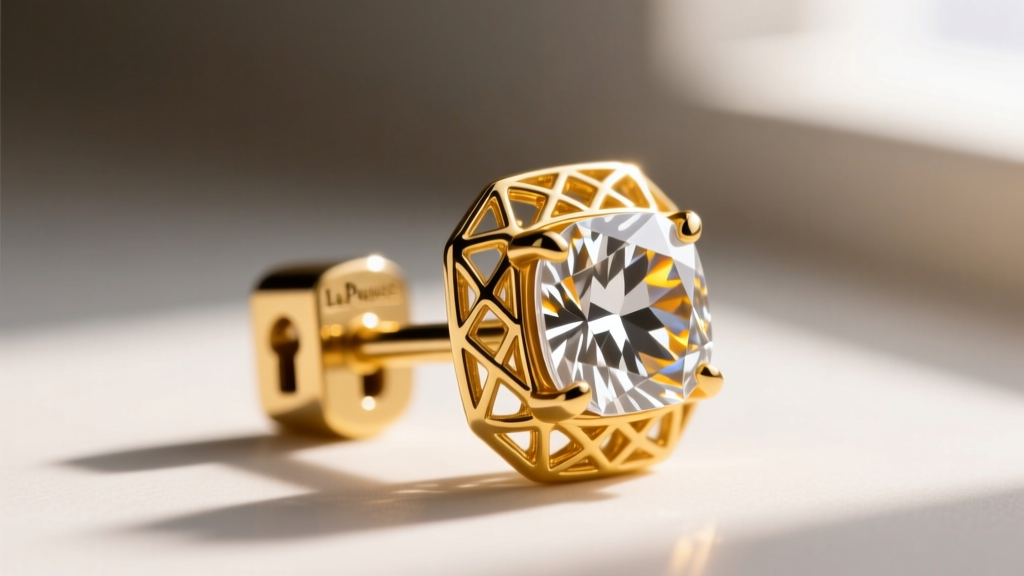
Expert Recommendation: Invest in La Pousette backs. These feature a spring-loaded internal mechanism that locks securely onto the post's groove, functioning similarly to a firearm safety. For a more budget-friendly alternative, silicone-lined screw-backs provide excellent grip and prevent the metal-on-metal grinding that wears down post notches.
Lab-Grown vs. Natural: The 2026 Material Reality
When purchasing large square diamond earrings, the origin of the material drastically alters the price point, though not the physical properties. As of 2026, the market has fully matured regarding lab-grown diamonds. According to GIA's comprehensive guidelines on lab-created stones, lab-grown diamonds possess the exact same chemical, physical, and optical properties as natural diamonds. Both are pure carbon crystallized in an isometric system, ranking 10 on the Mohs hardness scale.
The divergence lies in market valuation and size accessibility. A natural, high-clarity 3.00-carat Princess cut earring pair can easily exceed $35,000. Conversely, an identical 3.00-carat lab-grown pair of equal color and clarity often retails for under $3,500. Because square cuts require high color grades (G or better) to avoid showing warmth in the corners, lab-grown stones allow buyers to maximize material size and optical purity without compromising on the structural budget required for premium Platinum settings and 18-gauge posts.
Long-Term Maintenance and Failure Modes
Large square diamond earrings require specific maintenance protocols to prevent material degradation and stone loss:
- Prong Snagging: V-prongs on Princess cuts have a tendency to catch on hair and woven fabrics. Have your jeweler polish the outer edges of the V-prongs to a high smooth finish to reduce friction.
- Rhodium Depletion: If you choose White Gold, the rhodium plating will wear off first on the back of the setting and the post, where skin oils and friction are most prevalent. Re-plate annually to prevent nickel allergies from emerging as the base alloy is exposed.
- Ultrasonic Risks: While diamonds are incredibly hard, they possess distinct cleavage planes. If your large square diamond has been fracture-filled or has significant internal feathering near the girdle, ultrasonic cleaners can cause the stone to split. Always clean large square studs with a soft brush, warm water, and a mild degreasing detergent.
By prioritizing the structural integrity of the metal, selecting the correct post gauge, and matching the prong style to the specific geometry of the square cut, your large diamond earrings will remain secure, brilliant, and perfectly positioned for decades.


