The Physics of Level Earrings: Engineering the Perfect Fit
Master the physics of level earrings. Discover how gauge size, weight distribution, and backing mechanisms prevent drooping and ensure a perfect fit.

The Biomechanics of Earlobe Support
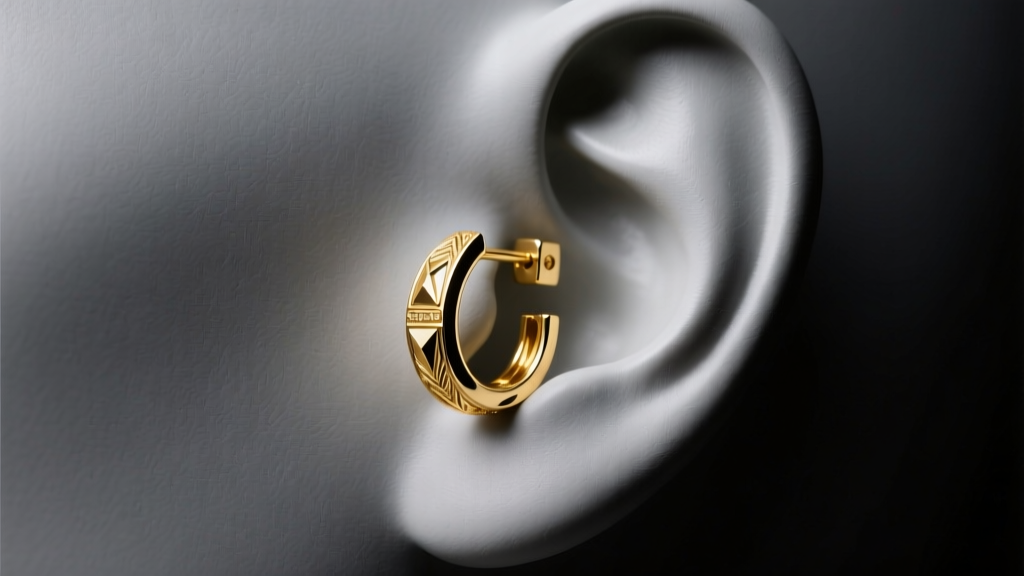
When master jewelers and horologists discuss 'level earrings,' they are not referring to a specific aesthetic trend, but rather a rigorous structural achievement. A truly level earring is one engineered to maintain a strict horizontal or perpendicular alignment against the earlobe, entirely resisting gravitational droop or forward tilt. The human earlobe is a soft-tissue fulcrum with minimal structural rigidity. When a piece of jewelry is introduced, the lobe acts as a lever arm. If the center of mass of the earring falls anterior (in front) of the piercing axis, the earring tilts forward. If the mass falls posterior, it drags the lobe backward. Achieving perfect equilibrium requires a deep understanding of biomechanics, metallurgical hardness, and precision weight distribution.
In 2026, the standard for high-end jewelry design has shifted away from purely aesthetic CAD modeling toward topology-optimized structures. Designers now use physics simulation software to calculate the exact center of gravity before a piece is ever cast, ensuring that even heavy gemstone drops sit perfectly level without the need for bulky, unsightly counterweights.
Gauge Thickness and Metallurgical Hardness
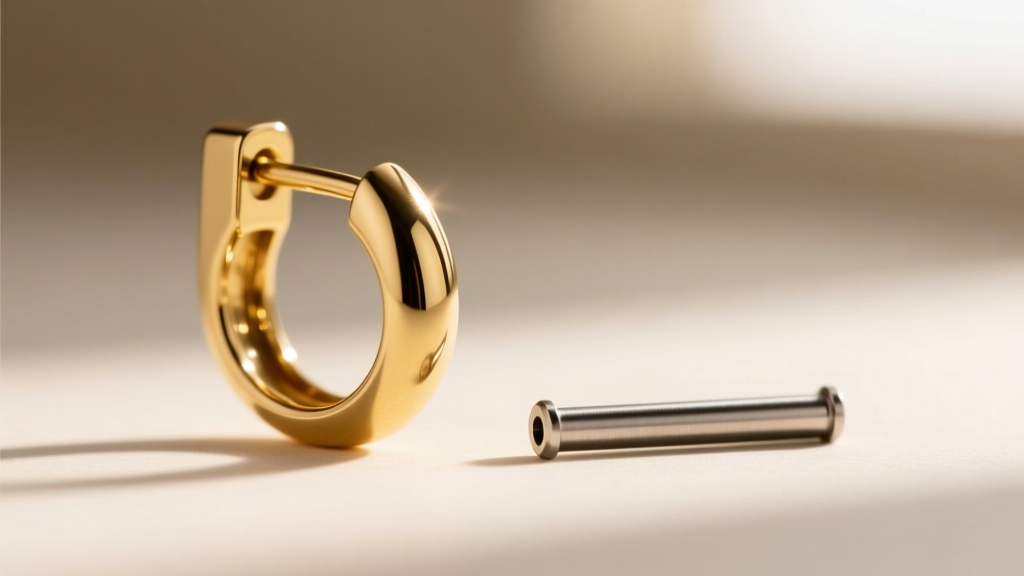
The most common failure mode preventing an earring from sitting level is post deformation. A standard commercial earring post is 20-gauge (0.81mm in diameter). While sufficient for lightweight studs, a 20-gauge post will inevitably bend under the dynamic load of a heavy drop or an active lifestyle, causing a permanent forward tilt.
The 18-Gauge and 16-Gauge Sweet Spots
To engineer level earrings that maintain their structural integrity, the post diameter must be increased. An 18-gauge post (1.02mm) offers a 58% increase in cross-sectional area over a 20-gauge post, exponentially increasing its resistance to bending moments. For heavy statement pieces exceeding 8 grams, a 16-gauge post (1.29mm) is mandatory.
However, gauge is only half the equation. Metallurgical hardness, measured on the Vickers scale (HV), dictates how the metal responds to stress. According to data from the Gemological Institute of America (GIA), standard 18-karat yellow gold has a Vickers hardness of roughly 115 HV, making it relatively soft and prone to post bending. In contrast, 14-karat gold alloys (approx. 135 HV) or platinum (which work-hardens up to 230 HV) provide the necessary rigidity to keep the post perfectly straight, ensuring the earring remains level over decades of wear.
Weight Distribution: Front-to-Back Ratios
Achieving a level profile requires managing the front-to-back weight ratio. The piercing hole acts as the pivot point. If a heavy gemstone is set on the front, the back of the earring must provide adequate counter-leverage. Below is a technical breakdown of optimal weight distribution ratios for different earring architectures.
| Earring Type | Optimal Front:Back Mass Ratio | Structural Mechanism | Max Recommended Front Weight |
|---|---|---|---|
| Friction Post Stud | 60:40 | Wide-back friction nut | 3.5 grams |
| Ear Jacket / Climber | 30:70 | Posterior decorative counterweight | 8.0 grams |
| Leverback Drop | 85:15 | Hinge pivot point offset | 12.0 grams |
| Omega Clip Back | 70:30 | Spring-loaded posterior tension arm | 15.0 grams |
As noted in advanced jewelry fabrication guides like those published by the Rio Grande jewelry findings catalog, leveraging the posterior space (the area behind the earlobe) is the most effective way to balance heavy anterior stones without increasing the overall mass of the piece.
Advanced Backing Mechanisms for Level Alignment
The backing mechanism is the unsung hero of level earrings. A standard butterfly clutch relies on friction and often slips down the post, altering the center of gravity and causing the earring to droop. For true leveling, mechanical locking systems are required.
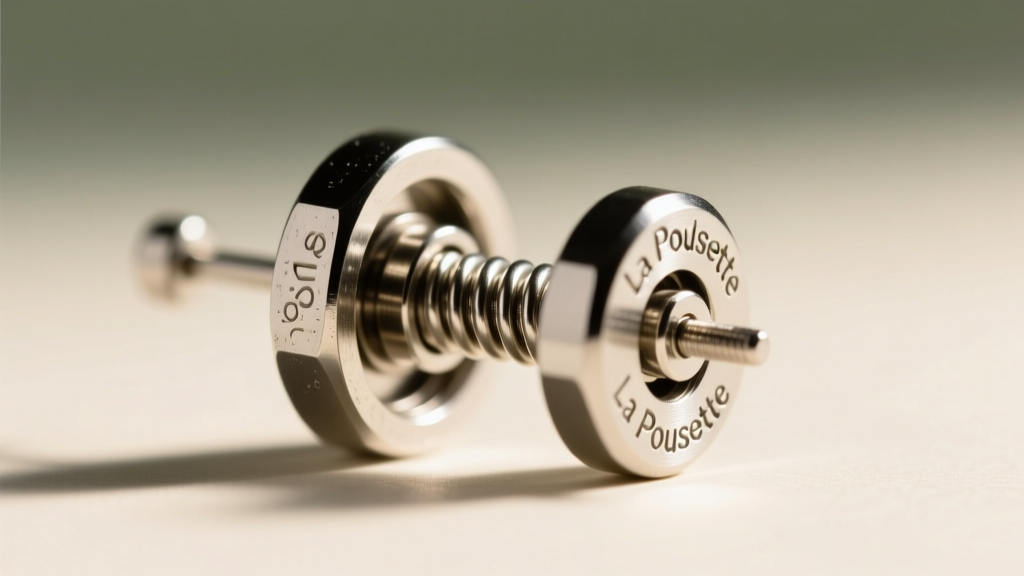
- La Pousette Clutches: Originally designed for high-value diamond studs, this mechanism uses a spring-loaded internal clutch that grips the post via dual internal pins. It locks at any point on the post, allowing the wearer to micro-adjust the tension against the earlobe, effectively pulling the earring into a perfectly level position.
- Silicone O-Ring Backings: For 18-gauge and 16-gauge posts, medical-grade silicone O-rings provide a high-friction seal. Unlike hard plastic, silicone compresses against the post, creating a vacuum-like grip that prevents the backing from sliding under the dynamic weight of a drop earring.
- Threaded Screw-Backs: By threading the final 4mm of the post and utilizing a internally threaded nut, the wearer can mechanically torque the backing against the lobe. This eliminates all posterior play, forcing the earring head to sit flush and level against the tissue.
Troubleshooting Common Alignment Failures
Even with meticulous CAD design, real-world variables like earlobe density and piercing angle can disrupt an earring's level alignment. Here is how to troubleshoot the most common issues:
The Forward Tilt (Anterior Droop)
Cause: The front assembly is too heavy, or the piercing channel is stretched, offering no lateral support to the post.
Fix: Switch to a larger-diameter backing (minimum 10mm across) to increase the posterior lever arm. If the piercing is stretched, consult a professional piercer for a temporary glass or titanium taper to tighten the fistula, or upgrade to a heavier 16-gauge post that fills the channel entirely.
The Lateral Lean (Side-to-Side Tilt)
Cause: The earring head is not soldered perfectly perpendicular to the post, or the post itself has a micro-bend from manufacturing stress.
Fix: Place the earring on a machined flat surface. If the post does not stand at a strict 90-degree angle, a jeweler must use a post-straightening jig to realign it. Never attempt to bend a hardened platinum or 14k white gold post with standard pliers, as this will cause work-hardening and eventual metal fatigue fracture.
Conclusion
The pursuit of level earrings is a masterclass in micro-engineering. It requires balancing the Vickers hardness of precious alloys, calculating exact front-to-back mass ratios, and selecting mechanical backings that defy gravity. By prioritizing 18-gauge minimums and leveraging posterior counterweights, jewelers can create pieces that sit flawlessly on the ear, proving that true luxury is as much about structural physics as it is about visual brilliance.


