The Anatomy of Fine Lily Earrings: A Technical Guide
Explore the metallurgy, casting techniques, and structural engineering behind fine lily earrings. An expert guide to floral jewelry design and durability.

The Engineering of Floral Motifs in Fine Jewelry
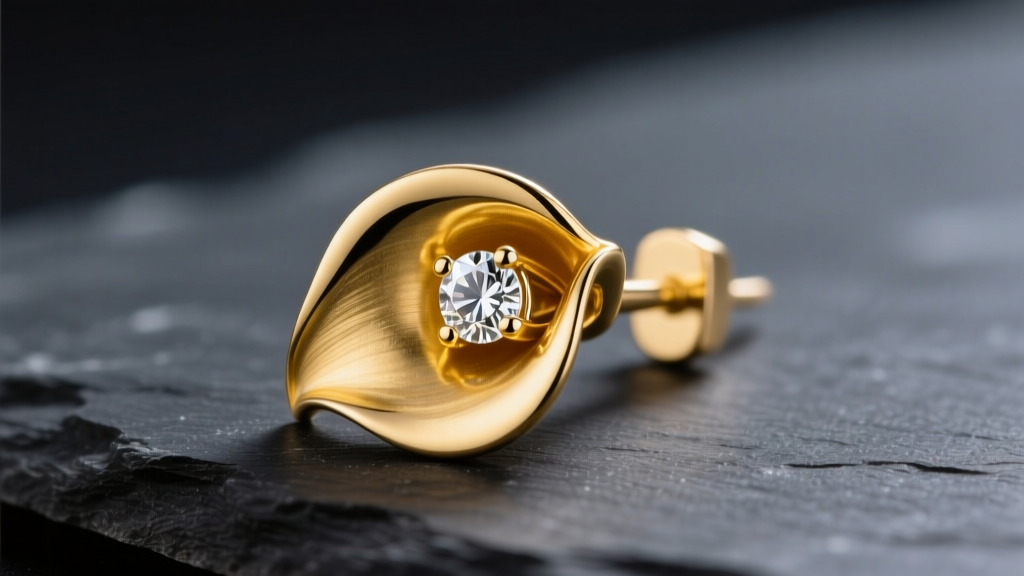
When translating the organic, sweeping lines of nature into fine jewelry, the lily motif presents a unique set of structural and metallurgical challenges. Unlike geometric designs that benefit from uniform mass distribution, lily earrings—whether depicting the trumpet-like curve of a Calla lily or the radial, overlapping petals of a Water lily—require extreme precision in edge tapering and weight management. The transition from the thick base of the flower to the ultra-thin edges of the petals (often tapering down to 0.3mm) creates inherent stress points. If the metallurgical framework is not engineered correctly, these delicate floral extremities become highly susceptible to torsional fatigue, bending, or catastrophic snapping during everyday wear.
In this technical deep dive, we deconstruct the anatomy of fine lily earrings, examining the material science, casting methodologies, and mechanical load distribution required to produce heirloom-quality floral jewelry that withstands the rigors of daily use.
Metallurgy and Material Selection for Thin Edges
The choice of precious metal alloy dictates the longevity of a lily earring's delicate petal edges. Jewelers must balance the Vickers Hardness (HV) of the metal with its malleability and tensile strength. Pure 24k gold (HV ~25) is entirely unsuitable for structural floral motifs due to its extreme softness. While 18k yellow gold (HV ~125) offers a rich color and is the industry standard for fine jewelry, it can be prone to warping on petal edges thinner than 0.4mm.
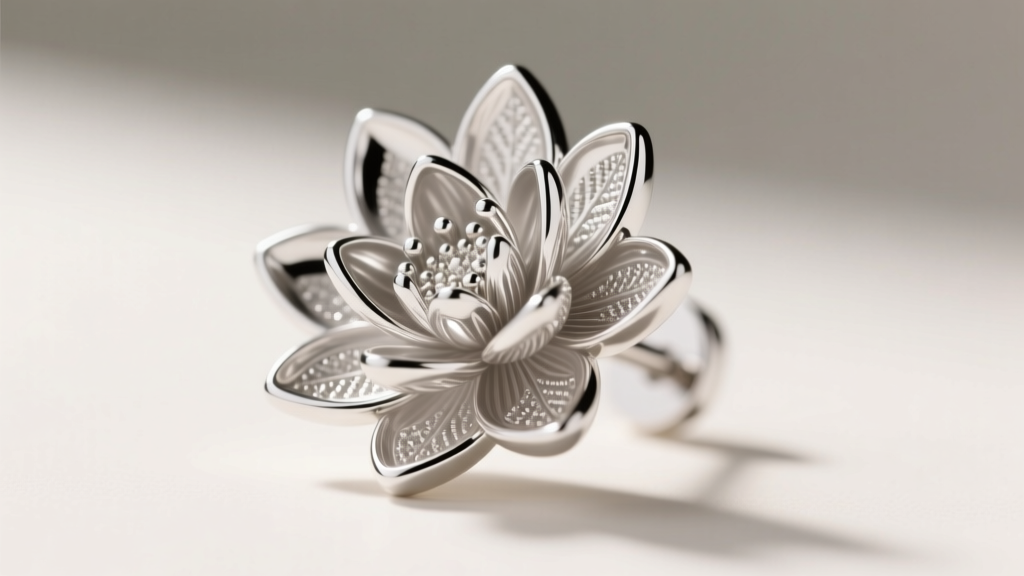
For ultra-fine Water lily designs with razor-thin petal margins, 14k gold (HV ~150) provides superior rigidity and resistance to deformation. Alternatively, Platinum (specifically 950Pt/5%Ru or 950Pt/5%Co) is highly favored by master jewelers for intricate floral work. Although platinum's Vickers Hardness (HV ~110-130) is comparable to 18k gold, its crystalline structure allows it to displace rather than chip or snap under stress, making it exceptionally forgiving for the ultra-thin, sweeping curves of a Calla lily.
Alloy Performance Matrix for Floral Motifs
| Alloy Composition | Vickers Hardness (HV) | Tensile Strength | Edge Fatigue Resistance | Recommended Lily Style |
|---|---|---|---|---|
| 18k Yellow Gold (Au750) | 120 - 130 | Moderate | Moderate | Calla Lily (Stud / Short Drop) |
| 14k Yellow Gold (Au585) | 145 - 160 | High | High | Water Lily (Complex Overlapping) |
| 950 Platinum / 5% Ruthenium | 115 - 125 | Very High | Exceptional | Calla Lily (Large Statement Drop) |
| 18k White Gold (Nickel-free) | 130 - 140 | High | High | Water Lily (Rhodium Plated) |
Advanced Casting and CAD/CAM Workflows
As of 2026, the creation of master models for fine floral jewelry has largely transitioned from traditional hand-carved wax to ultra-high-resolution CAD/CAM resin printing, achieving tolerances down to 10 microns. This allows designers to perfectly calculate the volumetric mass of a lily petal before the casting phase. However, the lost-wax (or lost-resin) casting process introduces thermal dynamics that can compromise thin floral edges.
When molten gold or platinum enters the investment flask, the thin extremities of the lily petals cool and freeze much faster than the thicker central spadix or base. This premature freezing can lead to micro-porosity or incomplete fills at the petal tips. To combat this, expert casters utilize directional solidification techniques. By strategically placing the sprue button at the thickest part of the flower base and applying precise thermal gradients to the flask, the alloy is forced to flow cleanly into the thinnest petal margins, ensuring a dense, porosity-free cast.
Vitreous Enameling on Curved Petal Surfaces
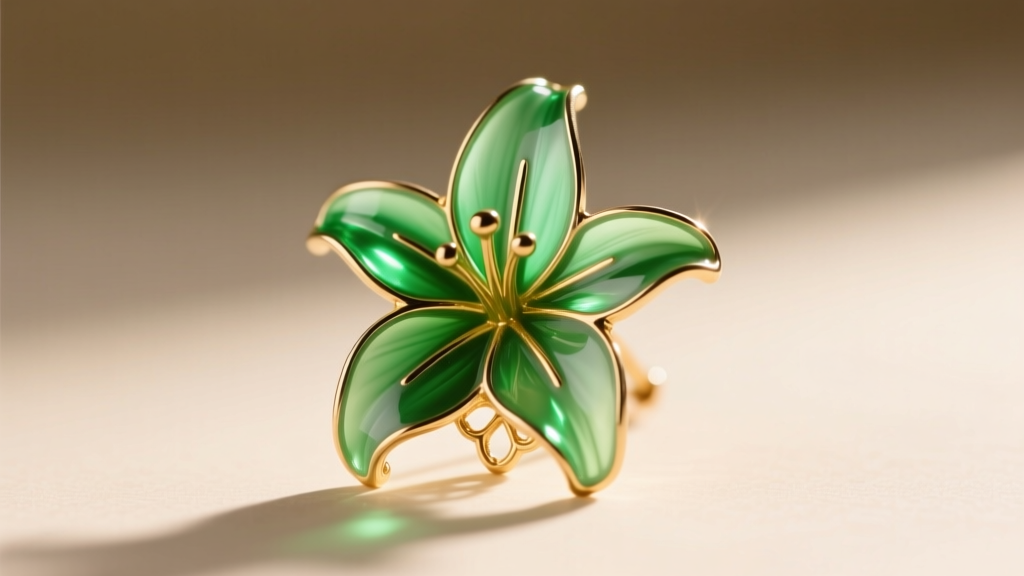
Water lily earrings frequently incorporate vitreous enamel to replicate the vibrant hues of nature. The most prestigious and technically demanding technique is plique-à-jour, which creates a translucent, stained-glass effect without a metal backing. For a lily petal to support plique-à-jour enamel, the gold framework must be exceptionally rigid. The structural wires forming the petal's cells must maintain a minimum thickness of 0.35mm to prevent the framework from flexing during the enameling process.
During the kiln firing phase, which typically reaches temperatures between 750°C and 800°C, the enamel fuses and shrinks slightly upon cooling. If the gold framework lacks the necessary tensile rigidity, the cooling enamel will exert inward torque, resulting in microscopic stress fractures that will eventually cause the enamel to pop out of the cell. Master enamelists often apply a counter-enamel layer or use specialized low-expansion borosilicate glass formulations to equalize the surface tension across the curved lily petal.
Load Distribution and Post Mechanics
A common failure point in floral drop earrings is the earring post. A solid cast 18k gold Calla lily drop earring can easily weigh between 4 to 7 grams. Standard 20-gauge (0.81mm) friction posts are entirely inadequate for this mass; the leverage exerted by the dangling flower will quickly bend the post, causing the earring to droop or fall out.
For lily earrings exceeding 3 grams, structural integrity demands an upgrade to an 18-gauge (1.02mm) or even a 16-gauge (1.29mm) post. Furthermore, standard butterfly friction backs are insufficient to hold the weight securely against the earlobe, leading to lobe fatigue and tearing over time. Expert bench jewelers recommend outfitting heavy floral drops with La Pousette backs (which utilize a mechanical spring-locking mechanism) or precision-threaded screw-backs. These mechanisms distribute the load more evenly across the earlobe and prevent the heavy lily motif from rotating or slipping.
Gemstone Integration: The Spadix and Pistil
Integrating gemstones into a lily motif requires specialized setting techniques that accommodate the organic curves of the flower. The central spadix of a Calla lily is often represented by a pear-cut or marquise-cut diamond. Setting a pear-cut stone into a curved, sweeping gold wrap requires custom-cut seats and extreme prong tension management. If the prongs are pulled too tightly to secure the stone, the surrounding thin gold 'petal' can warp or pucker.
For Water lily centers, rose-cut diamonds or cabochon moonstones are frequently used to mimic the dewy, textured center of the bloom. These are typically secured using flush (gypsy) settings or micro-bead settings. When flush-setting into a curved floral surface, the burring process must be meticulously controlled; removing too much metal from the curved surface to seat the stone will compromise the structural integrity of the petal's arch, leading to eventual metal fatigue.
Maintenance and Failure Mode Troubleshooting
Even expertly crafted lily earrings require specific maintenance protocols due to their intricate topography. Below are the most common real-world failure modes and their technical solutions:
- Petal Edge Snagging: Thin, polished edges can become micro-serrated over time from contact with hard surfaces. Solution: Annual re-polishing using a soft muslin wheel and fine rouge, avoiding aggressive cutting compounds that will round off the crisp petal margins.
- Prong Displacement on Spadix: The sweeping curve of the Calla lily often leaves the central gemstone prongs exposed to lateral impacts. Solution: Bench jewelers should perform a microscopic prong alignment and retipping every 18 months to ensure the stone remains securely seated.
- Enamel Micro-Fractures: Dropping a plique-à-jour Water lily earring on a hard surface will almost certainly shatter the enamel cells due to the shockwave traveling through the rigid gold framework. Solution: Immediate professional assessment; the piece must be carefully de-enameled, the frame annealed to relieve stress, and re-fired.
"The true mastery of floral jewelry lies not in the initial design, but in anticipating how the metal will behave under years of kinetic stress. A lily earring is a triumph of metallurgical foresight." — Master Jeweler's Bench Manual
Understanding the deep technical nuances of material selection, casting dynamics, and mechanical load distribution is essential for both the creation and curation of fine lily earrings. By respecting the physical limitations and strengths of precious metals, jewelers can craft floral motifs that remain as structurally sound as they are visually breathtaking. For further reading on advanced jewelry manufacturing technologies, consult the research archives at the Gemological Institute of America (GIA) or the technical papers published by the Santa Fe Symposium on Jewelry Manufacturing Technology.


