The Male Earring in Left Ear Myth: 2026 Men's Style Trends
Is the male earring in left ear rule still relevant in 2026? We debunk the outdated myth and explore modern men's earring trends, gauges, and styling tips.

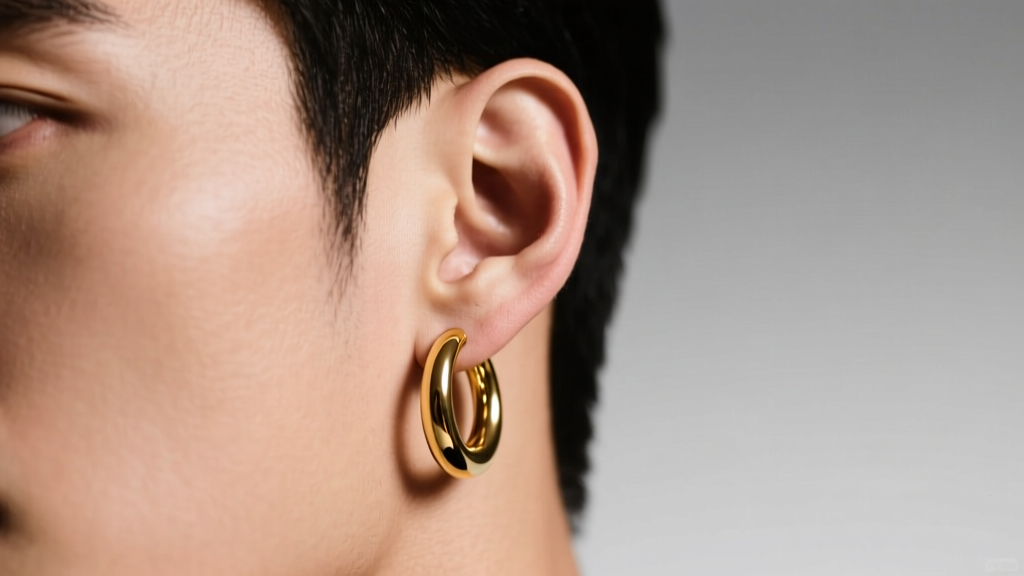
For decades, the phrase 'male earring in left ear' carried a heavy, unspoken cultural subtext. If you grew up in the late 20th century, you likely heard the whispered schoolyard rhyme: 'Left is right, and right is wrong.' It was a rigid, binary code that dictated how men could express themselves through jewelry without crossing invisible societal lines. But as we navigate the style landscape of 2026, that archaic rule has been entirely dismantled, melted down, and recast into something far more expressive.
Today, men's jewelry is experiencing a renaissance driven by gender-fluid fashion, high-end streetwear, and a return to artisanal craftsmanship. Whether you are considering a subtle lobe stud or a curated cartilage stack, understanding the history of this myth—and the modern science of piercing—is essential for building a contemporary aesthetic. Here is your definitive, no-nonsense guide to men's earrings in 2026.
The Historical 'Left Ear' Code: Where Did It Come From?
To understand why the male earring in left ear myth persisted for so long, we have to look back at the 1970s and 1980s. During this era, LGBTQ+ communities, facing severe marginalization, developed subtle visual signifiers to identify one another safely. The 'hanky code' and specific jewelry placements became covert communication tools. A single earring in the right ear was widely recognized in urban centers as a quiet signal of queer identity, while the left ear was deemed the 'safe' or heterosexual option.
By the 1990s, pop culture icons like George Michael and hip-hop pioneers like Slick Rick and Tupac Shakur mainstreamed men's earrings. However, the underlying anxiety about the 'right ear code' lingered in suburban and corporate America. Men defaulted to the left ear not necessarily out of style preference, but out of a desire to avoid misinterpretation. As documented by cultural historians and GLAAD, these rigid sartorial codes were born from necessity, not fashion.
The 2026 Reality: Symmetry, Asymmetry, and the Death of the Rule
In 2026, the idea that ear placement dictates sexual orientation or masculinity is entirely obsolete. The modern style paradigm is governed by facial symmetry, personal branding, and anatomical suitability. High-fashion runways and street-style icons now routinely sport bilateral symmetry (matching studs or hoops in both ears) or intentional, heavily curated asymmetry (a stacked left ear balanced by a single, bold statement piece on the right).
'The modern man doesn't ask which ear is safe; he asks which ear balances his jawline and complements his wardrobe. The left-ear rule is a relic of a deeply insecure era in menswear.' — Contemporary Menswear Stylist
If you are getting your first piercing today, the decision should be based purely on your dominant side, how you part your hair, and which profile you prefer to show in photographs. The 'male earring in left ear' mandate is officially dead.
Anatomical Guide: Lobe vs. Cartilage for Men
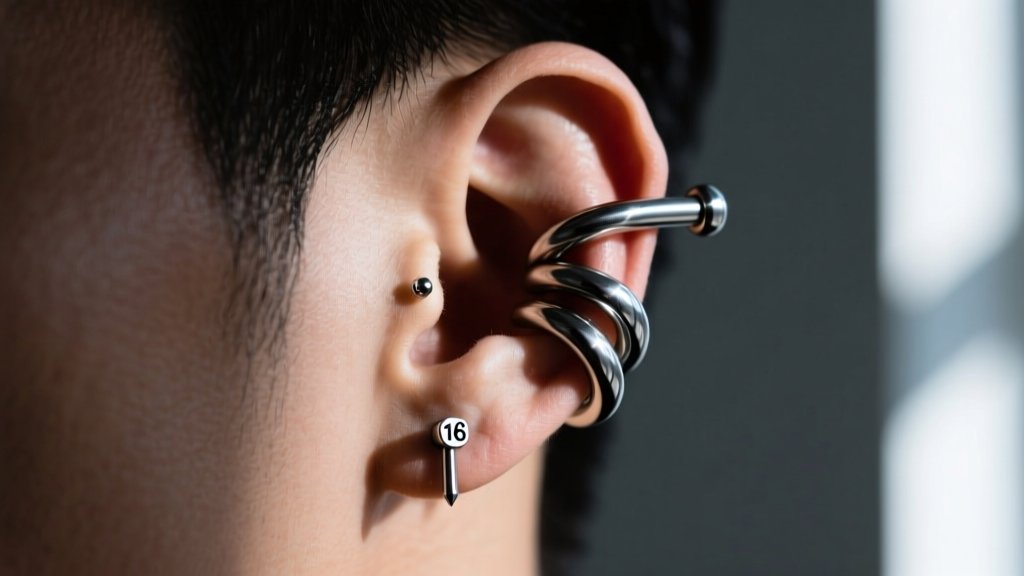
Once you discard the outdated placement myths, the real conversation begins: anatomy. Men's ear cartilage tends to be slightly thicker and more pronounced than women's, which influences both the healing process and the jewelry styles that look most proportional.
Standard Gauges and Sizing Metrics
One of the most common mistakes men make when buying earrings online is ignoring wire thickness (gauge). Wearing a 20G wire in a 14G hole will cause the 'cheese-cutter effect,' where thin metal slowly migrates through the tissue. Conversely, forcing a thick post into a standard lobe piercing will cause micro-tearing and blowouts.
| Piercing Placement | Standard Gauge | Millimeter (mm) | Best Jewelry Types for Men |
|---|---|---|---|
| Standard Lobe | 20G or 18G | 0.81mm - 1.02mm | Threadless studs, seamless hoops, huggies |
| Helix (Upper Cartilage) | 16G | 1.29mm | Flat-back labrets, cartilage cuffs, clickers |
| Industrial (Scaffold) | 14G | 1.63mm | Custom-length industrial barbells |
| Tragus | 16G | 1.29mm | Small bezel-set gems, minimalist balls |
According to the Association of Professional Piercers (APP), starting with the correct gauge and high-quality implant-grade materials is the single most critical factor in preventing rejection and infection.
Material Science: What to Buy (and What to Avoid)
The men's jewelry market is flooded with cheap alloys masquerading as premium metals. If you are investing in a curated ear, material science matters just as much as aesthetics.
The Gold Standard: Implant-Grade Titanium
For fresh piercings or sensitive ears, ASTM F-136 Implant-Grade Titanium is non-negotiable. It is completely nickel-free, highly polished to a mirror finish (which prevents bacterial adhesion), and lightweight. Brands like BVLA and Industrial Strength machine their titanium to aerospace tolerances, ensuring the post won't scratch the delicate fistula (the skin tube inside the piercing).
The Trap: 'Surgical Steel'
Avoid anything labeled simply as 'Surgical Steel' or '316L Stainless Steel.' While 316L is fine for surgical tools that are sterilized and used once, it contains up to 10% nickel. When worn in a warm, moist environment like a healing ear, 316L can leach nickel salts, leading to contact dermatitis, weeping, and delayed healing.
Solid Gold: 14k vs. 18k
If you prefer the warmth of gold, opt for 14k or 18k solid gold that is explicitly alloyed without nickel (often using palladium or silver instead). Avoid gold-plated or gold-filled jewelry for daily wear; the friction of taking shirts on and off will wear the plating down to the base brass within months, turning your ear green and triggering allergic reactions.
Curating Your Stack: 3 Modern Archetypes
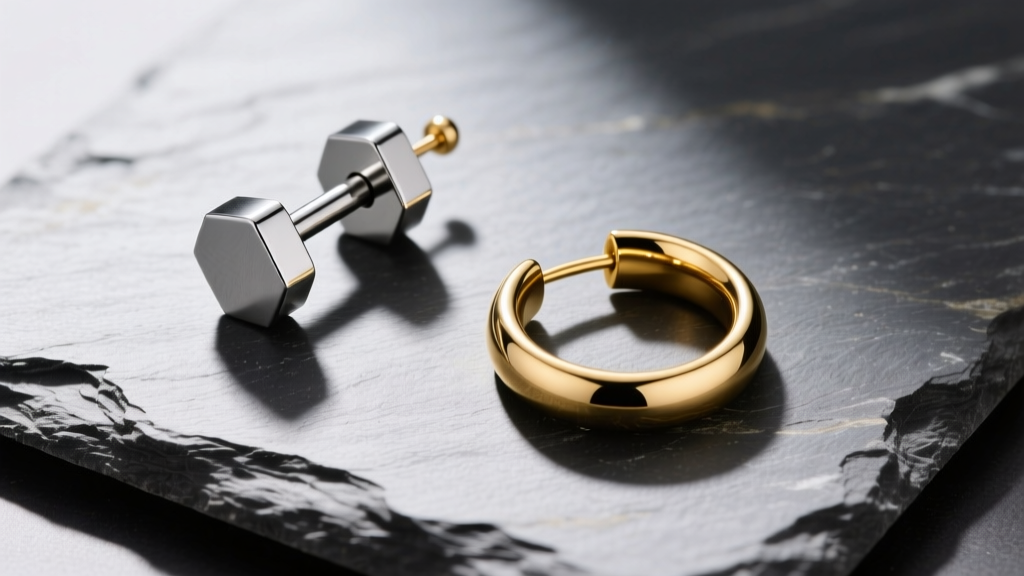
Building an earring stack is an exercise in visual weight and balance. Here are three distinct archetypes dominating men's style in 2026, moving far beyond the basic left-ear stud.
1. The Minimalist Executive
- Placement: Single standard lobe piercing on each ear (bilateral symmetry).
- Jewelry: 18G bezel-set black diamond or dark grey spinel studs (3mm to 4mm).
- Vibe: Understated, sharp, and boardroom-appropriate. The dark stones catch the light subtly without the flashiness of white diamonds.
2. The Streetwear Stack
- Placement: Double lobe + Helix on the left ear; single lobe on the right.
- Jewelry: 16G yellow gold seamless hoops (8mm diameter) in the lobes, paired with a 16G titanium threadless spike in the helix.
- Vibe: Edgy, dynamic, and heavily influenced by contemporary hip-hop and skate culture. The mixed metals (gold and silver-toned titanium) are intentionally clashed for a rugged look.
3. The Avant-Garde Architect
- Placement: Industrial scaffold + Tragus on one ear.
- Jewelry: A custom 14G black PVD-coated titanium industrial barbell with geometric prong-set ends, paired with a minimalist 16G tragus shield.
- Vibe: High-fashion, structural, and bold. This requires a commitment to a 6-to-12-month healing process but yields a striking, architectural profile.
Final Verdict: Wear What You Want
The cultural obsession with the male earring in left ear was always a symptom of a society uncomfortable with male vanity and self-expression. In 2026, the only rules that matter are proportional harmony, anatomical safety, and material integrity. Invest in ASTM F-136 titanium or nickel-free solid gold, respect your gauge sizes, and choose the ear—or both ears—that best frames your face. The code is broken; the canvas is yours.


