The Beginner's Guide to Round Earrings: Studs, Hoops & Huggies
Discover everything about round earrings. This beginner guide covers studs, hoops, huggies, gauge sizes, and face-shape styling tips.


Building a foundational jewelry collection can feel overwhelming, especially when navigating the sheer volume of shapes, sizes, and materials available. Among the most timeless and versatile options are round earrings. From the subtle geometry of a classic stud to the sweeping arc of a medium hoop, circular designs offer a soft, universally flattering aesthetic. However, not all round earrings are created equal. A poorly sized huggie can pinch your lobe, while an overly heavy round cabochon stud can cause irreversible stretching over time.
This beginner-friendly explainer breaks down the anatomy of round earrings, providing actionable advice on gauge thickness, diameter sizing, metallurgical safety, and face-shape matching. Whether you are buying your first pair of solid gold hoops or looking for hypoallergenic cartilage studs, this guide will ensure your choices are both comfortable and structurally sound.
The Anatomy of Round Earrings: Studs, Huggies, and Hoops
While 'round' implies a simple geometric shape, the structural execution varies wildly across three main categories. Understanding these differences is crucial for comfort and longevity.
1. Round Studs
Studs sit flush against the earlobe or cartilage. They consist of a decorative face (the 'head') and a straight post that passes through the piercing. Round studs typically feature a bezel-set gemstone, a pearl, or a simple metal dome (cabochon). The primary failure mode for heavy round studs is the use of thin posts (22-gauge or smaller) which bend easily and cause the earring to droop. For daily wear, always look for 18-gauge (1.02mm) or 20-gauge (0.81mm) posts.
2. Huggies
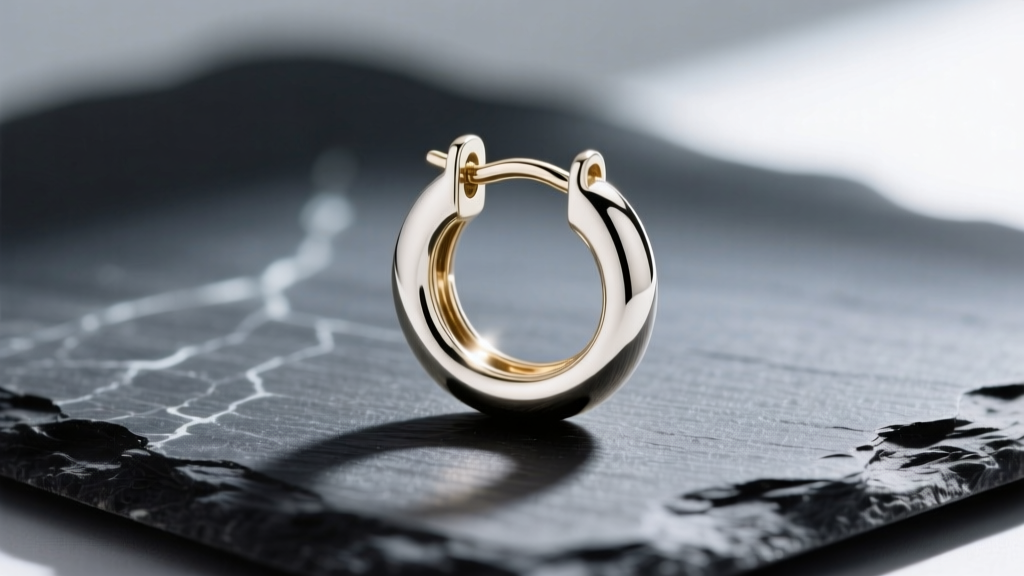
Huggies are small, thick hoops designed to 'hug' the earlobe. They typically range from 10mm to 15mm in outer diameter. The best huggies feature a hinged 'clicker' mechanism with a secure snap closure. Because they sit close to the skin, the inner diameter is more important than the outer diameter. If your earlobe is 5mm thick, a huggie with an 8mm inner diameter will leave only 3mm of clearance, which can cause irritation and swelling.
3. Classic Hoops
Hoops are larger circular earrings (usually 20mm and above) that dangle freely. They commonly use a latch-back closure (where a straight post clicks into a curved wire) or a continuous wire design. Beginners should avoid 'endless' or continuous hoops made from thin wire, as they easily warp out of their perfect round shape when inserted or removed. Latch-back hoops with a 1mm to 1.5mm wire thickness offer the best balance of durability and lightweight comfort.
The Gauge and Diameter Matrix
Sizing is where most beginners make mistakes. Piercing gauge refers to the thickness of the wire or post that passes through your skin, while diameter refers to the overall size of the circular design. Below is a practical matrix to help you select the correct specifications based on your piercing placement.
| Earring Style | Ideal Diameter (mm) | Standard Gauge (Thickness) | Best Placement |
|---|---|---|---|
| Round Studs | 3mm - 8mm (Face size) | 20G (0.81mm) or 18G (1.02mm) | Standard Lobe, Upper Lobe, Helix |
| Huggies | 10mm - 15mm (Outer) | 18G (1.02mm) or 16G (1.29mm) | Standard Lobe, Tragus |
| Small Hoops | 15mm - 25mm | 20G (0.81mm) or 18G (1.02mm) | Standard Lobe, Conch, Rook |
| Medium/Large Hoops | 30mm - 50mm+ | 18G (1.02mm) or 16G (1.29mm) | Standard Lobe (Fully Healed) |
Pro Tip: If you are buying round earrings for a fresh or healing piercing, always default to 18G or 16G implant-grade titanium. Thinner wires (like 22G) can act like a cheese wire, migrating through the healing tissue and causing tearing.
Matching Round Earrings to Your Face Shape
The geometry of your jewelry interacts directly with the natural angles of your face. Round earrings are incredibly versatile, but their size and proportion should be chosen deliberately to create visual harmony.
- Square & Angular Faces: Strong jawlines and prominent cheekbones benefit immensely from the softening effect of round earrings. Medium-sized round hoops (25mm-35mm) or curved drop earrings introduce gentle arcs that balance sharp facial angles.
- Round Faces: If your face is naturally circular, wearing oversized, perfectly round hoops can mimic your face shape and add unwanted visual width. Instead, opt for smaller, structured round studs (4mm-6mm) or slightly elongated oval/teardrop shapes that draw the eye vertically.
- Heart-Shaped Faces: With a wider forehead and a narrow chin, heart-shaped faces look excellent with round huggies or medium hoops. The circular volume at the earlobe helps add width to the lower half of the face, creating a balanced silhouette.
- Oval Faces: The universal shape. Oval faces can pull off virtually any round earring, from massive 50mm statement hoops to microscopic 2mm diamond studs. Experiment freely with proportions.
Metals and Allergies: What Touches Your Skin Matters
When shopping for round earrings, the metal alloy is just as important as the design. Contact dermatitis from jewelry is incredibly common, usually triggered by nickel exposure. According to the American Academy of Dermatology, nickel allergy is the most frequent cause of allergic contact dermatitis, affecting a significant portion of the population.
To avoid itchy, red, and weeping earlobes, adhere to these material standards:
The Gold Standard: ASTM F-136 Titanium
Often marketed simply as 'titanium', you must look for implant-grade titanium, specifically designated as ASTM F-136. This is the exact alloy used in medical joint replacements and is completely nickel-free. The Association of Professional Piercers (APP) highly recommends this material for all initial piercings and for anyone with metal sensitivities. It is lightweight, highly polished, and will not react with your body's chemistry.
Solid Gold: 14k vs. 18k
For a premium option, solid gold is excellent, but the karat matters. 14k gold contains 58.3% pure gold and is alloyed with other metals for strength. It is highly durable and ideal for intricate huggie clickers or hoop clasps that require structural integrity. 18k gold contains 75% pure gold, offering a richer, warmer yellow hue, but it is softer and more prone to scratching. Warning: Avoid 'gold-plated' or 'gold vermeil' round earrings if you have sensitive skin. Once the microscopic top layer wears away from friction against the piercing, the underlying base metal (often brass or nickel-silver) will trigger an allergic reaction.
Common Beginner Mistakes and Troubleshooting
Even with the right size and metal, structural oversights can ruin the wearing experience. Here is how to troubleshoot the most common issues beginners face with round earrings.
Problem 1: Heavy Studs Stretching the Lobe
The Cause: Large round cabochon or heavy gemstone studs can weigh upwards of 8 to 12 grams per ear. Over time, gravity pulls the post downward, elongating the piercing hole permanently. The Fix: Limit daily-wear studs to under 5 grams. For heavier statement pieces, use silicone earring support backs (like 'Lobe Wonder' patches) which distribute the weight across a wider surface area of the earlobe, preventing downward drag.
Problem 2: Huggies Pinching and Irritating
The Cause: Buying huggies based solely on the outer diameter without checking the inner clearance. If the inner diameter is too tight, the metal presses against the back of the lobe, trapping moisture and bacteria. The Fix: Measure your lobe thickness with a digital caliper (or estimate carefully). Always ensure the huggie's inner diameter is at least 2mm to 3mm larger than your lobe's thickness to allow for natural movement and swelling.
Problem 3: Butterfly Backs Catching and Harboring Bacteria
The Cause: The standard 'butterfly' friction back that comes with most round studs has deep crevices that trap dead skin, sebum, and hair. Furthermore, the sharp ends of the post often poke the neck during sleep. The Fix: Ditch the butterfly backs. Swap them for flat-back titanium labret posts. A flat-back post sits flush against the rear of the earlobe, eliminating the sharp poke and providing a smooth surface that is infinitely easier to keep clean.
Final Verdict for First-Time Buyers
Investing in round earrings is an exercise in balancing geometry, metallurgy, and anatomy. For your first foundational purchase, prioritize a pair of 4mm to 6mm round bezel-set studs in ASTM F-136 titanium or 14k solid gold, featuring an 18-gauge post. Follow this with a pair of 12mm huggies featuring a secure clicker hinge. By focusing on precise inner diameters, appropriate wire thicknesses, and hypoallergenic materials, you will build a collection of round earrings that are not only visually timeless but structurally built to last a lifetime.


