Man Earring Left or Right: 2026 Style & Trend Guide
Discover the truth behind the man earring left or right debate. Explore 2026 trends, gauge sizes, materials, and styling rules for men's piercings.


The Historical 'Code': Why Men Asked Left or Right
If you have ever found yourself typing 'man earring left or right' into a search engine, you are likely trying to navigate a minefield of outdated cultural stereotypes. The idea that the side of a man's ear piercing signals his sexual orientation is a relic of the late 20th century. During the 1970s and 1980s, the so-called 'hanky code' and subtle sartorial signals were necessary for marginalized communities to identify one another safely. In that era, a right-ear piercing on a man was widely adopted as a covert signal within the gay community, while the left ear was deemed the 'straight' default.
Pop culture of the 1990s and early 2000s perpetuated this myth, with tabloids and schoolyard rumors enforcing a rigid binary. However, as we navigate the fashion landscape of 2026, this code is not just obsolete; it is entirely irrelevant. Today, men's jewelry is driven by personal aesthetics, facial symmetry, and the 'curated ear' movement, rather than archaic signaling. The modern man chooses his piercings based on anatomy, style preferences, and professional environments, leaving the left-versus-right debate firmly in the past.
The 2026 Reality: Asymmetry, Symmetry, and the Curated Ear
In 2026, the most prominent trend in men's ear styling is intentional asymmetry and the 'curated ear.' Spearheaded by style icons like A$AP Rocky, Bad Bunny, and Lenny Kravitz, the modern approach treats the ear as a canvas. Rather than worrying about which side is 'correct,' men are opting for bilateral symmetry (matching studs in both lobes) or curated asymmetry (a single statement hoop on the left, paired with a delicate helix cuff on the right).
The rise of gender-fluid fashion has completely dismantled the old rules. High-end jewelry houses like Tiffany & Co. and independent artisans are releasing dedicated men's fine jewelry lines that cater to multiple piercings. The focus has shifted from which ear to how the jewelry interacts with the individual's jawline, haircut, and overall wardrobe. Whether you prefer a single 14k gold flat-back labret or a constellation of micro-hoops, the only rule in 2026 is intentionality.
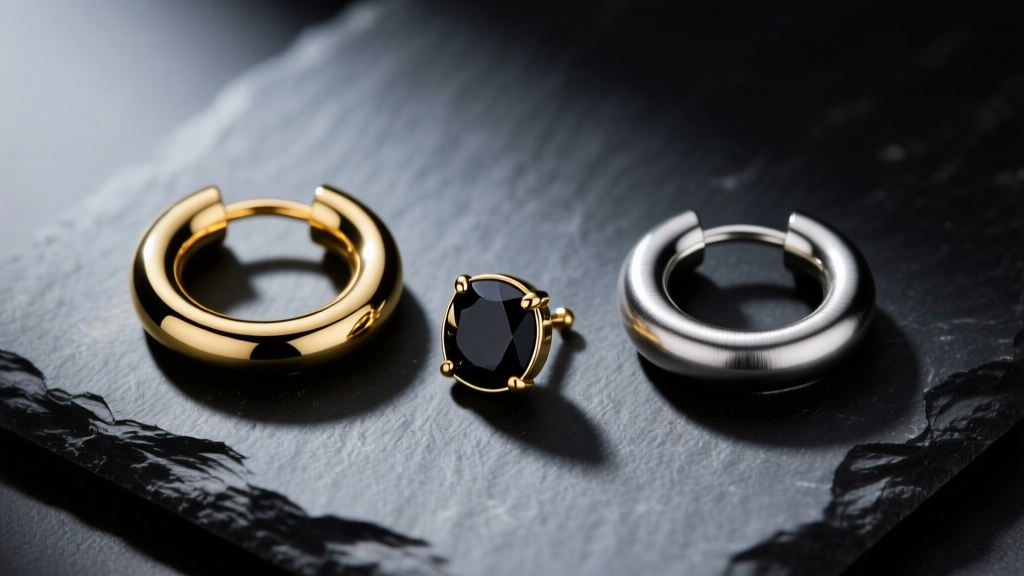
Technical Specifications: Gauges, Materials, and Fit
When transitioning from the philosophical debate of left versus right to the physical reality of getting pierced, technical specifications matter. Men's earlobes and cartilage often require different approaches than traditional women's jewelry, particularly regarding post thickness and material purity.
Understanding Gauge Sizes
The 'gauge' refers to the thickness of the jewelry post. Standard mall-kiosk piercings are often done at 20g (0.81mm) or 18g (1.02mm). However, many men prefer a slightly thicker, more substantial look for their lobes. An 18g or 16g (1.29mm) post provides a sturdier, more masculine aesthetic and reduces the 'cheese-cutter effect' (where thin jewelry slowly migrates through the lobe tissue over time). For cartilage piercings like the helix, tragus, or conch, 16g is the industry standard for optimal healing and stability.
Material Grades: What to Put in Your Body
According to the Association of Professional Piercers, material purity is non-negotiable. Avoid 'surgical steel,' which is a vague marketing term that often contains nickel and causes contact dermatitis. Instead, insist on:
- Implant-Grade Titanium (ASTM F136): The gold standard for initial piercings. It is completely nickel-free, lightweight, and highly biocompatible.
- Niobium: A highly reactive metal that is hypoallergenic and can be anodized to create deep, permanent colors like black or gunmetal.
- Solid 14k or 18k Gold: Must be nickel-free and alloyed for body safety. Avoid gold-plated brass or silver, as the plating will eventually wear off, exposing the skin to irritating base metals.
Men's Earring Material & Gauge Cheat Sheet
| Piercing Type | Recommended Gauge | Best Material for Healing | Best Material for Long-Term Wear |
|---|---|---|---|
| Standard Lobe | 18g (1.0mm) or 16g (1.2mm) | ASTM F136 Titanium | Solid 14k/18k Gold, Niobium |
| Helix / Cartilage | 16g (1.2mm) | ASTM F136 Titanium | Solid 14k Gold, Platinum |
| Tragus / Conch | 16g (1.2mm) | ASTM F136 Titanium | Solid 14k Gold, Anodized Niobium |
| Industrial | 14g (1.6mm) | ASTM F136 Titanium | Solid 14k Gold (Custom Fit) |
Face Shape & Placement Matrix
Instead of asking 'left or right,' ask 'what complements my face shape?' The placement and style of your earring can subtly alter the perceived proportions of your face. Here is a practical framework for selecting your jewelry based on your bone structure:
- Square Jawlines: Angular faces benefit from softening elements. Opt for medium-sized hoops (10mm-15mm) or curved huggies in the lobe. Avoid sharp, geometric studs that exaggerate the jaw's angles.
- Round Faces: Create the illusion of length and structure with angular, geometric studs or elongated drop earrings. A sharp, matte-black onyx stud in a bezel setting works exceptionally well.
- Oval Faces: The most versatile shape. You can pull off almost any style, from tight 8mm clicker rings in the helix to bold, oversized lobe hoops.
- Heart-Shaped Faces: Balance a wider forehead and narrower chin with bottom-heavy jewelry, such as teardrop dangles or thicker lobe huggies that draw the eye downward.
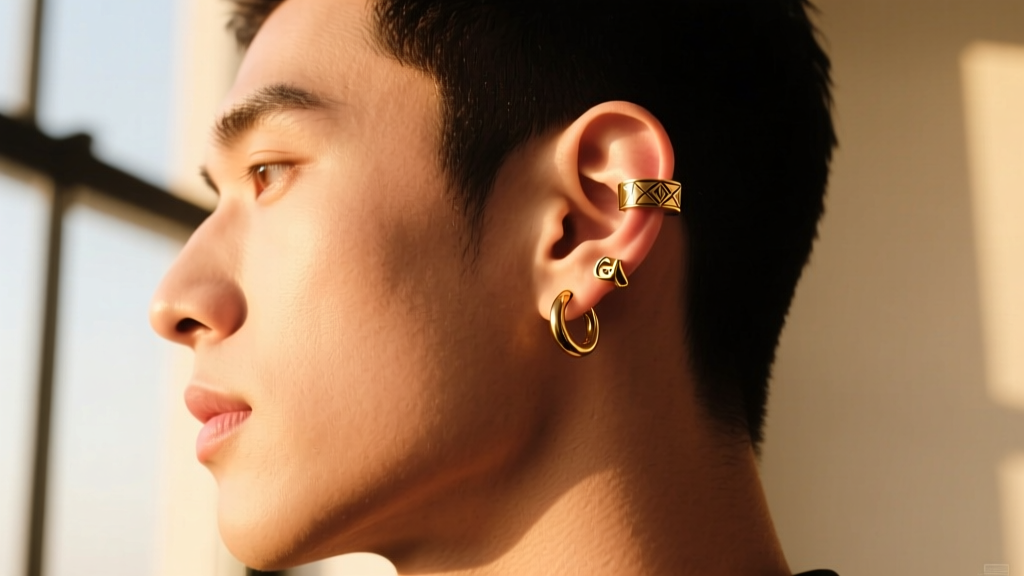
Breaking the Binary: Styling Rules for the Modern Man
Once you have abandoned the left-or-right myth, you can focus on building a cohesive jewelry wardrobe. Here are the core pillars of men's ear styling in 2026:
1. The Single Statement Piece
For men in conservative corporate environments who still want to express personal style, a single, high-quality piece in one lobe is the ultimate move. A 3mm or 4mm bezel-set diamond or black diamond stud in 14k white or yellow gold offers a subtle flash of luxury without overwhelming the face. Wear it on your 'dominant' side (the side you part your hair away from) to maintain visual balance.
2. The Mixed-Metal Curated Ear
Mixing metals was once considered a fashion faux pas; today, it is a hallmark of advanced styling. Pairing a yellow gold lobe hoop with a white gold or titanium helix cuff creates a layered, textured look that feels organic and lived-in. Brands like BVLA offer interchangeable ends, allowing you to mix gold and titanium seamlessly across different piercings.
3. Embracing the Flat-Back Labret
For cartilage piercings, the traditional butterfly-back earring is a comfort nightmare, especially for men who sleep on their sides or wear over-ear headphones. The 2026 standard is the flat-back labret. These feature a flat titanium disc that sits flush against the back of the ear, eliminating poking and snagging while providing a clean, minimalist aesthetic from the front.
Final Verdict: Which Side Should You Pierce?
So, when it comes to a man earring left or right, what is the final verdict? The answer is entirely up to you. If you are getting your first piercing, consider your hairstyle. If you have a distinct side part, piercing the 'open' side of your face (the side where your hair is swept away) ensures the jewelry is actually visible. If you wear your hair short or pushed back, bilateral symmetry (both ears) offers a balanced, classic look that suits almost any face shape.
Ultimately, the side you choose should be dictated by your anatomy, your comfort, and your personal aesthetic. Leave the outdated codes in the 20th century where they belong, and focus on investing in high-quality, implant-grade jewelry that elevates your personal style in 2026 and beyond.


