Navigating the Earring Plaza in Manhattan: A Beginner's Guide
Discover how to navigate the earring plaza in Manhattan. Learn expert tips on metal grades, gauge sizes, and negotiation for your next fine jewelry purchase.


The Myth and Reality of the Manhattan Earring Plaza
When jewelry enthusiasts and first-time buyers search for an earring plaza in manhattan, they are often envisioning a single, massive indoor mall dedicated solely to ear adornments. While Manhattan does not have one singular building officially named the "Earring Plaza," the search intent points directly to the dense, arcade-style jewelry exchanges and bustling street corridors that serve the exact same purpose. For a beginner, stepping into these high-density jewelry hubs—most notably the 47th Street Diamond District, the artisan corridors of Soho, or the bustling stalls of Canal Street—can feel overwhelming. Security buzzers, rapid-fire negotiations, and endless glass cases filled with glittering metals are the norm.
As of 2026, the landscape of New York's jewelry districts has evolved. The rise of premium lab-grown diamonds and advanced hypoallergenic alloys means buyers have more options than ever, but also more variables to verify. This guide will decode the Manhattan jewelry exchange experience, equipping you with the metallurgical knowledge, gauge specifications, and negotiation tactics required to secure high-quality earrings without falling into tourist traps.
Decoding the Displays: Metals and Materials 101
Before you approach a counter, you must understand what you are looking at. The metal composition of an earring post is critical, especially for fresh piercings or sensitive ears. According to the Gemological Institute of America (GIA), pure 24-karat gold is far too soft for earring posts; it will bend under the slight pressure of inserting it through a lobe. Therefore, alloyed gold is the industry standard.
- 14K Gold (58.5% Pure): The gold standard for earring posts. It offers the perfect balance of rich color and structural rigidity. A standard pair of 3mm 14K gold ball studs in the Diamond District should cost between $85 and $130 in 2026, depending on the market spot price.
- 18K Gold (75% Pure): Richer, deeper yellow, but softer. Best for bezel-set diamond studs where the post is thick and short, but not ideal for long, thin wire hooks.
- White Gold Alloys: Beware of nickel allergies. Traditional white gold is alloyed with nickel to achieve a silver color, which causes contact dermatitis in roughly 15% of the population. Always ask the jeweler if their white gold is alloyed with palladium instead of nickel.
- Implant-Grade Titanium (ASTM F136): If you are buying for a healing cartilage piercing or have severe metal sensitivities, skip the gold entirely and seek out ASTM F136 titanium. It is entirely nickel-free and biocompatible.

The Anatomy of an Earring: Gauges and Backings
One of the most common mistakes beginners make in a Manhattan jewelry exchange is assuming all earring posts are the same thickness. Piercing jewelry is measured in "gauge" (G), where a higher number indicates a thinner post. If you buy a post that is too thick for your healed piercing, insertion will cause micro-tears and irritation.
| Gauge Size | Millimeter (mm) | Standard Use Case | Common Backing Type |
|---|---|---|---|
| 20G | 0.81 mm | Standard lobe piercings, lightweight dangles, and most commercial fashion earrings. | Friction (Butterfly) Back |
| 18G | 1.02 mm | Thicker lobe posts, standard cartilage (helix/tragus), and nose studs. | Flat-back Labret or Screw Back |
| 16G | 1.29 mm | Healing cartilage piercings, daith, and conch piercings. Rarely used for standard lobes. | Threadless Push-Pin or Internally Threaded |
Why Backing Mechanics Matter
In a busy city like New York, losing an earring to a loose backing is a common tragedy. For valuable diamond or gemstone studs, insist on screw-backs or locking la-pousette backs. These feature a tiny mechanism that clicks into a groove on the post, making it virtually impossible for the earring to fall off if snagged on a winter scarf or hairbrush.
Haggling, Hallmarks, and Avoiding Tourist Traps
The arcade-style jewelry malls on 47th Street operate differently than boutique stores in Soho. Overhead is lower, and pricing is often fluid. However, this environment requires a sharp eye for authenticity.
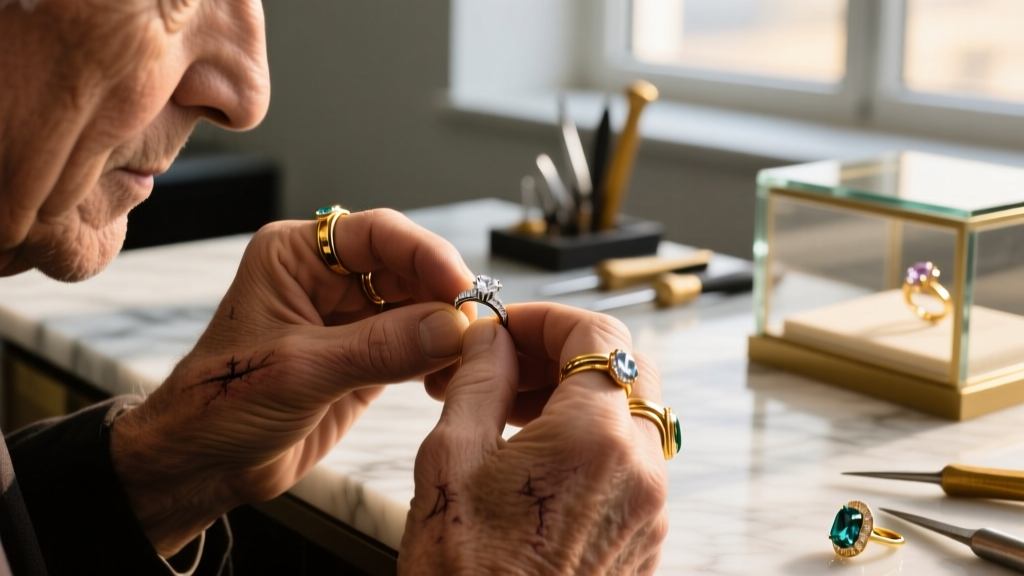
"Never purchase precious metal jewelry in a high-density exchange without verifying the hallmark stamp under a 10x jeweler's loupe. The stamp must match the seller's verbal claim."
The Federal Trade Commission (FTC) strictly regulates precious metal marking in the United States. If a vendor claims a piece is 14K gold, you must see a "14K", "14KT", or "585" stamp on the post or the thickest part of the hoop. If the piece is too thin to stamp, the vendor must provide a written receipt explicitly stating the metal purity.
The 2026 Lab-Grown Diamond Advantage
If you are shopping for diamond studs in Manhattan's jewelry plazas, 2026 is the year of the lab-grown diamond. Due to massive advancements in Chemical Vapor Deposition (CVD) technology, lab-grown diamonds are chemically and optically identical to mined diamonds but cost 60% to 80% less. A pair of 1-carat total weight (CTW) mined diamond studs might cost $2,500 in the Diamond District, while an identical pair of high-clarity (VS1) lab-grown studs can be negotiated down to $400–$600. Always ask the vendor if the stones are natural or CVD, and request a grading report from the IGI or GIA for any stone over 0.50 carats.
Step-by-Step Buying Strategy for First-Timers
To navigate the earring plazas and exchanges of Manhattan like a seasoned local, follow this precise execution plan:
- Do Your Spot-Price Homework: Check the daily spot price of gold before you leave your hotel. This gives you a baseline for the raw material cost, helping you gauge the vendor's markup on the craftsmanship.
- Dress the Part: Avoid looking like a lost tourist. Walk with purpose, and do not gasp or overly fawn over the first tray of jewelry a vendor shows you. Emotional attachment destroys negotiation leverage.
- Inspect the Posts: Ask to see the earring posts under the counter's LED task lighting. Look for pitting, uneven soldering near the bezel, or bent friction posts. A slightly bent 20G post is a sign of poor manufacturing and should be rejected.
- Offer Cash for a Discount: Credit card processing fees eat into the thin margins of exchange-booth jewelers. Offering to pay in physical cash can often yield an immediate 10% to 15% discount on the quoted price.
- Get It in Writing: Ensure your final receipt includes the exact metal weight (in grams), the metal purity (e.g., 14K), the gemstone origin (natural vs. lab-grown), and the vendor's physical booth number and contact information.
Final Thoughts
Finding the perfect pair of earrings in the bustling jewelry hubs of New York City is a rite of passage. While there may not be a single building officially mapped as the earring plaza in manhattan, the collective energy of the Diamond District and the artisan alleys of Lower Manhattan offer an unmatched shopping experience. By understanding gauge thicknesses, demanding hypoallergenic alloys, and leveraging cash negotiations, you will walk away with heirloom-quality pieces at a fraction of the retail boutique price.


