Mastering Beading Earrings: Threads, Tension, and Findings
Explore the technical construction of beading earrings. Learn about seed bead sizes, thread types, tension control, and hypoallergenic findings.

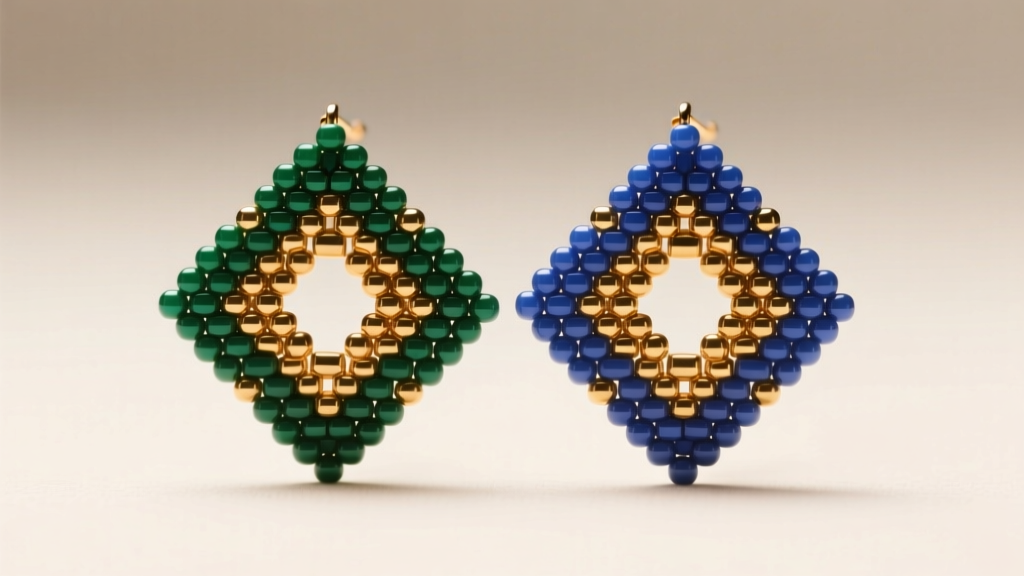
The Architecture of Structural Bead-Weaving
When master artisans and serious collectors discuss beading earrings, they are rarely referring to simple strung beads on a headpin. True beaded jewelry represents a complex intersection of textile arts, polymer chemistry, and metallurgy. Unlike mass-produced earrings that rely on rigid wire-wrapping or basic stringing, structural bead-weaving creates a flexible, fabric-like matrix that moves fluidly with the wearer while maintaining rigorous geometric integrity.
The foundation of high-end beading earrings relies on three primary off-loom stitching techniques: peyote stitch, brick stitch, and right-angle weave (RAW). Peyote stitch offers a supple drape, making it ideal for cascading drop earrings. Brick stitch provides a rigid, interlocking lattice perfect for geometric shapes and fringe bases, as the thread passes through the bead rather than locking the beads tightly against one another. Right-angle weave creates three-dimensional volume and structural resilience, often used in statement chandelier earrings. Understanding the mechanical properties of these stitches is the first step in mastering beading earrings.
Material Science: Decoding the Aught System
The structural integrity of beaded earrings begins with the beads themselves. The global standard for seed beads relies on the "aught" system (e.g., 11/0, 15/0), where the smaller the denominator, the larger the bead. For precision bead-weaving, Japanese cylinder beads—specifically Miyuki Delicas and Toho Treasures—are the undisputed industry standard. Unlike traditional round rocaille beads, cylinder beads feature uniform diameters and large, smooth holes that allow for multiple thread passes without fraying.
| Bead Size | Type | Diameter (mm) | Hole Size (mm) | Best Application in Earrings |
|---|---|---|---|---|
| 15/0 | Cylinder | 1.30 | 0.70 | Intricate bezel work, micro-fringe, and high-detail pictorial pieces. |
| 11/0 | Cylinder | 1.60 | 0.80 | The workhorse size for peyote and brick stitch structural bases. |
| 8/0 | Round Rocaille | 3.10 | 1.00 | Textural accents, structural RAW joints, and heavy fringe weights. |
While Japanese beads offer uniformity, Czech fire-polished glass beads are frequently incorporated for their faceted light refraction. However, Czech glass often presents a hidden danger: microscopic sharp edges around the drill hole. According to the GIA Gem Encyclopedia, the hardness and fracture patterns of man-made glass can act like tiny razors against inferior threads, leading to catastrophic earring failure if not properly managed.
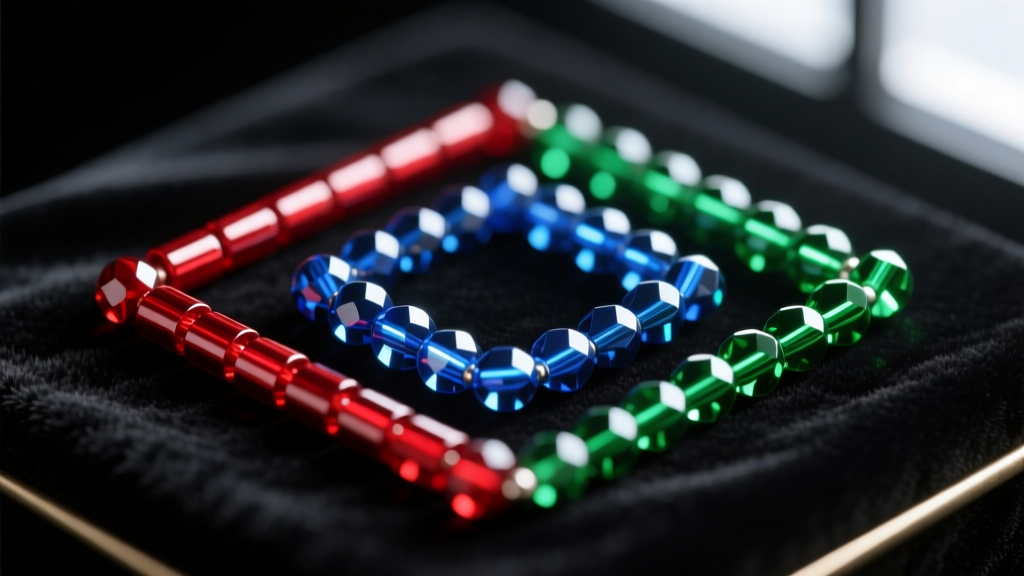
Thread Polymer Chemistry and Tension Dynamics
The most common point of failure in beading earrings is thread degradation. Traditional silk and cotton threads are entirely obsolete in modern structural bead-weaving due to their susceptibility to rot, stretch, and abrasion. Today, expert beaders rely on advanced synthetic polymers.
Gel-Spun Polyethylene (GSPE)
Threads like Fireline (6lb test) and WildFire are engineered from gel-spun polyethylene. These threads boast an incredibly high tensile strength-to-diameter ratio and exhibit zero stretch. A 6lb Fireline thread has a diameter of just 0.006 inches, allowing it to pass through a 15/0 seed bead up to six times. The lack of stretch is critical; it ensures that the tension applied during the weaving process remains permanent, preventing the beadwork from warping or sagging over time.
Bonded Nylon
Nymo D is a bonded nylon thread that offers a softer drape, making it preferable for earrings that require a fabric-like flow. However, nylon possesses a natural "memory" and stretch. To mitigate this, artisans must pre-stretch the thread and condition it with microcrystalline wax to reduce friction and prevent the thread from untwisting during the repetitive passes required for brick stitch.
Ear Wire Metallurgy and Weight Distribution
Connecting a delicate matrix of seed beads to the human ear requires careful consideration of metallurgy and biomechanics. Beading earrings, particularly those featuring long fringe or dense RAW components, can exert significant localized pressure on the earlobe. The choice of earring finding dictates both biocompatibility and structural longevity.
- Niobium: A highly reactive, hypoallergenic metal that can be anodized to produce vibrant colors without the use of toxic dyes or plating. Niobium ear wires are exceptionally lightweight, making them ideal for oversized beaded statement earrings that might otherwise drag on the lobe.
- Grade 23 Titanium (Ti-6Al-4V ELI): The gold standard for sensitive ears and fresh piercings. This aerospace-grade alloy is completely nickel-free and highly resistant to corrosion from skin oils and environmental humidity. It is slightly stiffer than niobium, providing excellent support for heavy, multi-tiered beaded drops.
- 14/20 Gold-Filled Leverbacks: Unlike gold-plated findings, which feature a microscopic flash of gold that wears away, 14/20 gold-filled wire contains a substantial mechanical layer of 14k gold bonded to a brass core. Leverback closures are essential for beading earrings, as the secure latch prevents the earring from being dislodged by the weight of the beadwork swinging during movement.
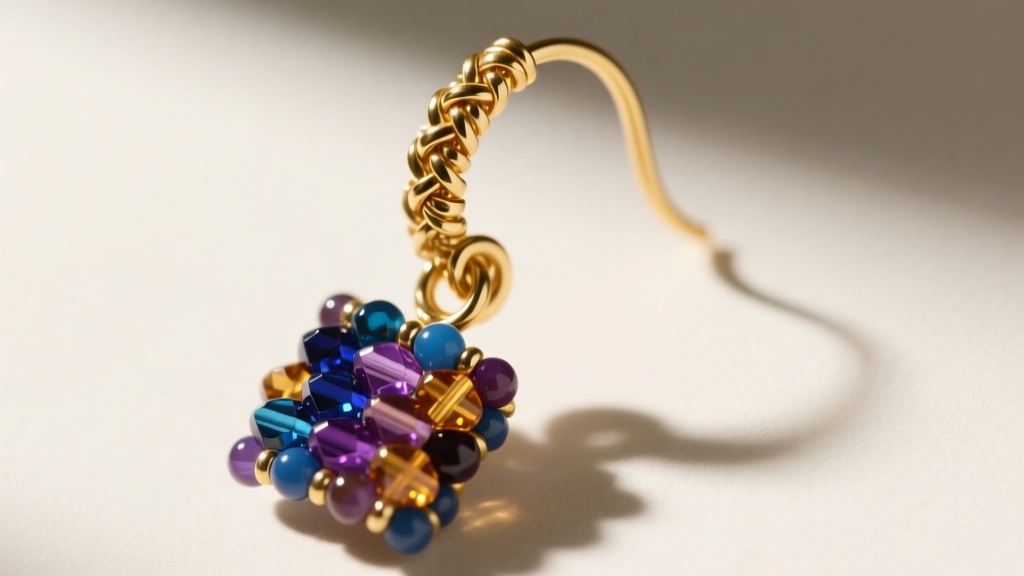
Troubleshooting Common Beading Failures
Even experienced artisans encounter structural anomalies when crafting beading earrings. Recognizing and correcting these issues separates amateur crafts from master-level jewelry design.
The Warping Effect
If a flat brick-stitch earring base begins to curl or warp into a concave bowl shape, the artisan has applied excessive tension. Because GSPE threads do not stretch, pulling the thread too tightly forces the beads out of their natural geometric alignment. The solution is to maintain a relaxed, consistent tension and use a bead mat to stabilize the work surface.
Thread Snap at the Finding
The transition point between the flexible beadwork and the rigid metal ear wire is a high-stress zone. If the thread is tied directly to a sharp metal loop, the repetitive friction of walking and movement will eventually sever the polymer. To prevent this, experts utilize a "wire guardian" or a carefully executed wrapped loop using 24-gauge dead-soft gold-filled wire to create a smooth, rolling hinge that absorbs kinetic energy without compromising the structural thread.
"The longevity of a beaded earring is not determined by the beauty of the glass, but by the unseen architecture of the thread path and the metallurgical quality of the finding."
By mastering the interplay between bead geometry, polymer thread chemistry, and hypoallergenic findings, artisans can create beading earrings that are not only visually breathtaking but engineered to withstand the rigors of daily wear for decades.


