Matching Small Heart Earrings With Larger Heart Necklace Fashion Guide
Solve proportion issues with our matching small heart earrings with larger heart necklace fashion guide. Expert tips on metals, gauge, and visual weight.

The Visual Weight Dilemma: Why Proportion Fails
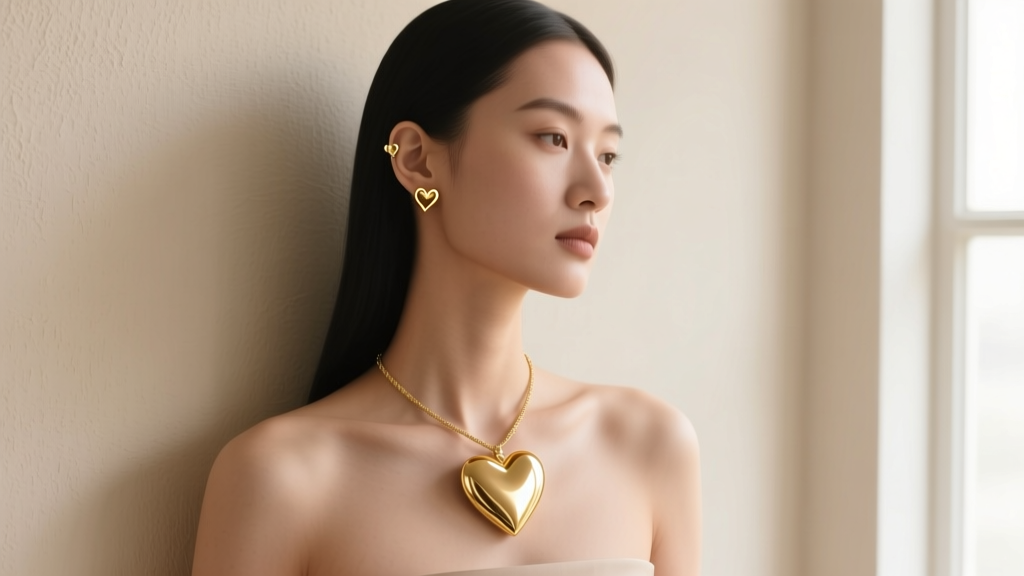
One of the most common styling frustrations in fine jewelry is attempting to balance sentimental or statement pieces with everyday staples. If you have found yourself searching for a matching small heart earrings with larger heart necklace fashion guide, you are likely experiencing the 'lollipop effect.' This occurs when a heavy, oversized pendant (typically 20mm to 30mm) draws all the visual gravity to the décolletage, leaving dainty 4mm or 5mm heart studs looking disconnected and disproportionately fragile near the face.
The core issue is not the motif itself, but the visual weight distribution. The human eye naturally tracks the largest, most reflective object in a styling ensemble. When the scale gap between the necklace and the earrings exceeds a 4:1 ratio, the styling feels accidental rather than intentional. To troubleshoot this, we must stop trying to force a direct 'match' and instead focus on bridging the visual gap through metallurgical consistency, hardware scaling, and strategic secondary styling.
Troubleshooting Metal Grade and Finish Clashing
When scaling down the earrings, the metal color must be absolutely identical to the necklace to maintain a cohesive line of sight. A frequent failure point occurs when mixing karat weights. According to the Gemological Institute of America (GIA), the alloy composition in gold drastically shifts the hue. An 18k yellow gold necklace (75% pure gold) possesses a rich, buttery yellow tone, while a 14k yellow gold earring (58.5% pure gold) often leans slightly paler or even greenish depending on the copper-to-silver alloy ratio.
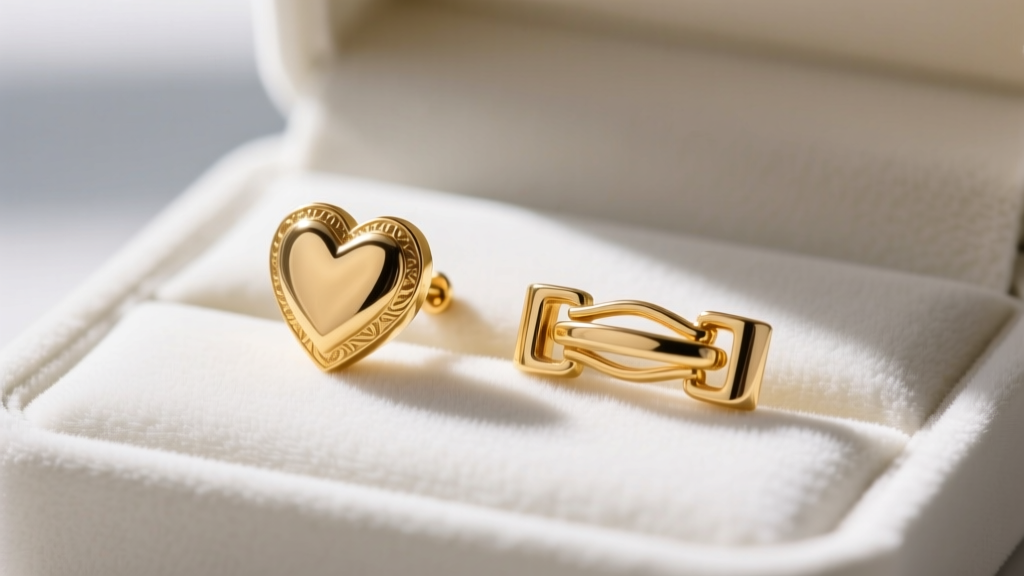
The Fix: Always verify the karat stamp on both pieces. If your large heart pendant is 18k, your small heart studs must also be 18k. If you are working with sterling silver, ensure both pieces share the same plating. A rhodium-plated sterling silver necklace will look stark, cool, and mirror-like, while an unplated or oxidized sterling silver earring will look dull and gray. If your studs are tarnished, a quick professional ultrasonic cleaning and rhodium re-dip (usually costing between $25 and $40 at a local bench jeweler) will instantly realign the finish.
The Hardware Mismatch: Chain Thickness vs. Earring Gauge
Proportion is not just about the heart motif; it is about the structural hardware supporting it. A common mistake is pairing a large heart pendant on a thick chain (such as a 3mm or 4mm Cuban link or rope chain) with standard 20-gauge (0.81mm) heart stud earrings. The heavy chain implies a rugged, substantial aesthetic, while the ultra-thin 20-gauge post and delicate butterfly backing of the earring feel flimsy by comparison.
As outlined in standard jewelry manufacturing charts like those from Rio Grande, gauge thickness dictates the perceived durability of a piece. To troubleshoot this hardware dissonance, you need to upgrade the earring post or the backing.
- Upgrade to 18-Gauge Posts: If your ear piercings allow, swap your dainty heart studs for custom-fitted 18-gauge (1.02mm) heart studs. The slightly thicker post visually anchors the earring, making it look substantial enough to 'converse' with a heavier chain.
- Use La Poussière or Screw Backs: Standard friction backs look cheap and small. Upgrading to 14k gold screw-backs or large 6mm La Poussière clutch backs adds physical width to the earring profile, artificially increasing its visual weight without changing the heart motif itself.
The 'Bridge Piece' Strategy: Fixing the Scale Gap
If you only have one earlobe piercing per ear, bridging a 5mm heart stud and a 25mm heart pendant is nearly impossible without adding an intermediary element. The solution is the 'Bridge Piece' strategy, which utilizes secondary piercings to create a gradient of scale that leads the eye smoothly from the ear down to the neckline.
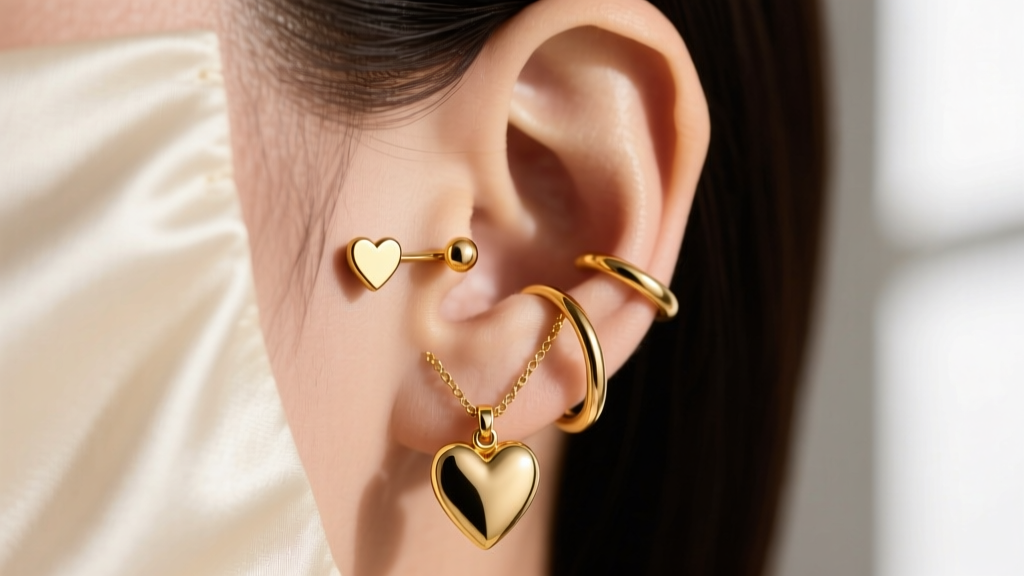
How to Execute the Gradient:
- Lobe Piercing 1 (The Anchor): Your 5mm small heart stud.
- Lobe Piercing 2 (The Bridge): A 3mm to 4mm gold huggie hoop or a bezel-set round brilliant diamond stud (approx. 0.10 carat / 3mm). This introduces a new shape but maintains the metal color, acting as a visual stepping stone.
- Upper Lobe or Helix (The Echo): A tiny 2mm gold bead or a subtle cartilage cuff. This pulls the visual weight upward, balancing the heavy downward pull of the large heart necklace.
Stylist Insight: Never wear a large heart pendant with a bare ear. The negative space around the ear will make the necklace look like it belongs to a completely different outfit. Always introduce at least 4mm of metallic mass to the earlobe to reflect the pendant's light.
Face Shape and Neckline Interference Matrix
Matching small heart earrings with a larger heart necklace also requires troubleshooting the geometry of your face and the neckline of your garment. A large pendant resting on a high crew neck will compete with small earrings, whereas a deep V-neck creates a natural frame. Use the matrix below to troubleshoot your specific styling scenario.
| Face Shape | Ideal Necklace Drop | Earring Troubleshooting Fix |
|---|---|---|
| Round | 18 to 20 inches (V-shape) | Add a 6mm vertical drop chain to the heart stud to elongate the jawline. |
| Square | 16 to 18 inches (Collarbone) | Use 5mm heart studs with softened, rounded edges to offset angular jaws. |
| Heart | 14 to 16 inches (Choker/Princess) | Keep studs under 4mm; avoid top-heavy earrings that widen the forehead. |
| Oval | Any length (Versatile) | Focus purely on metal matching; proportions will naturally balance. |
Real-World Styling Scenarios & Quick Fixes
To wrap up this guide, here are three common real-world scenarios and their immediate troubleshooting fixes:
- Scenario 1: The necklace is a two-tone heart (e.g., silver center, gold border), but your studs are solid gold.
Fix: Introduce a mixed-metal bridge ring on your finger or a two-tone watch to tie the disparate metals together. Do not attempt to find two-tone heart studs, as they often look dated and cluttered at a 5mm scale. - Scenario 2: The large heart pendant features pavé diamonds, but the small heart studs are plain metal.
Fix: The sparkle disparity will make the plain studs look like dull hardware. Swap the plain heart studs for a pair of 3mm diamond solitaire studs. The motif mismatch (heart vs. round) is actually preferable to a 'sparkle mismatch,' as the diamonds will echo the pavé on the pendant. - Scenario 3: You are wearing a high-neck turtleneck, and the large heart pendant sits awkwardly on the fabric.
Fix: High necklines absorb light and hide chain details, making the pendant look like a floating, heavy object. In this case, remove the large pendant and layer two delicate chains instead, allowing your small heart studs to act as the primary focal point of the ensemble.
By focusing on metallurgical consistency, hardware gauge, and strategic gradient styling, you can seamlessly integrate dainty ear aesthetics with bold neckline statements without sacrificing sophistication or proportion.


