How to Measure, Insert, and Style Bangle Earrings Safely
Learn how to measure, safely insert, and style thick bangle earrings. Expert tips on gauge sizes, continuous hoop insertion, and face-shape matching.


What Exactly Are Bangle Earrings?
In the evolving landscape of 2026 body jewelry trends, bangle earrings have emerged as a dominant force. Unlike standard lightweight hoops or delicate huggies, bangle earrings are defined by their rigid, thick, and continuous circular architecture. Mimicking the substantial profile of a wrist bangle, these earrings typically range from 12-gauge to 6-gauge in thickness, offering a bold, sculptural aesthetic. They are worn either as continuous rings through stretched or standard lobe piercings, or as seamless cartilage cuffs that wrap around the helix.
Because of their substantial metal volume and rigid structure, bangle earrings require a completely different approach to sizing, insertion, and daily wear compared to traditional wire hoops. Mishandling them can lead to warped metal, misaligned seams, and severe piercing trauma. This comprehensive guide will walk you through the exact mechanics of measuring, inserting, and styling bangle earrings to ensure both the longevity of your jewelry and the health of your piercings.
Step 1: Decoding Gauge and Diameter Measurements
The most common mistake consumers make when purchasing bangle earrings is confusing Internal Diameter (ID) with Outer Diameter (OD), or underestimating the visual weight of the gauge. Because bangles are exceptionally thick, a hoop with a 10mm ID and a 4mm thickness will actually have an 18mm OD, drastically changing how it sits on the ear.
The Bangle Thickness and Pricing Matrix
Below is a professional breakdown of standard bangle earring gauges, their exact millimeter thickness, ideal placements, and current market pricing for high-quality, solid 14k gold options.
| Gauge Size | Thickness (mm) | Best Placement | Avg. Price Range (Solid 14k) |
|---|---|---|---|
| 12g | 2.05mm | Standard Lobe, Helix | $85 - $140 |
| 10g | 2.57mm | Stretched Lobe (0g-8g), Conch | $120 - $220 |
| 8g | 3.26mm | Moderate Stretch, Cartilage Cuff | $180 - $350 |
| 6g | 4.11mm | Heavy Stretch, Outer Conch Cuff | $250 - $500+ |
According to the Association of Professional Piercers (APP), ensuring the correct Internal Diameter is critical. If the ID is too tight, the thick metal will press against the tissue, causing pressure necrosis and migration. Always measure your ear from the center of the piercing hole to the outer edge of the ear, then add 1-2mm for a comfortable bangle fit.
Step 2: The Safe Insertion Method for Continuous Bangles
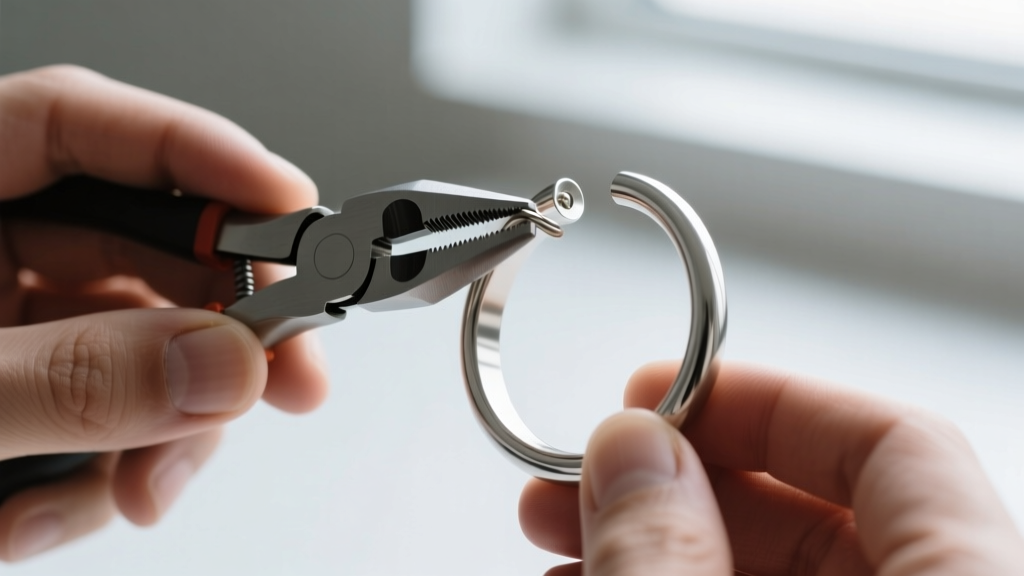
Continuous bangle earrings do not feature hinges or clickers; they rely on a precision-machined tension seam where a slightly undersized pin slots into a hollow tube. Forcing this seam open by pulling the ends apart will permanently warp the rigid metal, ruining the circular geometry and preventing the seam from ever closing flush again.
The Lateral Twist Technique
Follow this exact step-by-step protocol to insert your bangle earrings safely:
- Sanitize and Lubricate: Wash your hands and the jewelry with sterile saline. Apply a microscopic amount of water-based lubricant to the insertion pin to reduce friction.
- The Lateral Twist: Grip the bangle with both hands. Instead of pulling the ends away from each other (outward), twist one hand toward you and the other away from you. This lateral torsion opens the gap just enough to slide the pin through the piercing without altering the circle's shape.
- Threading the Piercing: Gently guide the insertion pin through the fistula. Because bangles are thick (often 2.5mm+), never force the metal. If you meet resistance, the gauge is too large or the piercing has shrunk.
- Align and Snap: Once the jewelry is fully through, reverse the lateral twist to align the pin with the receiving tube. You should feel and hear a distinct, satisfying 'snap' as the tension seam locks into place.
Pro Tip: For 8-gauge and 6-gauge bangles, manual twisting is nearly impossible due to the metal's rigidity. You must use specialized continuous ring opening and closing pliers, available from professional jewelry suppliers like Rio Grande, to manipulate the seam without marring the gold or titanium.
Step 3: Cartilage vs. Lobe Placement Guide
Bangle earrings are incredibly versatile, but their rigid nature means they behave differently depending on the anatomy they adorn.
Helix and Conch Bangle Cuffs
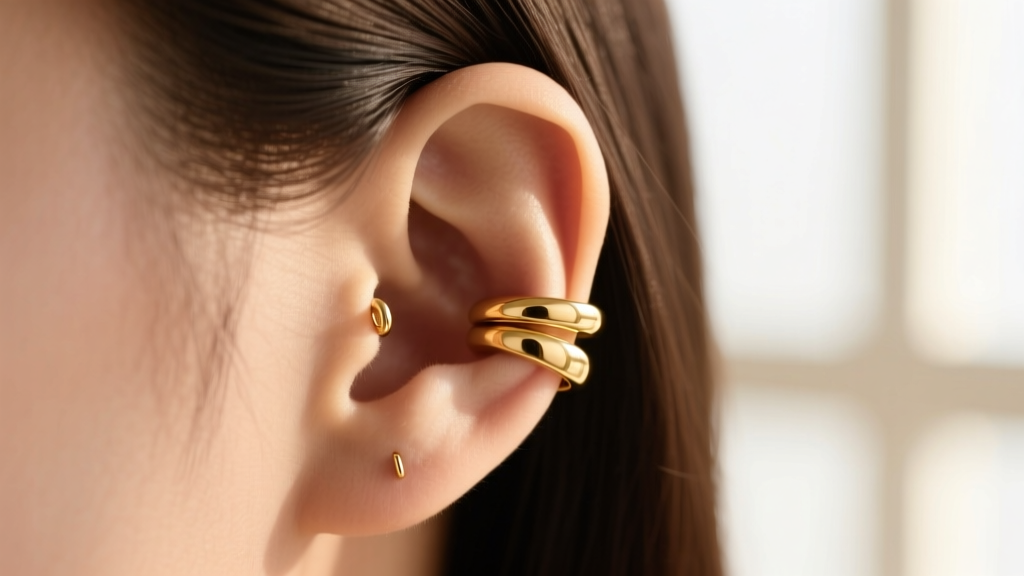
When worn as a cartilage cuff (often without a piercing, or wrapping around a helix piercing), the bangle must be custom-bent to match the curvature of the ear's outer rim. Unlike flexible wire cuffs, a solid bangle cuff relies on exact anatomical mapping. A 10-gauge niobium or gold bangle cuff should be gently squeezed around the cartilage ridge, ensuring the gap sits at the front of the ear for a seamless, continuous illusion.
Stretched Lobe Bangles
For stretched lobes, bangle earrings provide a sleek alternative to heavy glass plugs or stone tapers. The weight of a solid 14k gold bangle is distributed evenly around the bottom of the fistula, promoting healthy tissue circulation compared to bottom-heavy teardrop stretchers. However, sleeping in thick bangles is highly discouraged, as the rigid metal can press into the neck and cause the piercing to migrate at an angle.
Step 4: Styling Bangle Earrings for Your Face Shape
The visual weight of a bangle earring can dramatically alter facial proportions. Because they lack the dangling movement of drop earrings, their geometric presence is front and center.
- Round Faces: Opt for bangles with a larger Internal Diameter (14mm+) that elongate the jawline. Alternatively, choose geometric or hexagonal bangles (a massive trend in 2026) to introduce sharp angles that contrast with soft facial curves.
- Square Faces: Smooth, perfectly round, and highly polished bangle earrings work best. The continuous curve softens strong jawlines and angular cheekbones. Avoid thick, square-shaped bangles, which will only exaggerate facial sharpness.
- Heart-Shaped Faces: Medium-sized bangles (10mm-12mm ID) that sit close to the earlobe draw attention upward toward the eyes and cheekbones, balancing a narrower chin. Stacking a 12g bangle with a smaller 16g huggie creates a beautiful, layered volume.
Material Grades and Failure Modes
Because bangle earrings require significant force to open and close, the metallurgical integrity of the piece is paramount. Gold-plated or vermeil bangles are a poor investment; the friction of the tension seam, combined with the thickness of the metal, will quickly strip the plating away at the closure point, exposing base metals that cause contact dermatitis.
Always invest in ASTM F138 implant-grade titanium or solid, nickel-free 14k/18k gold. According to the Gemological Institute of America (GIA), high-karat gold alloys used in premium body jewelry are specifically formulated for hardness and biocompatibility, ensuring the tension seam remains tight and secure over years of daily wear.
"A well-machined bangle earring should last a lifetime. If the seam begins to catch on your hair or clothing, the metal has been warped through improper lateral insertion. Never use standard jewelry pliers to squeeze a continuous hoop closed; the serrated teeth will permanently destroy the mirror finish."
Troubleshooting Common Bangle Issues
Issue: The seam won't close flush.
Solution: The ring was pulled outward instead of twisted laterally. Use nylon-jaw pliers to gently squeeze the ring back into a perfect circle, then use the lateral twist method to snap the pin back into the tube.
Issue: The piercing feels tight and throbs.
Solution: The Internal Diameter is too small for the thickness of the bangle. The thick metal is compressing the tissue. Upsize the ID by at least 2mm to allow for natural swelling and tissue draping over the thick gauge.


