Troubleshooting Mens Big Hoop Earrings: Weight, Sizing & Care
Fix sagging lobes, green skin, and broken clasps. Our expert troubleshooting guide to mens big hoop earrings covers weight limits, gauges, and metals.

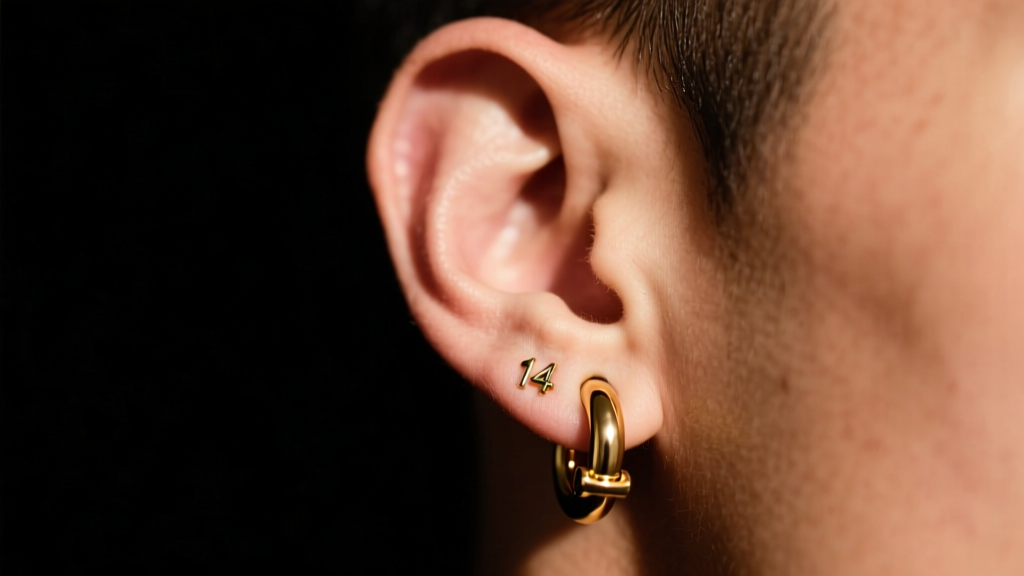
Upgrading to mens big hoop earrings is a definitive style move, but it introduces a unique set of mechanical and biological challenges that smaller studs or huggies simply do not present. Large-diameter hoops act as pendulums, subjecting the earlobe to dynamic shear forces, while increased surface area accelerates metal-to-skin friction and galvanic corrosion. If you are experiencing lobe migration, contact dermatitis, or persistent clasp failures, the issue is rarely your anatomy—it is a mismatch between jewelry engineering and physical stress.
This troubleshooting guide bypasses generic styling advice to address the structural and metallurgical failures common in large hoop earrings for men, providing actionable, data-driven solutions to protect your piercings and your investment.
The "Cheese Cutter" Effect: Solving Lobe Migration and Tearing
The most frequent complaint among men wearing hoops larger than 30mm in diameter is a gradual thinning of the earlobe piercing channel, clinically referred to as migration. This is caused by the "cheese cutter effect." When a heavy hoop swings, the localized pressure on the bottom of the piercing channel exceeds the tissue's tensile strength, slowly slicing through the collagen matrix.
Calculating Dynamic Weight Limits
A standard 20mm 18-gauge hoop weighs approximately 2.5 grams. However, a 40mm hoop crafted from dense materials like solid 14k gold or surgical steel can easily exceed 12 grams. While the human earlobe can tolerate static weight, dynamic weight (the force generated by walking, turning your head, or exercising) multiplies the shear stress on the fistula.
- Safe Dynamic Threshold: Keep the total weight of large hoops under 8 grams per earring to prevent long-term migration.
- Wire Thickness (Gauge): Never wear heavy, large-diameter hoops on standard 18G (1.0mm) or 16G (1.2mm) wires. The surface area is too small to distribute the load.
Actionable Fixes for Lobe Stress
If your lobes are aching or the piercing hole is elongating into a slit, you must immediately increase the wire thickness to distribute the gravitational load. Upgrade your jewelry to 14-gauge (1.6mm) or 12-gauge (2.0mm) wire. If your current piercing is stretched to an 18G and cannot accommodate a 14G post, visit a professional piercer to undergo a controlled taper stretch using borosilicate glass to safely reach a 12G or 10G (2.5mm) baseline before reinserting heavy hoops.
Metal Reactivity: Troubleshooting "Green Ear" and Contact Dermatitis
Men generally have higher sebum production and sweat rates than women, creating a highly acidic, saline-rich microenvironment around the earlobe. When this environment interacts with cheap alloy blends, it triggers galvanic corrosion, resulting in the dreaded "green ear" or severe contact dermatitis.

According to the American Academy of Dermatology, nickel allergy is the leading cause of allergic contact dermatitis. Many mass-market "surgical steel" hoops are stamped as 316L stainless steel. While 316L is generally safe for short-term wear, it contains 8-10% nickel. Over months of continuous wear, sweat can leach microscopic nickel ions from the alloy, triggering an itchy, flaky rash on the lobe.
The Metallurgy Upgrade Path
To permanently eliminate skin reactivity, you must audit your jewelry materials. Discard any hoops labeled "gold-plated brass" or "zinc alloy," as the plating will inevitably wear off at the friction points where the hoop passes through the ear.
Expert Rule of Thumb: If you are buying large hoops for daily wear, the only acceptable baseline materials are ASTM F-136 Implant-Grade Titanium, Niobium, or solid 14k/18k Nickel-Free Gold.
ASTM F-136 Titanium (Ti-6Al-4V ELI) is the gold standard for troubleshooting sensitive piercings. It is entirely nickel-free, highly resistant to saline corrosion, and weighs roughly 45% less than stainless steel, which simultaneously solves the dynamic weight issue outlined in the previous section.
Clasp and Hinge Mechanics: Why Your Hoops Keep Falling Out
Large hoops are notorious for catching on hoodies, towels, and headphones. When a hoop snags, the closure mechanism bears the brunt of the lateral force. If your hoops are frequently popping open or bending out of their circular geometry, you are likely using the wrong closure type for your lifestyle.
Diagnosing Closure Failures
- Continuous (Endless) Hoops: These rely on the metal's natural tension, where a thin pin slides into a hollow tube. The Failure: Repeated pulling causes metal fatigue, widening the gap until the pin no longer seats securely. The Fix: Retire them to occasional wear; do not use endless hoops for daily, active lifestyles.
- Hinged Segment Rings (HSRs): These feature a friction-fit latch. The Failure: If the gauge of the wire is slightly thinner than your actual piercing hole, the hinge joint will sit inside the fistula, causing irritation and allowing the latch to pop open under pressure. The Fix: Ensure the wire gauge perfectly matches or slightly exceeds your piercing gauge.
- Hinged Clickers: These use a mechanical snap closure that produces an audible "click." The Verdict: This is the most secure option for mens big hoop earrings, as the mechanical interlock resists lateral pulling far better than friction latches.
Proportional Scaling: Matching Hoop Diameter to Jawlines
A common styling failure occurs when the diameter of the hoop clashes with the wearer's facial geometry, creating visual imbalance. Big hoops draw the eye downward; selecting the correct millimeter span is critical for complementing your jawline and neck proportions.
| Face Shape | Ideal Hoop Diameter | Wire Thickness Recommendation | Troubleshooting Note |
|---|---|---|---|
| Square | 25mm - 35mm | 14G (1.6mm) or 12G (2.0mm) | Avoid perfectly round, massive hoops; opt for slightly oval or geometric shapes to soften sharp jaw angles. |
| Oval | 20mm - 40mm | 16G (1.2mm) to 12G (2.0mm) | Highly versatile. Ensure the bottom of the hoop does not extend past the mid-neck to avoid visual crowding. |
| Diamond | 30mm - 45mm | 12G (2.0mm) minimum | Wider, chunkier hoops add necessary visual weight to the lower half of the face, balancing prominent cheekbones. |
| Round | 20mm - 30mm | 14G (1.6mm) | Stick to smaller, structured hoops. Excessively large hoops will exaggerate the roundness of the facial structure. |
Longevity Protocol: Cleaning and Storage
Improper maintenance destroys the structural integrity and finish of large hoops. Many men mistakenly use ultrasonic cleaners or harsh chemical dips (like silver polish) on modern jewelry finishes, which can strip PVD (Physical Vapor Deposition) coatings and degrade gemstone settings.
The Association of Professional Piercers (APP) recommends strict, gentle cleaning protocols for body jewelry. For solid gold or titanium hoops, a simple soak in warm water with a few drops of mild, fragrance-free dish soap, followed by a gentle brush with a soft-bristled toothbrush, is sufficient to remove sebum and dead skin buildup from the closure mechanisms.
Storage to Prevent Metal Fatigue
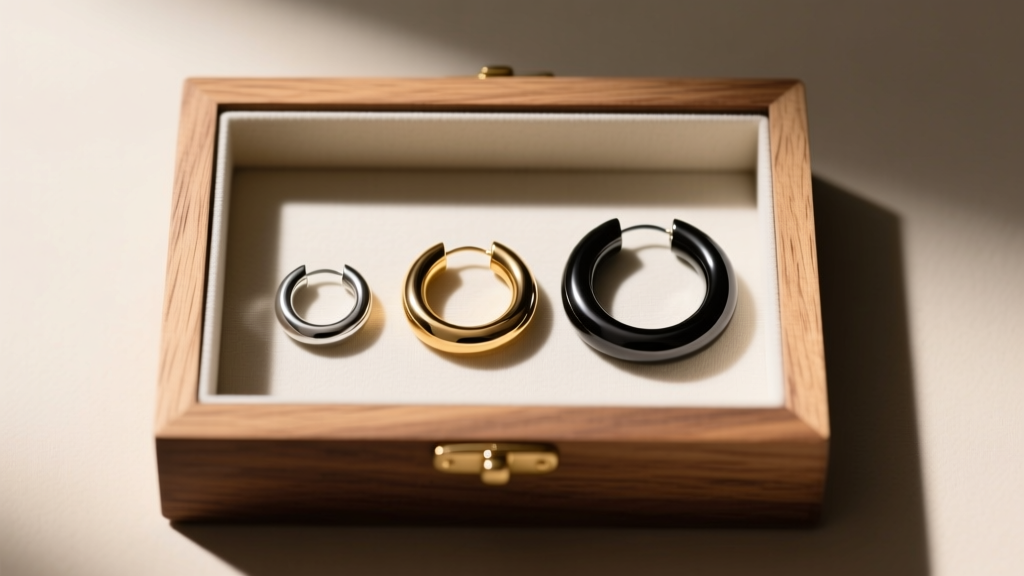
Never toss large hoops loosely into a drawer where they can become tangled and bent. Store them individually in a lined jewelry box or hang them from a dedicated rack. If you are wearing PVD-coated titanium (such as matte black or rose gold finishes), ensure the hoops do not rub against one another, as PVD is highly durable but can still scratch if subjected to repetitive metal-on-metal friction in a confined space.
By respecting the physics of weight distribution, upgrading to biocompatible metallurgy, and selecting the correct mechanical closures, you can wear mens big hoop earrings with total confidence, free from the pain of torn lobes and the frustration of broken clasps.


