Men's Black Earrings: The Ultimate 2026 Trend Guide
Explore 2026 trends in men's black earrings. Discover top materials like PVD titanium and black zirconium, gauge guides, and expert styling tips.


The Shift: Why Black is Dominating Men's Ear Styling in 2026
Men's jewelry has decisively shed the minimalist, overly cautious constraints of the previous decade. As we navigate 2026, the focus in masculine adornment has shifted toward intentional, architectural darkness. Men's black earrings are no longer just an afterthought, a subtle office-safe choice, or a fleeting rebellious phase; they are a cornerstone of modern masculine styling. From the dark academia influences seen on high-fashion runways to the utilitarian edge of streetwear tech-fashion, the monochromatic dark aesthetic is thriving.
The modern man is curating his ear stack with the same precision he applies to his watch collection or sneaker rotation. However, the market is flooded with subpar, poorly manufactured black jewelry that degrades within weeks. This guide cuts through the noise, providing a deep-dive analysis into the material science, anatomical sizing, and silhouette trends defining men's black earrings this year.
Material Science: Beyond Basic Black Plating
The biggest mistake consumers make when buying black jewelry is assuming all dark metals are created equal. The method used to achieve the black finish dictates the earring's longevity, biocompatibility, and price point. According to the Association of Professional Piercers (APP), implant-grade materials are non-negotiable for fresh or healing piercings, and they remain the gold standard for long-term wear.
PVD-Coated Titanium vs. Electroplating
Physical Vapor Deposition (PVD) is the industry standard for high-quality black metal jewelry. In this process, an ASTM F136 implant-grade titanium base is placed in a vacuum chamber where titanium nitride or zirconium nitride is vaporized and bonded to the surface at a molecular level. The result is a black finish that is up to ten times more durable than traditional electroplating. PVD-coated titanium pieces typically range from $30 to $80. Conversely, cheap electroplated black jewelry (often over brass or low-grade steel) will flake, turn your skin green, and harbor bacteria in the micro-fissures of the degrading plating. Always verify the base metal before purchasing.
Black Zirconium: The Ceramic Conversion
Black Zirconium is a marvel of modern metallurgy. It is not a coating or a plating. When zirconium metal is heated to extreme temperatures (around 1200°F), it undergoes a ceramic conversion, creating a hard, black oxide layer (ZrO2) on its surface. This layer is completely hypoallergenic, highly scratch-resistant, and possesses a unique, matte-to-satin luster that PVD coatings struggle to replicate. High-end black zirconium huggies and seamless rings usually retail between $45 and $120.
Gemstones: Navigating the Dark Stones
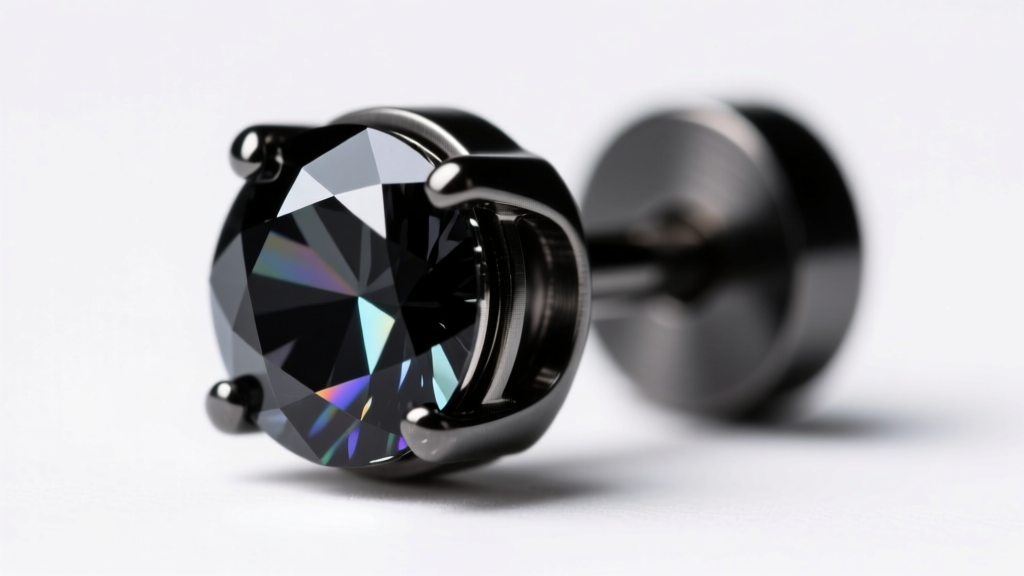
When incorporating stones into men's black earrings, the material choice drastically affects both the visual impact and the price. The Gemological Institute of America (GIA) notes that black spinel is often confused with black onyx or black diamond, but it offers superior natural luster and durability for jewelry.
- Black Onyx: Technically a dyed agate. It is opaque, affordable ($15–$40), and provides a flat, matte black look perfect for understated studs.
- Black Spinel: A natural gemstone with a sharp, glassy luster. It reflects light beautifully without the overwhelming sparkle of a white diamond. Expect to pay $60–$150 for quality cuts.
- Black Diamond (Carbonado): Porous, heavily included, and naturally opaque. While trendy, they are brittle and can chip if struck against hard surfaces. Prices start around $200 and scale rapidly.
Gauge Sizing and Anatomy: Getting the Fit Right
A common point of failure in men's ear styling is ignoring gauge thickness. Wearing a delicate 20-gauge earring in a stretched 14-gauge lobe piercing will cause the "cheese-cutter effect," where the thin wire slowly migrates through the tissue. Below is the definitive 2026 gauge chart for men's ear placements.
| Gauge | Millimeter | Primary Placement | Recommended Black Style |
|---|---|---|---|
| 20G | 0.81mm | Standard Lobe (Fine) | Black Onyx Threadless End |
| 18G | 1.0mm | Standard Lobe, Nostril | PVD Titanium Huggie Hoop |
| 16G | 1.2mm | Helix, Conch, Tragus | Black Zirconium Seamless Ring |
| 14G | 1.6mm | Industrial, Thick Lobe | Matte Black Barbell / Clicker |
2026 Silhouette Trends: What Men Are Actually Wearing
The era of the single, oversized diamond stud is firmly in the rearview mirror. Today's trends favor modularity, texture, and curated stacking.
The Dominance of Threadless Ends
Threadless (or push-pin) jewelry has completely revolutionized the piercing industry. Brands like Neometal and BVLA lead the market with PVD black titanium ends that snap securely into a universal titanium post via a slight bend in the pin. This mechanism eliminates the cross-threading and lost gems associated with traditional screw-in jewelry. For men, a 3mm or 4mm black spinel threadless end offers a sharp, masculine geometric profile that sits flush against the ear.
Architectural Huggies and Clickers
Huggies—small, tight-fitting hoops that "hug" the earlobe or helix—are a massive trend in 2026. The modern iteration features a hinged "clicker" closure, which provides a satisfying snap and a seamless look without the bulky ball closure of older hoop designs. A matte black zirconium clicker in a 10mm diameter is currently the most requested piece in high-end piercing studios for both lobe and cartilage placements.

Tension Ear Cuffs for the Unpierced
For men who want to experiment with the dark aesthetic without committing to a needle, tension-based ear cuffs have evolved. Unlike the flimsy wrap-around wires of the past, 2026's cuffs utilize precision-calibrated spring tension and PVD-coated titanium to grip the outer helix securely. They offer the illusion of a complex cartilage stack with zero healing time.
Maintenance and Failure Modes: Keeping the Dark Finish
Black jewelry requires specific maintenance to preserve its finish. Understanding how these pieces fail is crucial for long-term wear.
Expert Insight: "The most common cause of PVD coating failure isn't chemical; it's mechanical. Sleeping on a PVD-coated earring creates micro-abrasions against the cotton pillowcase and mattress pressure, eventually wearing through the black layer down to the silver titanium base."
Troubleshooting Zirconium: While the black oxide layer on zirconium is incredibly hard, it is technically a ceramic. If you drop a black zirconium ring onto a tile floor or strike it forcefully against a metal gym weight, the black layer can chip or crack, revealing the bright silver metal underneath. Unlike PVD, which can sometimes be re-coated by specialized manufacturers, a chipped zirconium oxide layer cannot be repaired and the piece must be replaced.
Cleaning Protocol: Never use ultrasonic cleaners or harsh chemical dips (like silver polish) on black jewelry. Ultrasonic vibrations can cause micro-fractures in gemstone settings, and chemicals can strip the luster from black spinel or onyx. The only approved cleaning method is a soak in warm water with a few drops of mild, fragrance-free dish soap, followed by a gentle wipe with a clean microfiber cloth.
Final Verdict
Men's black earrings in 2026 represent a mature, sophisticated approach to body jewelry. By prioritizing advanced materials like PVD-coated titanium and black zirconium, understanding the critical nuances of gauge sizing, and embracing modular silhouettes like threadless ends and clickers, you can build an ear stack that is as durable as it is stylish. Invest in quality, respect the anatomy of your piercings, and let the dark aesthetic speak for itself.


