Thread Earrings Trend Analysis: 2026 Chain & Threading Styles
Discover the 2026 thread earrings trend analysis. Explore chain gauges, cartilage threading techniques, and material grades for curated ear styling.

The 2026 Resurgence: Why Thread Earrings Dominate Curated Ears
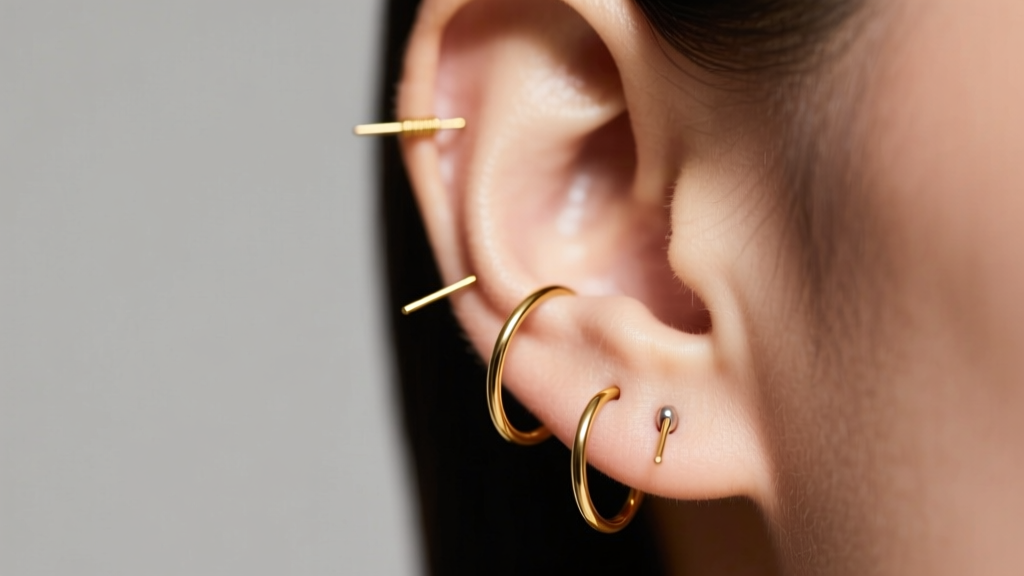
Thread earrings, often referred to as threaders or ear threads, have undergone a massive evolution. Once relegated to the minimalist dangle trends of the early 2010s, they have emerged in 2026 as the cornerstone of avant-garde cartilage curation. Unlike traditional studs or hoops that occupy a single piercing with a fixed silhouette, threaders introduce kinetic movement and structural connectivity across multiple piercings. According to trend forecasts from JCK Online, the modern consumer is prioritizing fluid, customizable jewelry that bridges the gap between fine jewelry and body modification aesthetics.
This shift is largely driven by the "curated ear" movement, which has matured from a simple cluster of lobe studs into complex, anatomical mapping. Thread earrings act as the connective tissue in these layouts. They allow wearers to weave delicate chains through a helix, down to a lobe, or across a conch, creating a bespoke look that changes with every movement. However, styling threaders requires a deep understanding of gauge tolerances, chain drape, and metal friction—nuances that separate a high-end curated ear from a tangled, uncomfortable mess.
Anatomy of a Threader: Gauge, Chain, and Post Specifications
To master the thread earring trend, one must first understand the strict anatomical requirements of the jewelry itself. A standard threader consists of three parts: the insertion post (the "needle"), the chain or decorative body, and the terminal end (which may be a simple bead, a diamond bezel, or a bare chain tip). The most critical point of failure in threaders is the insertion post. If the post is too thick, it will traumatize the fistula; if the transition from post to chain is not perfectly flush, it will snag and tear the piercing.
Most high-quality threaders feature an insertion post between 0.6mm (22-gauge) and 0.8mm (20-gauge). While 18-gauge (1.0mm) is standard for many cartilage piercings, threading a 20-gauge post through a healed 18-gauge or 16-gauge hole is generally safe and preferred for the delicate drape of the chain. The Association of Professional Piercers (APP) emphasizes that any jewelry passing through a fistula must have a mirror-smooth finish to prevent micro-tears, a rule that is especially vital for the elongated posts of threaders.
| Chain Style | Thickness (mm) | Drape Quality | Snag Risk | Best Piercing Route |
|---|---|---|---|---|
| Box Chain | 0.8 - 1.2 | Structured, geometric | High (catches on hair) | Lobe to Lobe, single drops |
| Snake Chain | 0.9 - 1.5 | Fluid, heavy, liquid-like | Low (smooth surface) | Helix to Lobe weaves |
| Cable Chain | 0.7 - 1.0 | Classic, lightweight | Medium (links can catch) | Conch loops, multi-lobe |
| Rope Chain | 1.0 - 1.5 | Textured, sparkling | High (deep grooves) | Short lobe dangles only |
Advanced Threading: Cartilage & Multi-Piercing Configurations
The true artistry of the 2026 thread earring trend lies in multi-piercing configurations. Stylists and piercing architects are no longer treating piercings as isolated canvases; they are using threaders to draw physical lines across the ear's topography.
The Helix-to-Lobe Weave
This configuration requires a minimum of 4 to 5 inches of chain length. The threader is inserted downward through a mid-helix piercing, allowing the chain to drape behind the ear, before being brought forward and threaded upward through the primary lobe piercing. The terminal end (often a small bezel-set diamond or sapphire) rests against the helix, while the excess chain cascades from the lobe. This creates an illusion of a floating gemstone suspended on the outer rim of the ear. To execute this without bending the chain, the insertion post must be perfectly straight, and the wearer must use a threading needle tool or steady tweezers to guide the post through the lobe without pulling the chain taut.
The Conch Threader Loop
For those with a healed inner conch piercing, a shorter threader (2 to 3 inches) can be pushed through the conch from the front of the ear to the back. Instead of letting it hang straight down, the chain is looped around a flat-back labret post situated in an adjacent anti-helix or rook piercing, creating a structural, harness-like aesthetic. This look demands precise chain length calculations; a chain that is too long will sag and catch on clothing, while one that is too short will pull uncomfortably on the conch fistula.
Material Grades & Tarnish Resistance: A Buyer’s Matrix
Because thread earrings rely on friction and gravity rather than a secure butterfly back or clicker hinge, the material's weight and surface friction dictate how well the earring stays in place. Furthermore, the constant sliding of the chain through the fistula means the metal must be highly resistant to tarnish and oxidation, which can cause irritation and discoloration inside the piercing channel.
The Gemological Institute of America (GIA) notes that alloy compositions in gold jewelry drastically affect both durability and skin reactivity. For threaders, 14k gold is often superior to 18k gold. While 18k gold offers a richer yellow hue, its higher pure gold content makes it softer. A soft 18k gold insertion post is highly prone to bending when the wearer attempts to thread it through a tight cartilage angle. 14k gold, alloyed with silver, copper, or zinc, provides the necessary tensile strength to remain rigid during insertion.
- Implant-Grade Titanium (ASTM F136): The absolute gold standard for sensitive ears and newly healed piercings. It is lightweight, reducing the gravitational pull that causes threaders to slip out, and completely hypoallergenic.
- 14k Solid Gold (Yellow or White): Offers the best balance of luxury, tensile strength, and tarnish resistance. White gold threaders are typically rhodium-plated, but the friction of threading can wear this plating down over time, making unplated yellow or rose gold a more durable long-term choice.
- Platinum: Extremely durable and hypoallergenic, but significantly heavier than gold or titanium. The extra weight of a platinum chain will cause the threader to slide out of the ear much faster, requiring the use of silicone stoppers.
- Sterling Silver: Generally avoided for threaders. The friction of pulling the chain through the ear can cause microscopic silver sulfide tarnish to deposit inside the fistula, leading to localized argyria (skin discoloration) or contact dermatitis.
Troubleshooting Threaders: Snagging, Bending, and Loss Prevention
The most common complaint regarding thread earrings is their tendency to fall out. Because they lack a mechanical backing, they rely entirely on the balance of the chain's weight and the friction of the metal against the skin. When styling threaders, you must account for "loss vectors"—the physical actions that pull the jewelry from the ear.
1. The Sweater Snag: Box chains and rope chains are notorious for catching on knitted fabrics and loose hair. If you wear your hair down or favor turtlenecks, you must restrict your threader choices to snake chains, which possess a completely smooth, interlocking surface that allows fabrics to glide right off.
2. Gravitational Slip: If a threader features a heavy decorative element on one end (such as a cluster of pave diamonds), the weight distribution will inevitably pull the chain through the piercing until it falls out. To counteract this, professional stylists use microscopic silicone threader stoppers. These tiny, translucent O-rings can be slid onto the chain behind the ear to act as a friction brake. Alternatively, some high-end jewelers now manufacture threaders with a subtle, adjustable silicone sleeve pre-fused to the center of the chain.
3. Post Bending: Never force a threader. If the insertion post meets resistance in a cartilage piercing, pulling it will bend the 20-gauge metal. Once a threader post is bent, it loses its structural integrity and will never thread smoothly again, posing a severe risk of scratching the fistula. Always use a specialized threading tool—a small, hollow metal tube that caps the chain and provides a rigid, elongated needle tip to guide the jewelry through the piercing safely.
Final Verdict: Investing in the Threader Trend
Thread earrings represent a unique intersection of fine jewelry and anatomical styling. As we move through 2026, the demand for customizable, kinetic ear curation continues to elevate the threader from a niche accessory to a fundamental pillar of the modern jewelry wardrobe. Success with this trend requires abandoning the "one size fits all" mentality. By carefully selecting the appropriate chain weave for your lifestyle, respecting gauge tolerances, and investing in high-tensile metals like 14k gold or ASTM F136 titanium, you can master the art of the threader. Whether you are weaving a delicate snake chain through a helix configuration or anchoring a diamond-bezel threader in your lobe, the key lies in precision, material science, and an understanding of your own unique ear topography.


