Moonstone Dangle Earrings: A Gemological & Technical Buying Guide
An expert gemological and technical guide to buying moonstone dangle earrings, covering adularescence, setting mechanics, and metal pairings.

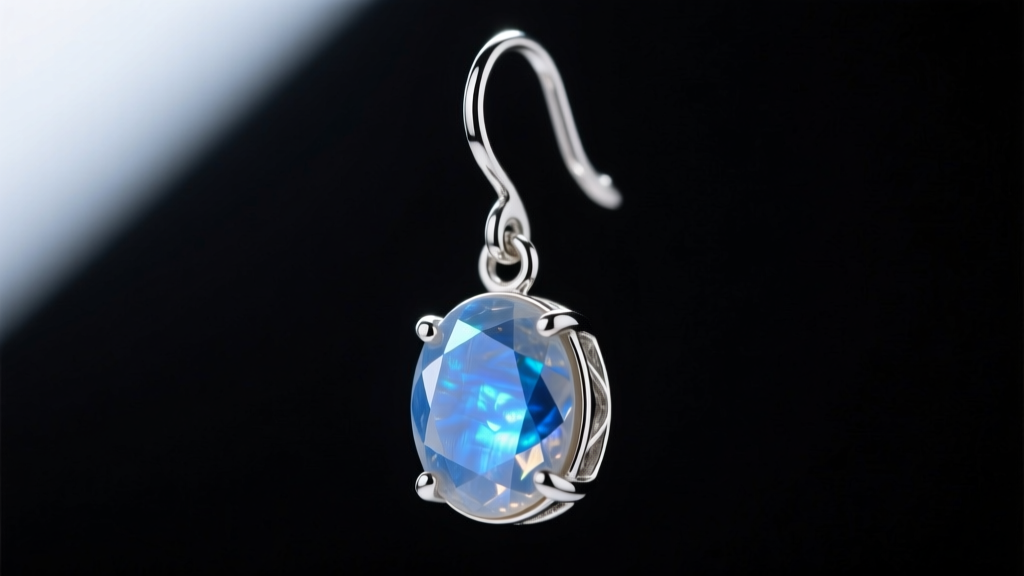
Moonstone dangle earrings represent a unique intersection of kinetic jewelry design and complex mineralogy. Unlike static studs, dangle earrings are subject to constant pendulum motion, meaning the gemstones and their settings must endure repetitive stress, occasional impacts against the jawline, and varying gravitational loads. For jewelers and informed collectors, selecting the perfect pair requires looking beyond the ethereal glow of the stone and deeply into the structural engineering of the drop mechanism, the precise gemological grading of the feldspar, and the metallurgical properties of the ear wire. This technical deep dive explores the exact specifications required to evaluate, design, and maintain high-quality moonstone dangle earrings.
The Gemology of Adularescence: Exsolution Lamellae
The defining characteristic of moonstone is adularescence—a billowy, floating light phenomenon that appears to glide just beneath the surface of the cabochon. According to the Gemological Institute of America (GIA), this optical effect is not caused by inclusions, but rather by a structural phenomenon known as exsolution. Moonstone is a variety of orthoclase feldspar. As the molten mineral cools, it separates into alternating, microscopic layers of orthoclase and albite feldspar.
When light enters the stone, it hits these alternating layers and scatters. The specific color of the sheen is dictated by the thickness of the albite layers, which typically range from 100 to 200 nanometers. Thinner layers (around 100nm) produce the highly prized, electric blue sheen via Rayleigh scattering, while thicker layers produce a milky white sheen. When evaluating moonstone dangle earrings, the highest technical grade requires a semi-transparent body color with a centered, highly directional blue sheen that rolls smoothly across the dome of the cabochon as the earring swings.
Orthoclase vs. Labradorite: The 'Rainbow' Misnomer
A critical technical distinction in the market is the difference between true moonstone and 'rainbow moonstone.' True moonstone is orthoclase (potassium feldspar). Rainbow moonstone, however, is actually a variety of labradorite, which is a plagioclase feldspar. While both exhibit phenomenal optical properties, labradorite's iridescence (labradorescence) is caused by light interference in twinning planes rather than exsolution lamellae. From a durability standpoint, both share a Mohs hardness of 6 to 6.5, but labradorite often exhibits more pronounced internal fracturing (schiller). For dangle earrings, true orthoclase moonstone with a clean, glassy body is generally preferred for its superior structural cohesion when subjected to the kinetic movement of a drop setting.
Engineering the Dangle: Articulation and Drop Mechanics
The primary failure point in any dangle earring is the articulation joint—the connection between the ear wire and the drop component. Because moonstone possesses two directions of perfect cleavage, it is highly susceptible to splitting if subjected to sudden, sharp shocks. If a dangle earring lacks proper articulation, the kinetic energy from the earring swinging and suddenly stopping (such as when caught on a sweater) transfers directly into the gemstone's setting, potentially cracking the stone or snapping the wire.
Wire Gauge and Component Specifications
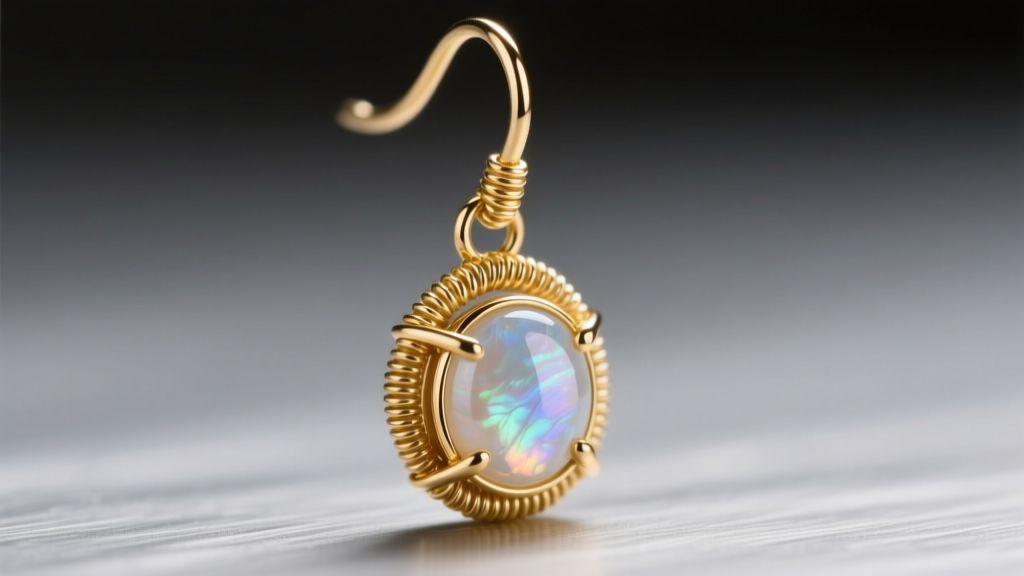
To ensure structural longevity, jewelers must adhere to strict wire gauge standards. The ear wire itself must balance comfort with load-bearing capacity. A standard 20-gauge (0.81mm) wire is ideal for most lobe piercings, but if the moonstone cabochon exceeds 15 carats (approx. 3 grams), the pendulum weight can slowly bend a 20-gauge wire open over time. In such cases, an 18-gauge (1.02mm) French wire or a reinforced leverback mechanism is technically required. Furthermore, the jump ring connecting the components must be soldered shut or work-hardened to prevent the drop from detaching during wear.
Setting Mechanics: Bezel vs. Prong for Feldspar
Due to moonstone's perfect cleavage and relatively low Mohs hardness (6-6.5), setting the stone securely without applying excessive localized pressure is a masterclass in lapidary engineering.
| Setting Type | Technical Viability for Dangles | Pros & Cons |
|---|---|---|
| Full Bezel | Excellent | Distributes pressure evenly around the girdle. Protects the fragile edges from lateral impacts. Requires precise 24-gauge (0.51mm) bezel wire to burnish without cracking the stone. |
| Half-Bezel | Good | Allows more light entry to enhance adularescence, but leaves two sides of the cleavage plane exposed to chipping during pendulum motion. |
| Prong (4 or 6) | Poor | High risk. Point pressure from prongs can easily induce internal fractures along the cleavage planes. Snags easily on clothing, causing sudden kinetic shock. |
| Wire-Wrapped | Moderate | Popular in artisan dangles. Requires a flat-back cabochon. Must use dead-soft wire that is work-hardened after wrapping to prevent the cage from loosening over time. |
Assessing Quality: The 4 Technical Pillars of Valuation
When pricing or appraising moonstone dangle earrings, gemologists rely on four specific technical pillars rather than the traditional diamond 4Cs:
- Body Transparency: The most valuable stones possess a 'glass body'—highly transparent with minimal internal fractures or milky inclusions that would block light transmission.
- Sheen Color and Saturation: Electric blue is the most valuable, followed by silver/white. The color must be highly saturated and visible under standard, diffused lighting, not just under direct, pinpoint LED beams.
- Sheen Orientation: The exsolution layers must be cut perfectly parallel to the base of the cabochon. If the lapidary cuts the stone slightly off-axis, the adularescence will only be visible from a steep, unnatural angle, rendering it useless for a dangle earring that hangs vertically.
- Dome Proportions: A high, steep dome maximizes the optical effect but creates a high profile that is prone to impact damage in a dangle setting. A medium-dome cabochon offers the best compromise between optical performance and structural safety.
Market Valuations and Pricing Tiers
Understanding the technical grading directly correlates to market pricing. Commercial-grade moonstone (opaque, white sheen, heavily included) typically costs between $2 and $5 per carat. Fine-grade material (semi-transparent, strong blue sheen, eye-clean) commands $15 to $40 per carat. The rarest tier, often referred to as 'glass body blue,' where the stone is nearly transparent with a vivid, floating blue adularescence, can exceed $100 per carat. For a pair of 10-carat dangle earrings, this means the gemstone value alone can range from $40 to over $2,000, entirely dependent on the precision of the lapidary cut and the exsolution layer thickness.
Care, Maintenance, and Structural Integrity
The Mindat Mineralogy Database notes that feldspar minerals are highly sensitive to thermal shock and chemical abrasion. Moonstone dangle earrings must never be cleaned in ultrasonic or steam cleaners. The high-frequency vibrations of an ultrasonic bath can easily exploit the stone's natural cleavage planes, causing the cabochon to split cleanly in half. Furthermore, the constant swinging motion of dangle earrings means they are frequently exposed to cosmetics, perfumes, and hairsprays. These chemicals can degrade the polish of the feldspar and tarnish the sterling silver or gold settings. Maintenance should be restricted to a soft, untreated microfiber cloth and, if necessary, a brief soak in lukewarm water with a mild, phosphate-free dish soap, followed by immediate air drying to prevent water spots from dulling the adularescent sheen.


