How to Clean, Repair & Style Star of David Earrings
Troubleshoot common Star of David earring issues. Learn expert repair techniques for bent points, tarnish removal, and lobe support solutions.


The Star of David (Magen David) is a powerful symbol of faith, heritage, and identity. When rendered as earrings, its geometric complexity—two interlocking equilateral triangles—creates unique structural and metallurgical challenges. Whether you own delicate 14k gold studs, heavy oxidized silver dangles, or modern minimalist ear cuffs, troubleshooting these pieces requires an understanding of both jewelry fabrication and piercing anatomy. In this 2026 guide, we diagnose the most common failures of Star of David earrings and provide expert-level solutions for repair, maintenance, and wearability, ensuring your meaningful jewelry lasts a lifetime.
The Geometry of Failure: Why Hexagram Points Snap
To understand why Star of David earrings break, we must look at their geometry. The design consists of two overlapping triangles, creating six acute 60-degree outer points and a complex central lattice. In jewelry manufacturing, specifically investment casting, molten metal struggles to flow smoothly into these sharp extremities. This often results in microscopic porosity at the very tips of the star.
When a cast 925 sterling silver Star of David earring is subjected to lateral pressure—such as being caught in a sweater or sleeping in them—the porous points act as structural weak links, snapping cleanly off. Conversely, die-struck 14k gold versions are compressed under immense pressure, aligning the metal grain and making the points significantly more resistant to bending. If your cast silver earrings frequently lose their points, the issue is not necessarily your clumsiness, but rather the manufacturing method. Upgrading to die-struck gold or 316L surgical steel will drastically reduce structural failures.
Troubleshooting Tarnish, Oxidation, and Rhodium Wear
Tarnish on silver Star of David earrings is caused by a chemical reaction between the copper alloy in sterling silver and sulfur compounds in the air, forming black silver sulfide. However, the overlapping lines of the hexagram create deep crevices that trap moisture, skin oils, and cosmetics, accelerating localized tarnishing.
Many manufacturers apply a rhodium plating (typically 0.1 to 0.5 microns thick) to prevent this. Over time, friction from the earlobe and the earring back wears this plating away, leading to patchy discoloration. Furthermore, many Star of David designs feature intentional oxidation (blackening) in the crevices to make the geometric lines pop. The Gemological Institute of America (GIA) strongly warns against using ultrasonic cleaners on jewelry with intentional oxidation or delicate gemstone settings, as the high-frequency vibrations will strip the dark patina and loosen pave stones.
| Material Grade | Tarnish Risk | Hypoallergenic Profile | Best Cleaning Protocol |
|---|---|---|---|
| 925 Sterling Silver | High | Good (ensure nickel-free solder) | Polishing cloth; mild soap soak |
| 14k/18k Gold Vermeil | Low (until plating wears) | Excellent (if 2.5+ microns) | Microfiber wipe only; no chemicals |
| Plated Brass Base | Very High | Poor (high nickel allergy risk) | Replace; avoid wearing in showers |
| 316L Surgical Steel | Negligible | Excellent (implant grade) | Ultrasonic safe; alcohol wipe |
Repairing Broken Joints: Laser vs. Torch Soldering
When a central joint or an outer point of your Star of David earring snaps, the repair method is critical. Traditional torch soldering uses a filler metal with a lower melting point to join the broken pieces. However, silver is highly thermally conductive. Applying a torch to a delicate 0.8mm wire joint often causes the heat to travel through the entire star, potentially melting the adjacent thin points or warping the geometric symmetry.

As of 2026, Nd:YAG laser welding is the absolute gold standard for repairing intricate Star of David earrings. Laser welding uses a highly focused beam of light to melt the exact point of the break in milliseconds, without transferring heat to the surrounding metal. This allows a jeweler to reattach a 60-degree point with a microscopic weld seam that is virtually invisible after polishing. If you are taking your earrings to a bench jeweler, explicitly request laser welding for any breaks on the hexagram's perimeter to preserve the structural integrity of the piece.
Solving Lobe Sag and the 'Cheese-Cutter' Effect
Heavy Star of David dangle earrings, especially those featuring enamel work or cubic zirconia, can weigh between 8 to 15 grams per ear. When suspended from a standard 20-gauge (0.81mm) ear wire, this concentrated weight creates downward pressure on the fistula (the piercing hole). Over time, this causes a dermatological issue known as the 'cheese-cutter effect,' where the thin wire slowly migrates downward through the earlobe tissue, causing permanent stretching and sagging.
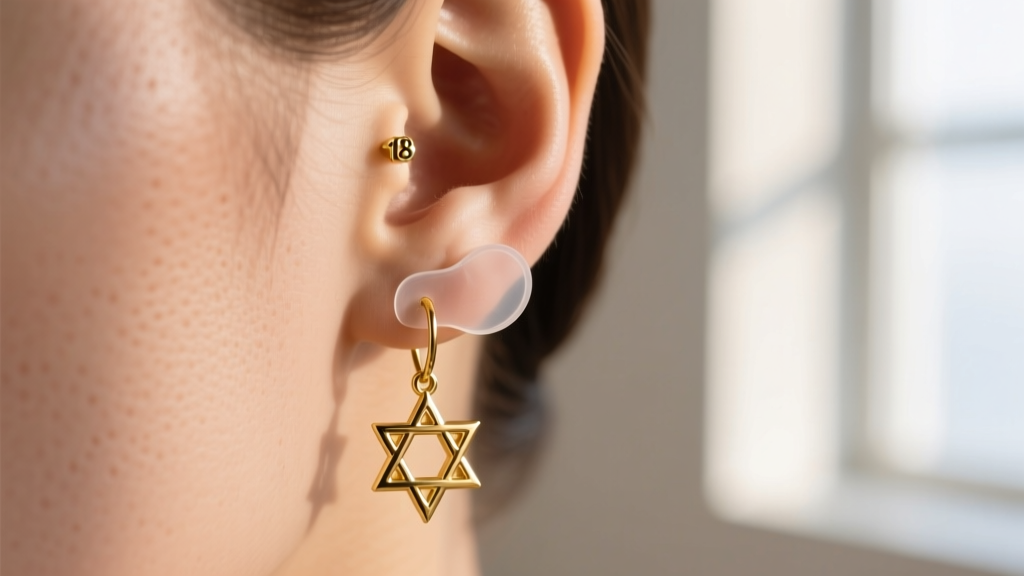
To troubleshoot this, you must address both the wire gauge and the weight distribution. First, consult a jeweler to upgrade the ear wires to 18-gauge (1.0mm) or even 16-gauge (1.2mm) French hooks, which distribute the pressure across a wider surface area of the piercing. According to the American Academy of Dermatology, reducing mechanical stress on the earlobe is just as vital as avoiding allergens to prevent contact dermatitis and tissue tearing.
Second, utilize medical-grade silicone earring support patches (often called earlobe lifters). These adhesive pads sit behind the earlobe, providing a rigid barrier that prevents the heavy Star of David pendant from pulling the tissue downward. For a more permanent solution, consider converting heavy dangles into leverback styles, which hug the earlobe more securely and reduce the pendulum swinging motion that exacerbates lobe stretching.
The 2026 Preventative Maintenance Protocol
Preventing damage to your Star of David earrings is always more cost-effective than repairing them. Implement this specific maintenance routine to preserve the geometry and finish of your jewelry:
- The 'Last On, First Off' Rule: Always put your earrings on after applying cosmetics, perfumes, and hairspray. The overlapping joints of the Star of David trap aerosolized chemicals, which degrade rhodium plating and accelerate silver tarnish.
- Friction Back Upgrades: Discard standard butterfly friction backs. They easily slip off the post, leading to lost earrings. Upgrade to silicone disc backs or screw-backs, which provide a secure grip and offer a larger surface area to support the weight of the star design against the back of the lobe.
- Proper Storage Geometry: Never throw Star of David earrings loose into a jewelry box. The sharp 60-degree points will inevitably scratch softer gold pieces or become bent when crushed under heavier items. Store them in individual soft flannel pouches or thread the posts through a dedicated felt jewelry roll.
- Annual Prong and Joint Check: If your hexagram features pave diamonds or gemstones set within the interlocking lines, have a jeweler inspect the prongs annually. The natural flexing of the metal during wear can slowly loosen the stones from their settings.
By understanding the unique metallurgical and structural demands of the Magen David design, you can confidently troubleshoot issues, ensure comfortable wear, and keep your meaningful earrings in pristine condition for years to come.


