Nautilus Earrings Value Assessment: Pricing & Metal Grades
Assess the true value of nautilus earrings. We break down pricing tiers, metal grades, and craftsmanship to help you buy smart.

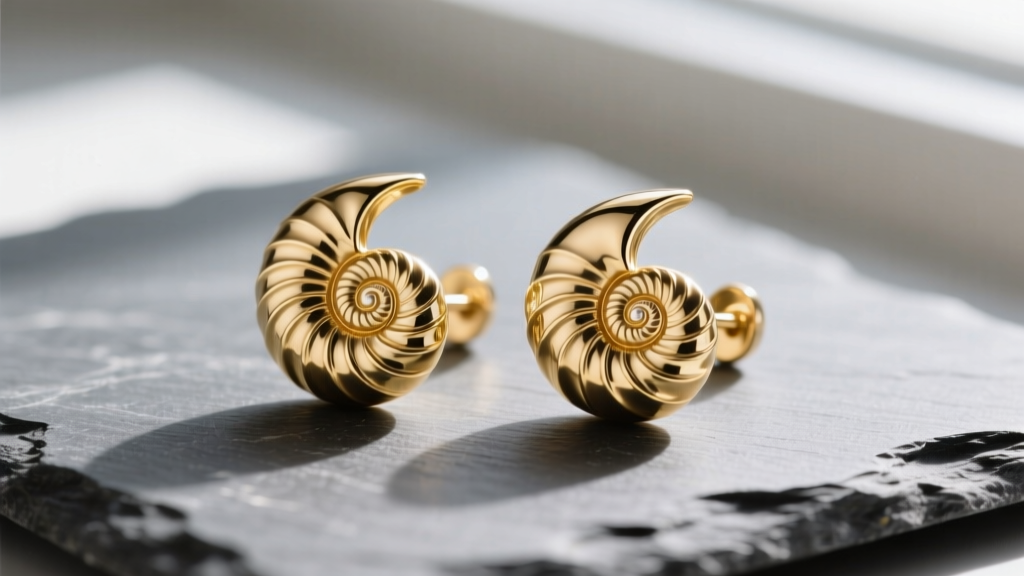
The nautilus shell has captivated jewelry designers for centuries. Its chambers grow in a precise logarithmic spiral, closely approximating the golden ratio (Fibonacci sequence). When translated into earrings, this organic geometry creates a striking, sculptural effect. However, as we evaluate the market in 2026, the price disparity between seemingly identical nautilus earrings is staggering. You can find them for $15 on fast-fashion marketplaces or $1,500 at fine jewelry boutiques.
As a buyer, how do you separate genuine craftsmanship from overpriced markup or deceptive manufacturing? This comprehensive value assessment breaks down the metallurgy, casting complexities, and hardware ergonomics of nautilus earrings to ensure your investment matches the quality you receive.
The Mathematics of the Shell: Why Nautilus Earrings Are Complex to Produce
To understand the pricing of nautilus earrings, you must first understand the manufacturing challenges. In jewelry CAD (Computer-Aided Design), creating a mathematically perfect nautilus shell requires precise NURBS (Non-Uniform Rational B-Splines) modeling. The design features a thick, dense inner columella (the central axis) that tapers into an incredibly thin, fragile outer lip.
When this digital model is 3D printed in casting wax and subjected to the lost-wax casting process, these varying wall thicknesses create severe thermal gradients. The thin outer edge of the shell cools and solidifies much faster than the dense inner chambers. According to manufacturing experts at Ganoksin, this rapid differential cooling frequently leads to shrinkage porosity—tiny air pockets trapped inside the metal.
The Failure Mode: Budget manufacturers often ignore this porosity or simply fill the surface pits with cheap solder. Over time, this leads to structural weakness, causing the delicate outer lip of the nautilus shell to snap off under minor pressure. Premium jewelers mitigate this by using specialized casting flasks, precise temperature controls, and sometimes designing the inner chambers with hidden structural struts that are invisible to the naked eye but vital for longevity.
Material Breakdown: What You Are Actually Paying For
The base metal and plating thickness dictate the baseline value of your earrings. Here is how the materials stack up in terms of durability and cost.
The Tarnish Trap in Spiral Crevices
Sterling silver (925) is the most common entry point for quality nautilus earrings, typically ranging from $40 to $90. However, silver is highly susceptible to oxidation. The deep, recessed crevices of the nautilus spiral trap moisture, skin oils, and sulfur from the air, accelerating the formation of silver sulfide (tarnish). While a jeweler can polish the high ridges, removing tarnish from the deepest inner chambers requires ultrasonic cleaning or harsh chemical dips, which can damage certain gemstone accents.
Vermeil vs. Flash Plating: The Micron Deception
Gold-ton 10k gold, which lacks the rich color and durability of higher karats.
Hardware and Ergonomics: The Hidden Cost of Front-Heavy Designs
A beautiful nautilus shell is useless if it droops uncomfortably on your ear. The asymmetric, spiral nature of the shell makes it inherently front-heavy. This is where budget brands cut corners, and where true value is revealed.
Post Gauge and Soldering Precision
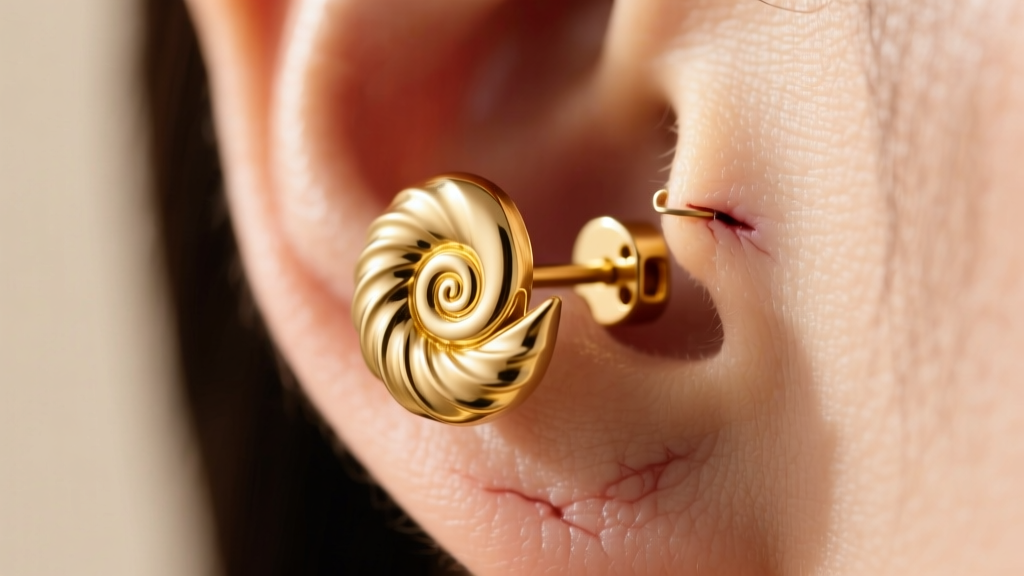
For nautilus studs, the post must be soldered exactly at the design's center of gravity. If the post is off by even 1.5 millimeters, the heavy outer lip of the shell will pull the earring downward, causing it to droop awkwardly on the earlobe.
Furthermore, you must check the gauge (thickness) of the post. Many mass-produced earrings use 22-gauge (0.64mm) wire to save on gold costs. A heavy cast nautilus shell will easily bend a 22-gauge post during insertion or if snagged on a sweater. Actionable advice: Always insist on 20-gauge (0.81mm) or 18-gauge (1.02mm) posts for nautilus studs to ensure structural rigidity.
Securing the Weight: Backing Mechanisms
Standard butterfly friction backs rely on a small groove on the post to hold the earring in place. For a heavy nautilus drop or a solid gold stud, friction backs are a liability; the weight of the shell can slowly work the backing loose throughout the day. High-value nautilus earrings will feature secure hardware, such as:
- La Pousette Backs: These feature a mechanical locking mechanism with tiny wings that snap securely into a groove, virtually guaranteeing the earring stays put.
- Screw Backs: The backing threads onto a specially notched post, providing the highest level of security for heavy, valuable shells.
- French Wires with Safety Latches: For nautilus dangles, a secure latch prevents the ear wire from slipping out of the piercing.
Real Shells vs. Metal Castings: A Buyer's Warning
Not all nautilus earrings are cast in metal. Some budget and bohemian brands use actual, harvested nautilus shells, either sliced and set in resin, or wrapped in silver wire. While visually striking, these carry significant ethical and practical red flags.
Certain species of nautilus are protected under CITES (the Convention on International Trade in Endangered Species) due to overharvesting for the shell trade. If a brand is selling real shell earrings, they must provide documentation proving the shells were ethically and legally sourced. Moreover, real shells are incredibly brittle. A minor drop onto a bathroom tile will shatter the delicate outer chambers. For daily wear, a metal casting of the nautilus shape offers vastly superior durability, ethical peace of mind, and long-term value retention.
Final Verdict: How to Maximize Your Investment
When shopping for nautilus earrings, look past the initial aesthetic and scrutinize the specifications. The sweet spot for value in 2026 lies in the mid-tier artisan market ($120–$350). At this price point, you should expect heavy 14k gold vermeil (minimum 2.5 microns) or solid 10k/14k gold, a mathematically balanced CAD design free of visible casting porosity, and a sturdy 20-gauge post paired with a secure locking back.
By understanding the metallurgical challenges of the Fibonacci spiral and demanding transparent material grades, you can acquire a piece of mathematical art that will endure as a lifelong staple in your jewelry collection, rather than a fleeting, tarnished trend.


