Navajo Squash Blossom Earrings: Silver Grades & Turquoise Guide
Explore the technical details of authentic Navajo squash blossom earrings, from coin silver metallurgy and turquoise grading to lobe weight support.

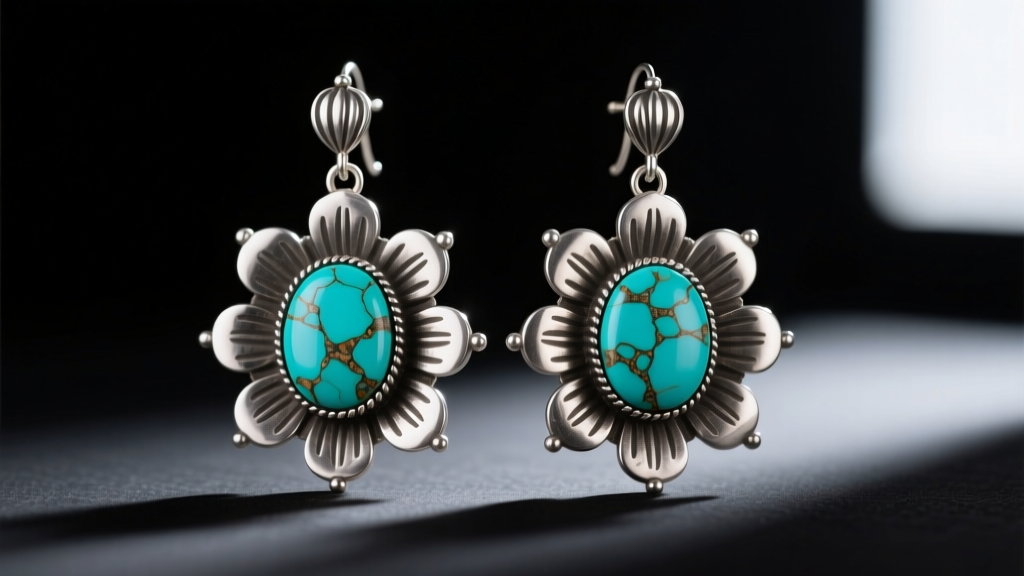
The Anatomy of the Squash Blossom Motif
While the term "squash blossom" is ubiquitous in Southwestern jewelry, the motif is actually a historical misnomer. The tri-petal beads found on authentic Navajo squash blossom earrings are derived from Spanish-Moorish pomegranate motifs introduced to the Navajo (Diné) people in the mid-19th century. Today, these earrings represent a masterclass in traditional silversmithing and lapidary arts. However, the market is saturated with mass-produced imports. For collectors and enthusiasts, understanding the technical specifications of silver alloys, turquoise treatments, and structural weight distribution is critical for evaluating authenticity and quality.
Metallurgy: Coin Silver vs. Modern Sterling
The foundation of any high-end Navajo earring lies in its silver content. While modern pieces are typically crafted from .925 sterling silver, vintage and traditionally crafted pieces often utilize "coin silver."
Understanding Coin Silver (Approx. 90% Silver)
Prior to the widespread availability of commercial silver sheet and wire, Navajo smiths melted down US and Mexican coins. US coins minted before 1965 contain roughly 90% silver and 10% copper. This specific alloy behaves differently under the hammer than modern sterling:
- Malleability and Work Hardening: Coin silver is slightly softer initially but work-hardens to a remarkably durable finish. Hand-hammered ingots will show microscopic variations in thickness, a hallmark of authentic bench work.
- Patina Development: The higher copper content (10% vs. 7.5% in sterling) causes coin silver to oxidize more rapidly, developing a deep, complex, dark-gray patina that is highly prized by collectors.
- Identifying Marks: Vintage coin silver earrings rarely bear a ".925" stamp. Instead, look for a lack of uniform machine-milling and the presence of hand-filed edges.
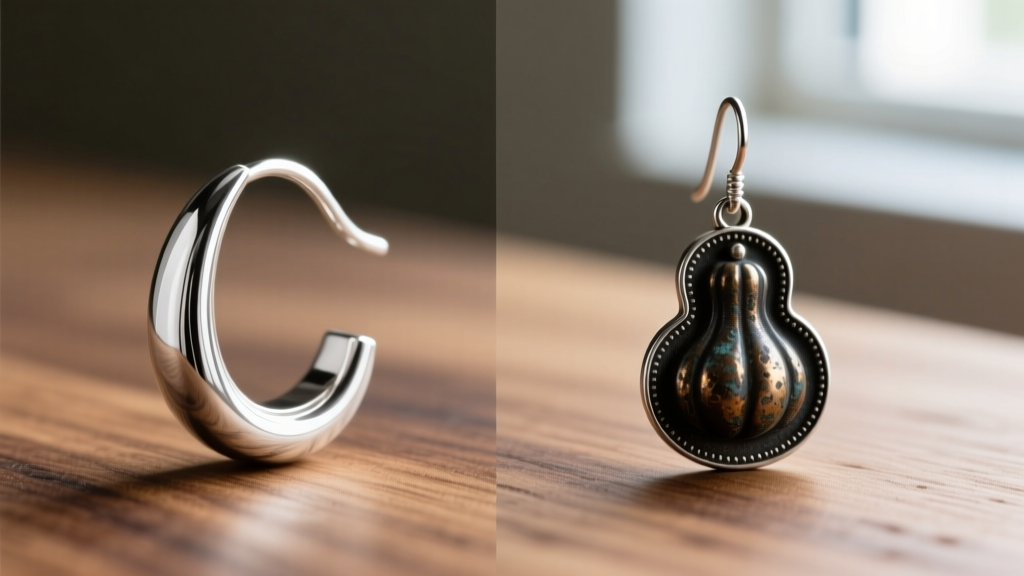
Modern .925 Sterling Silver
Contemporary Navajo artisans frequently use commercial .925 sterling silver (92.5% silver, 7.5% copper) due to its predictable tensile strength and uniform gauge availability. When evaluating modern sterling squash blossom earrings, check for the ".925" stamp and the artist's hallmark. Note that some modern smiths intentionally alloy their own silver to mimic the working properties of historical coin silver.
Turquoise Grading and Lapidary Techniques
The cabochons set into the Naja (crescent pendant) and blossom beads dictate a significant portion of the earring's value. Turquoise is a porous, hydrous phosphate of copper and aluminum, ranking between 5 and 6 on the Mohs hardness scale. According to the Gemological Institute of America (GIA), natural, untreated turquoise of high density is increasingly rare, making provenance and treatment disclosure vital.
Stabilization vs. Natural Stone
Over 90% of turquoise on the market is stabilized using epoxy resins or the Zachery treatment method to enhance color and prevent the stone from absorbing skin oils and lotions, which can cause it to turn green or crack over time. While stabilization is an accepted industry practice for mid-tier stones, high-grade natural turquoise (often referred to as "gem-grade") commands a massive premium.
| Turquoise Mine | Visual Characteristics | Hardness (Mohs) | Market Impact |
|---|---|---|---|
| Sleeping Beauty (AZ) | Uniform, clear sky-blue; minimal matrix | 5.5 - 6.0 | Highly sought after; mostly stabilized post-closure (2012) |
| Kingman (AZ) | Deep blue with distinct black or brown copper pyrite matrix | 5.0 - 6.0 | Premium pricing for natural, high-domed cabochons |
| Royston (NV) | Light to deep green with heavy golden-brown matrix | 4.5 - 5.5 | Requires stabilization; prized for unique matrix patterns |
| Bisbee (AZ) | Vivid blue with smoky black or red-brown matrix | 5.5 - 6.5 | Rare; commands top-tier collector pricing |
Bezel Setting Techniques
Authentic Navajo silversmiths use a "push-bezel" technique. A thin strip of silver (usually 24-gauge or 26-gauge) is soldered around the stone's perimeter and pushed over the edge using a bezel pusher and burnisher. Avoid earrings with glued-in stones or bezels that show visible gaps, which indicate poor lapidary cutting or mass-production casting.
Structural Engineering: Weight Distribution and Wire Gauge
Squash blossom earrings are inherently heavy. A standard pair of fully beaded dangles can weigh between 15 and 35 grams per ear. This presents a significant biomechanical challenge for the earlobe.
Ear Wire Gauge Specifications
Standard commercial ear wires are typically 20-gauge (0.81mm) or 22-gauge (0.64mm). Hanging 30 grams of silver and stone from a 20-gauge wire will cause the "cheese-cutter effect," where the wire slowly slices through the earlobe tissue over time. For heavy Navajo dangles, you must verify the structural hardware:
- Minimum Wire Gauge: Look for 18-gauge (1.02mm) or 16-gauge (1.29mm) ear wires.
- French Wire vs. Leverback: Heavy French wires (fishhooks) require constant use of secure silicone stoppers. Leverback closures offer superior security but must be forged from heavy-gauge wire to prevent the hinge mechanism from warping under the pendulum weight of the blossom beads.

Lobe Support Solutions
If you own a pair of vintage, heavy-gauge squash blossom earrings, utilize invisible silicone earlobe support patches (such as LobeWonder). These adhesive patches distribute the downward sheer force across a wider surface area of the ear's cartilage and skin, preventing permanent lobe elongation and tearing.
Authentication and the Indian Arts and Crafts Act
The market for Native American jewelry is plagued by counterfeit imports, primarily manufactured in the Philippines and China. These pieces often feature dyed howlite or block plastic disguised as turquoise, cast in white metal and plated with a thin layer of silver.
Under the Indian Arts and Crafts Act of 1990, it is illegal to offer or display for sale any art or craft product in a manner that falsely suggests it is Indian-produced. When purchasing Navajo squash blossom earrings, look for the following authentication markers:
"All products must be marketed truthfully regarding the Indian heritage and tribal affiliation of the producer. Misrepresentation can result in severe civil and criminal penalties." — Indian Arts and Crafts Board (IACB)
Spotting the Fakes: A Technical Checklist
- The Stamp Work Test: Authentic Navajo stamp work is done by hand using individual steel dies. Look for slight variations in depth and alignment. Machine-stamped imports will have perfectly uniform, laser-like precision.
- The Matrix Test: Examine the turquoise matrix under a 10x jeweler's loupe. Natural matrix will show depth and crystalline structures. Dyed howlite will show dye pooling in the cracks, and plastic will appear flat and opaque.
- The Solder Test: Turn the earring over. Authentic pieces will show clean, silver-colored solder lines where the bezel cups meet the backplate. Imports often use toxic lead-based solder or industrial epoxies, visible as dull gray or yellowish residue around the base of the settings.
By understanding the metallurgical nuances of coin silver, the geological realities of turquoise grading, and the structural requirements for heavy earlobe jewelry, you can confidently evaluate and invest in authentic Navajo squash blossom earrings that will endure for generations. For further historical context on Diné silversmithing, the Smithsonian National Museum of the American Indian offers extensive archives on the evolution of Southwestern adornment.


