What Is a Nova Audio Earring? Beginner's Smart Jewelry Guide
Discover how the nova audio earring blends wearable tech with fine jewelry. Learn about materials, gauge sizes, and styling tips in this beginner guide.

The Intersection of Wearable Tech and Fine Jewelry
As we navigate the wearable landscape in 2026, the line between fine jewelry and consumer electronics has completely blurred. The nova audio earring represents the pinnacle of this evolution, transforming a classic lobe stud into a sophisticated hub for directional audio and biometric health tracking. For jewelry enthusiasts and tech adopters alike, understanding how these devices function—and how to wear them safely—is essential. Unlike bulky over-ear headphones or intrusive in-ear monitors, smart earrings leverage the natural anatomy of the ear to deliver sound and gather health data without compromising your personal style.
This beginner-friendly explainer will demystify the engineering, metallurgy, and styling requirements of audio-enabled jewelry, ensuring you can confidently integrate smart wearables into your daily rotation.
How the Nova Audio Earring Actually Works
The magic of the nova audio earring lies in its ability to project sound without a speaker sitting inside your ear canal. This is achieved through parametric array technology, often referred to as directional audio. The earring houses a microscopic ultrasonic emitter that projects high-frequency sound waves (typically around 40 kHz). As these waves travel through the air, they demodulate into audible frequencies in a highly focused beam.
By angling the emitter upward toward the tragus and concha of the ear, the sound bounces naturally into the ear canal. This means only the wearer can hear the audio, eliminating the need for noise isolation while keeping you aware of your surroundings. According to advancements in directional audio wearables, this technology has shrunk dramatically in recent years, allowing the acoustic components to fit inside a decorative stud measuring just 10mm to 12mm in diameter.
Biometric Tracking: Why the Earlobe?
Beyond audio, the nova audio earring serves as a highly accurate health monitor. While smartwatches rely on wrist-based photoplethysmography (PPG), the earlobe offers a superior, motion-resistant vascular bed. The posterior (back) of the earring rests flush against the skin, utilizing embedded thermistors and optical sensors to track core body temperature, heart rate variability (HRV), and even early signs of hormonal shifts.
Because the earlobe is rich in capillaries and experiences far less kinetic noise than a swinging arm, the data collected by wearable electronics and bio-integrated sensors in this region is remarkably precise. However, this constant skin contact brings us to a critical consideration: material safety.

Material Grades and Hypoallergenic Safety
When a piece of jewelry houses a micro-battery and a processor, it generates a micro-thermal environment. Standard 316L surgical steel contains 10-14% nickel. When exposed to the slight heat of a discharging battery combined with natural skin oils and sweat, nickel leaching accelerates, leading to severe allergic reactions. Therefore, the post of a high-quality nova audio earring must be crafted from Grade 23 Titanium (Ti-6Al-4V ELI) or solid, nickel-free 14k/18k gold.
Grade 23 Titanium is entirely biocompatible, non-magnetic, and immune to galvanic corrosion. Furthermore, the decorative outer shell of the smart stud should utilize PVD (Physical Vapor Deposition) coating rather than traditional electroplating. PVD bonds the color (like rose gold or yellow gold) at a molecular level, ensuring it will not chip or degrade when exposed to the micro-heat of the internal electronics. The American Academy of Dermatology strongly recommends hypoallergenic metals to prevent contact dermatitis and nickel allergies, a rule that becomes exponentially more important when heat-generating tech is involved.
Sizing, Gauge, and Weight Distribution
A standard decorative stud weighs between 1 and 2 grams. A fully equipped nova audio earring, complete with a micro-battery, directional speaker, and biometric sensors, typically weighs between 5 and 8 grams. This massive increase in weight dictates a complete shift in how we approach piercing gauges and lobe support.
The Gauge Size Shift
Standard lobe piercings are usually done at 20G (0.81mm) or 18G (1.02mm). However, a smart earring requires a thicker post to house the micro-wiring that connects the front-facing decorative module to the back-facing sensor pad. Most premium audio earrings are manufactured at 16G (1.29mm) or 14G (1.63mm). If your piercings are strictly 20G, you may need a professional jeweler or piercer to gently taper the hole to accommodate the smart post without tearing the tissue.
| Feature | Standard Stud Earring | Nova Audio Smart Earring |
|---|---|---|
| Average Weight | 1.0g - 2.5g | 5.0g - 8.5g |
| Standard Post Gauge | 20G (0.81mm) or 18G (1.02mm) | 16G (1.29mm) or 14G (1.63mm) |
| Primary Post Material | 316L Steel, Sterling Silver | Grade 23 Titanium, Solid 14k Gold |
| Backing Type | Standard Push-Back or Butterfly | Silicone Friction Back + Sensor Pad |
Preventing Lobe Stretching
Wearing a 7-gram earring on a standard lobe for 8 hours a day will inevitably cause the piercing channel to migrate downward, leading to irreversible lobe stretching. To counteract this, you must use silicone adhesive support patches (such as LobeWonder) or specialized wide-base silicone backs that distribute the weight across a broader surface area of the posterior earlobe. Never wear heavy smart studs while sleeping or exercising, as sudden kinetic movements can tear the weighted piercing.

Styling Your Audio Earrings for Everyday Wear
Because the nova audio earring relies on the fleshy, vascular tissue of the earlobe for both biometric tracking and structural support, it is strictly a lobe-only accessory. Cartilage piercings (like the helix or tragus) lack the necessary capillary density for accurate temperature reading and are too thin to safely bear the weight of a micro-battery.
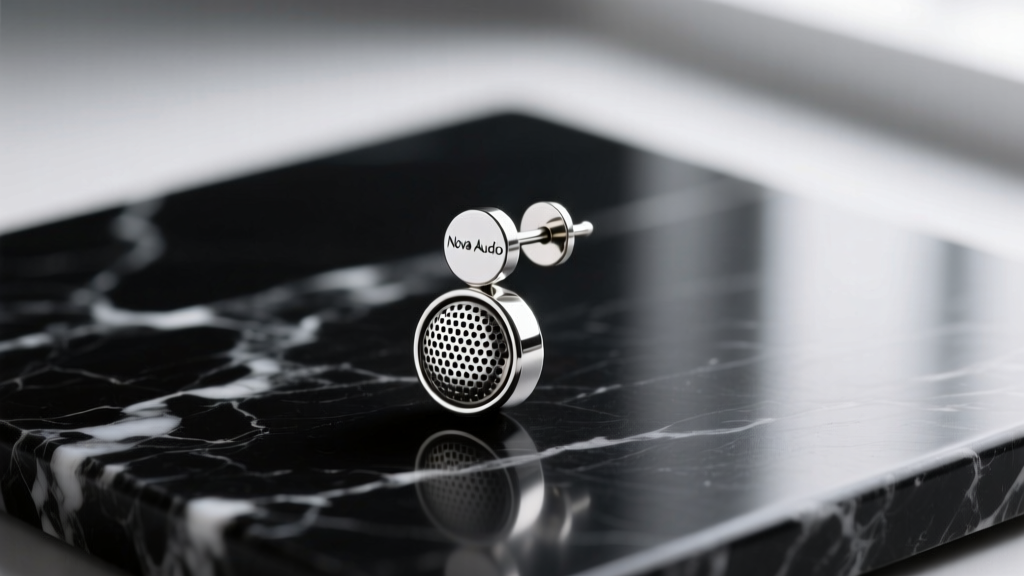
When styling, treat the smart earring as a statement piece or a minimalist anchor. Because the tech requires a slightly larger surface area (usually a 10mm to 12mm dome or geometric disc), it pairs beautifully with a curated ear stack. Try wearing the nova audio earring in your primary lobe piercing, and complement it with lightweight, 20G titanium huggies or threadless studs in your secondary and tertiary lobe holes. This balances the visual weight while ensuring your ear isn't overwhelmed by heavy metals.
Final Thoughts on the Future of Ear Wearables
The nova audio earring is more than a novelty; it is a masterclass in functional jewelry design. By respecting the anatomy of the ear, utilizing biocompatible Grade 23 Titanium, and leveraging directional acoustics, these pieces offer a seamless blend of utility and elegance. As you transition into smart jewelry, prioritize proper gauge sizing, rigorous lobe support, and strict adherence to hypoallergenic materials to ensure your piercings remain as healthy as the data you track.