Open Circle Earrings: 2026 Trend Analysis & Style Guide
Discover the 2026 open circle earrings trend. Explore architectural styles, gauge guides, and face-shape styling for this minimalist staple.

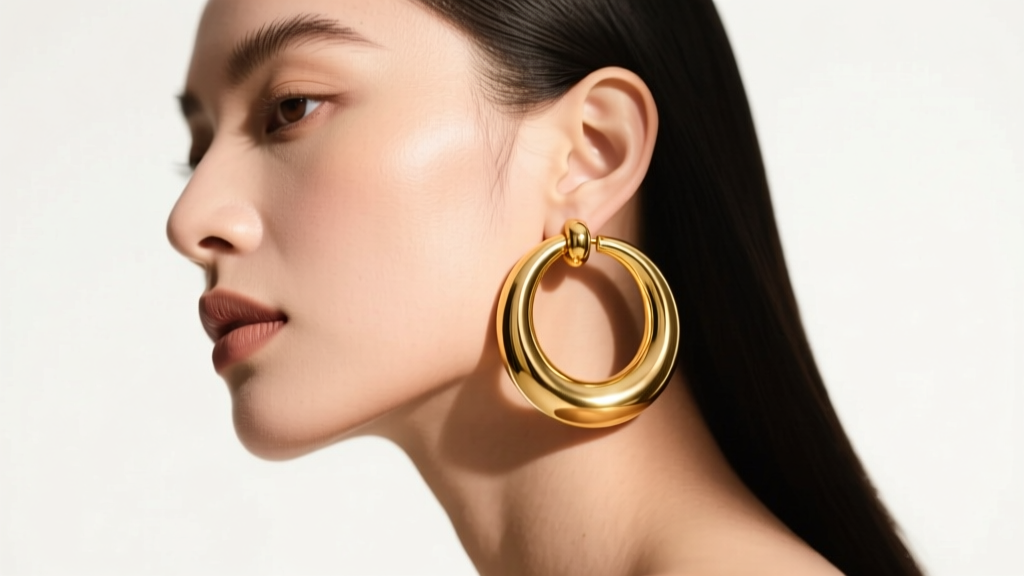
The 2026 Evolution: From Minimalist to Architectural
For the past decade, open circle earrings have been relegated to the realm of hyper-minimalism—think delicate, barely-there 20-gauge wires that served as subtle office-appropriate staples. However, the 2026 jewelry landscape has radically redefined this silhouette. Today, open circle earrings are no longer just background noise; they are architectural statement pieces that leverage negative space to frame the face without the visual heaviness of solid discs or traditional closed hoops.
This year's trend analysis reveals a distinct pivot toward 'structural geometry.' Designers are experimenting with asymmetrical thicknesses, where one side of the circle is a heavy 4mm gauge that tapers into a razor-thin 1mm wire. This creates a dynamic sense of movement and light reflection that solid hoops simply cannot achieve. Furthermore, the integration of mixed metals—such as a yellow gold outer circle intersecting with a white gold inner geometric line—has elevated the open circle from a basic staple to a focal point of contemporary ear curation.
Material & Gauge Matrix: What to Buy Now
When investing in open circle earrings, structural integrity is paramount. Because the circle is incomplete, the metal is under constant tensile stress, particularly at the terminals (the two ends of the gap). Choosing the right metallurgical grade and gauge thickness prevents the gap from warping and the earring from falling out. Below is the definitive 2026 buying matrix based on placement and material science.
| Material Grade | Recommended Gauge | Best Placement | Avg. Price Range | Durability Factor |
|---|---|---|---|---|
| ASTM F136 Titanium | 16G (1.2mm) - 14G (1.6mm) | Helix, Conch, Daith | $45 - $95 | Exceptional (High Tensile) |
| 14k Solid Gold | 18G (1.0mm) - 16G (1.2mm) | Standard Lobe, Upper Lobe | $180 - $450 | Moderate (Prone to Bending) |
| 18k Solid Gold | 20G (0.8mm) - 18G (1.0mm) | Standard Lobe (Lightweight) | $250 - $600 | Low (Requires Careful Handling) |
| Anodized Niobium | 16G (1.2mm) - 12G (2.0mm) | Statement Lobe, Industrial | $30 - $75 | High (Hypoallergenic & Stiff) |
According to the Association of Professional Piercers (APP), implant-grade titanium (ASTM F136) remains the gold standard for any fresh or healing cartilage piercings due to its biocompatibility and high tensile strength. If you are threading an open circle through a helix or flat piercing, avoid 18k gold in gauges thinner than 18G, as the natural tension of the cartilage can slowly warp the open gap over time.
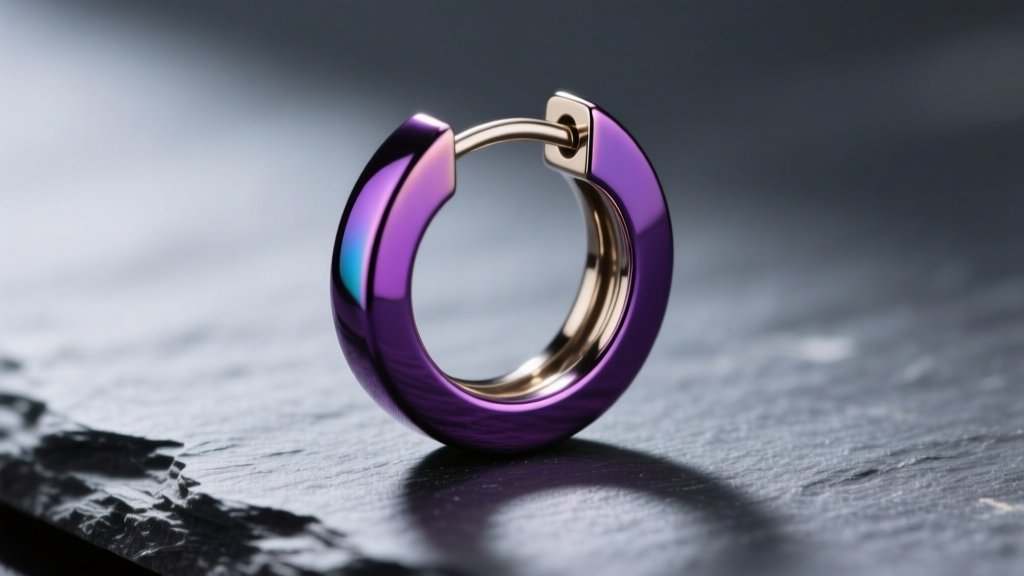
Face Shape Geometry: Matching the Curve
The true power of the open circle earring lies in its ability to manipulate facial proportions through optical illusion. Because the center of the earring is empty, it draws the eye to the perimeter of the face. Here is how to map the diameter and shape of your open circles to your specific bone structure in 2026.
Angular Faces (Square and Diamond)
Angular jawlines and prominent cheekbones benefit from softening elements. Opt for open circles with a diameter between 40mm and 60mm. The key detail to look for this year is 'rounded terminals'—ends that finish in a smooth bead or polished dome rather than a sharp, flat cut. This softens the visual impact. Avoid elongated or oval open circles, as they can drag the face downward; stick to perfect geometric circles to balance the sharp angles of the jaw.
Round and Oval Faces
For rounder face shapes, the goal is elongation and structure. In 2026, the 'teardrop open circle' (a circle that gently pulls into a soft point at the bottom) is dominating the market. Aim for a 30mm to 45mm drop. The negative space inside the teardrop creates a vertical line that visually lengthens the neck and jawline. Oval faces have the most versatility and can easily pull off the ultra-modern 'squircle' (a square with heavily rounded corners) open shapes that are trending heavily on runways this season.
Heart-Shaped Faces
Heart faces feature a broader forehead and a narrow, pointed chin. The objective is to add visual weight to the lower half of the face to create balance. Medium-sized open circles (30mm-40mm) featuring bottom-heavy detailing—such as a single flush-set diamond or a thicker gauge at the 6 o'clock position—work beautifully. This draws the eye downward, softly widening the appearance of the chin area.
Lobe vs. Cartilage: Placement Mechanics
The physics of an open circle earring change drastically depending on where it is worn. In the standard earlobe, gravity pulls the earring straight down, meaning the gap of the open circle naturally rests at the 6 o'clock position. This is the most secure placement, as gravity keeps the two terminals resting against each other.
'When placing an open circle in a cartilage piercing like the helix or tragus, the angle of the piercing channel dictates where the gap will sit. If the gap rests at the 3 or 9 o'clock position against the cartilage, the natural pressure of the ear can slowly pry the terminals apart. Always use a clicker-style hinge for cartilage open circles to eliminate the gap entirely.' — Senior Piercer & Jewelry Fabricator
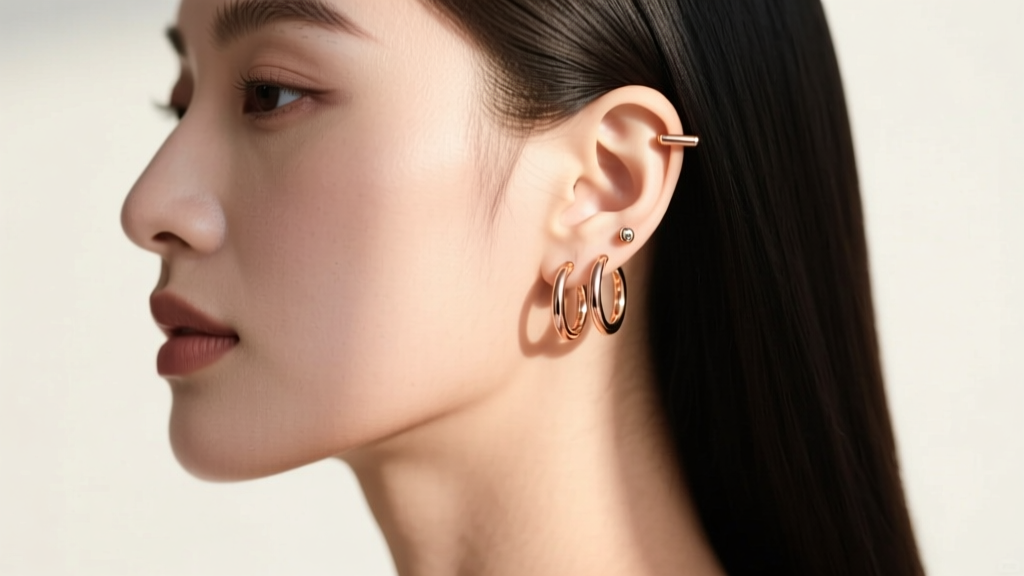
For cartilage placements, the industry has largely moved away from traditional 'seamless' open rings that require you to twist the metal laterally to open and close them. Twisting compromises the structural memory of the metal. Instead, 2026's premier cartilage open circles utilize micro-hinges with a 'clicker' clasp. This allows the earring to open on a hinge and snap shut securely, maintaining the perfect circular tension without warping the metal. For standard lobes, the classic French wire or the modern 'continuous hoop' (where a thin wire threads into a hollow tube) remains the most comfortable and secure option.
Styling Framework: The 'Rule of Asymmetry'
If you are building an ear curation around the open circle trend, the outdated rule of matching your left and right ears has been entirely discarded. The 2026 styling framework relies on the 70/30 Asymmetry Rule. Here is how to execute it flawlessly:
- The Anchor (70% Visual Weight): On one ear, wear a large, bold open circle (50mm+) in the standard lobe. This serves as the anchor of your look. Leave the upper lobe and cartilage bare, or use microscopic, flush-set studs to keep the focus on the negative space of the large circle.
- The Constellation (30% Visual Weight): On the opposite ear, skip the standard lobe entirely (or wear a tiny 5mm stud). Instead, stack three small, 10mm-15mm open circle huggies in your helix, flat, and conch piercings.
- Metal Mixing: The 70/30 rule thrives on mixed metals. Pair a 14k yellow gold anchor hoop with white gold or platinum cartilage huggies on the opposite ear. The contrast highlights the architectural lines of the open circles.
- The Hair Tuck: Open circles rely on light passing through them. Always style your hair with a deep side part, tucking the 'Constellation' ear behind the ear to expose the cartilage stack, while letting the hair fall just behind the 'Anchor' ear so the large circle rests against the neck.
Final Verdict & Sourcing
Open circle earrings in 2026 are a masterclass in modern jewelry design—proving that what is removed from a piece is just as important as what remains. By understanding the metallurgical requirements of your specific piercings and mapping the geometry of the circle to your facial structure, you can elevate this trend from a fleeting fad to a permanent fixture in your personal style arsenal.
When sourcing your pieces, always verify the metal hallmark. As noted by the Gemological Institute of America (GIA), legitimate precious metals will carry specific stamps (like 14K, 18K, or 950Pt). For titanium, request documentation of the ASTM F136 grade from your jeweler to ensure you are getting implant-grade material rather than cheap, nickel-laced surgical steel that can cause contact dermatitis. Invest in the hinge mechanics, respect the gauge limits, and let the negative space do the talking.


