How to Open Huggies Earrings: A Trend & Mechanism Survival Guide
Learn exactly how to open huggies earrings without bending the post. We analyze trending hinge mechanisms, gauge sizes, and material durability.

The Anatomy of a Huggie: Why Mechanisms Matter in 2026
Huggie earrings have completely dominated the curated ear landscape, evolving from simple 1990s gold bands into the architectural, gem-encrusted micro-huggies defining 2026 trends. However, as the aesthetic has shrunk and become more intricate, the hardware has struggled to keep up. The most common point of failure—and the source of countless frustrated searches—is the closure mechanism. Understanding exactly how to open huggies earrings without compromising the structural integrity of the post is essential for both jewelry longevity and ear health.
Unlike standard hoops that swing freely, huggies are designed to "hug" the earlobe or cartilage. This snug fit places continuous lateral stress on the hinge and closure post. When you combine this mechanical stress with the softness of high-karat gold or the rigidity of implant-grade titanium, improper opening techniques quickly lead to stripped grooves, bent posts, or snapped hinges. Below, we break down the exact mechanics of modern huggie closures and how to operate them safely.
Step-by-Step: How to Open Huggies Earrings by Closure Type
The method you use to open your huggies depends entirely on the closure mechanism engineered by the manufacturer. Pulling a post that is meant to twist, or twisting a wire that is meant to pull, will permanently deform the metal.
1. The Hinge and Snap (Clicker) Closure
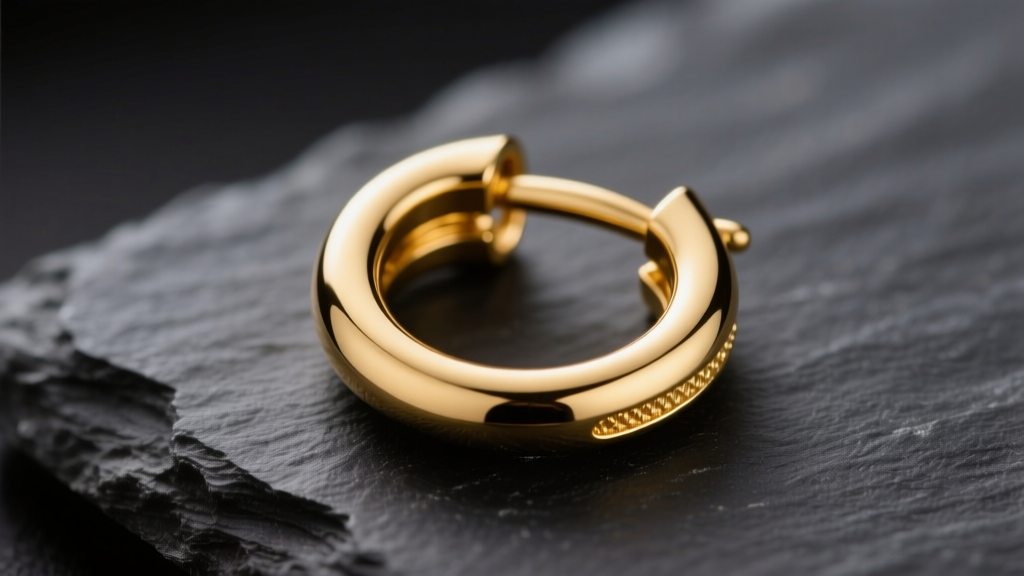
The clicker is the undisputed king of 2026 huggie trends due to its flush, seamless appearance when closed. It features a hinged front section and a curved post with a microscopic locking groove that snaps into the hollow receiving tube.
- The Technique: Do not pull the post away from the tube. Instead, hold the huggie with your thumb and index finger on either side of the seam (the side opposite the hinge). Apply gentle, opposing rotational pressure—twisting the top half up and the bottom half down.
- The Failure Mode: Pulling the post outward bends the 18-gauge or 16-gauge wire. Once bent, the locking groove will no longer align with the internal catch, resulting in a huggie that refuses to "click" shut.
2. The Continuous Tension Wire (Endless Huggie)
Endless huggies feature a thin, slightly curved wire that slides into a hollow tube, relying on the natural tension of the metal to stay in place. There is no hinge.
- The Technique: Grip the hollow tube with one hand and the wire end with the other. Pull the wire straight out along its natural curve. To close, gently squeeze the hoop to reduce the diameter, align the wire with the tube, and push it straight back in until it seats flush.
- The Failure Mode: Bending the wire upward or downward to "pry" it out of the tube. This fatigues the metal, eventually causing it to snap or lose its tension, making the earring fall out constantly.
3. The Threadless (Push-Pin) Huggie
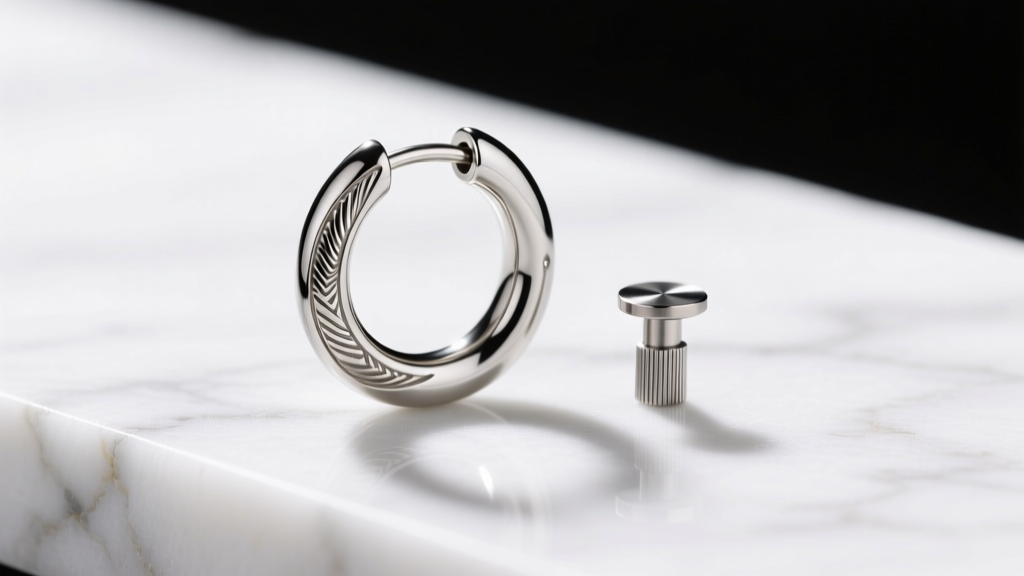
Popularized by high-end body jewelry brands, threadless huggies use a bent pin that slides into a receiving tube. The tension of the bent pin against the inner wall of the tube holds it securely.
- The Technique: Push the two halves together slightly to compress the internal tension, then pull them apart while wiggling slightly. Never just yank them apart dry, as the friction can scratch the polished post.
Material Science: Why Your Huggie Keeps Snapping or Sticking
The ease with which you can open and close a huggie is directly tied to the metallurgy of the piece. According to data from Rio Grande jewelry supply, the Vickers hardness (HV) of precious metals dictates how they handle mechanical stress.
| Material | Hardness (Approx. HV) | Mechanism Behavior | Best Closure Type |
|---|---|---|---|
| 18k Yellow Gold | 100 - 120 HV | Very soft; posts bend easily if pulled. Prone to losing tension in endless hoops. | Hinge & Snap (Clicker) |
| 14k Yellow Gold | 120 - 140 HV | Moderate hardness; holds a clicker groove well but can still bend under extreme force. | Clicker or Endless |
| Implant-Grade Titanium (ASTM F136) | 330 - 360 HV | Highly rigid; will not bend, but will snap if fatigued repeatedly. Excellent for threadless. | Threadless or Clicker |
| Platinum (950) | 110 - 130 HV | Dense and malleable; highly durable but heavy. Clicker posts can warp if oversized. | Hinge & Snap (Clicker) |
If you are buying 18k gold huggies, you must be exceptionally gentle when opening them. The Association of Professional Piercers (APP) frequently notes that high-karat gold jewelry requires specialized care, as the alloy mix prioritizes color and purity over structural rigidity. For cartilage piercings where the ear's natural curve puts pressure on the jewelry, ASTM F136 titanium is vastly superior because it will not warp and alter the piercing angle.
Troubleshooting: Fixing a Loose or Stuck Huggie Post
Even with perfect technique, daily wear can cause mechanical drift. Here is how to troubleshoot the two most common huggie hardware failures without ruining the piece.
Problem 1: The Clicker Won't Stay Closed
The Cause: The receiving tube has slightly widened, or the post's locking groove has worn down, eliminating the friction required for the "snap."
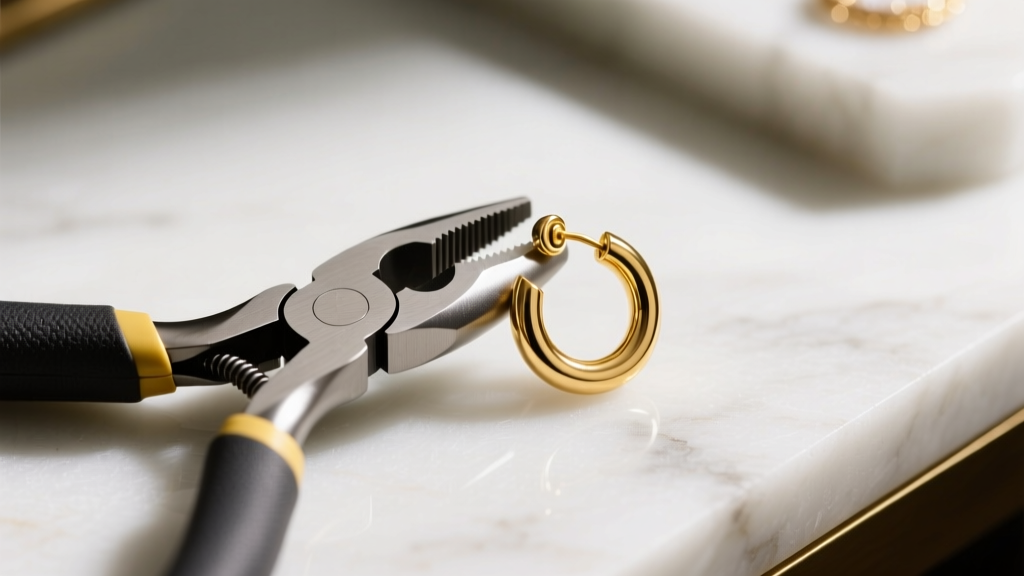
The Fix: Take a pair of nylon jaw pliers (never use metal steel-jaw pliers, which will gouge the gold). Gently squeeze the hollow receiving tube vertically to slightly compress its diameter. Test the click. Repeat in micro-increments until the snap returns. Do not over-squeeze, or the post will no longer fit inside.
Problem 2: The Post is Bent and Won't Align
The Cause: The earring was pulled open rather than twisted, bending the 16g (1.2mm) or 18g (1.0mm) wire.
The Fix: Using your fingers or nylon jaw pliers, apply gentle counter-pressure to bend the post back to its original curvature. You can use a standard steel hoop mandrel as a visual guide for the correct curve. If the metal is work-hardened and resists bending, stop immediately to avoid snapping it; take it to a professional jeweler for laser welding or post replacement.
Sizing & Gauge Standards for Cartilage vs. Lobe Huggies
Understanding how to open huggies earrings is only half the battle; ensuring you have the correct gauge and Inner Diameter (ID) prevents the mechanism from failing in the first place. A huggie that is too small will constantly pull at the hinge, while one that is too large will snag and bend the post.
- Standard Lobe Huggies: Typically 18-gauge (1.0mm) or 20-gauge (0.8mm) with an Inner Diameter (ID) of 10mm to 12mm. The larger ID allows the clicker to swing freely without lateral stress.
- Helix / Cartilage Huggies: Usually 16-gauge (1.2mm) with an ID of 6mm to 8mm. Cartilage is rigid, so a smaller, thicker huggie prevents the jewelry from acting as a lever against the piercing fistula.
- Conch / Snug Huggies: Often require custom IDs (5mm or smaller) and are best suited for threadless titanium hardware, as clicker hinges cannot accommodate the extreme curvature required for these placements.
Final Verdict on Huggie Hardware
The huggie earring remains a staple of modern styling, but its miniaturized hardware demands respect. By matching your opening technique to the specific closure type—twisting clickers, pulling endless wires, and compressing threadless pins—you can extend the life of your jewelry by years. Furthermore, selecting the right metal hardness for your specific piercing placement ensures that the mechanism functions exactly as the designer intended, keeping your curated ear secure and flawlessly styled.