Pagoda Earrings: Technical Guide to Carved Jade & Tiered Designs
Master the technical details of pagoda earrings. Explore carved jade grading, Art Deco tiered structural engineering, and pagoda clutch mechanics.

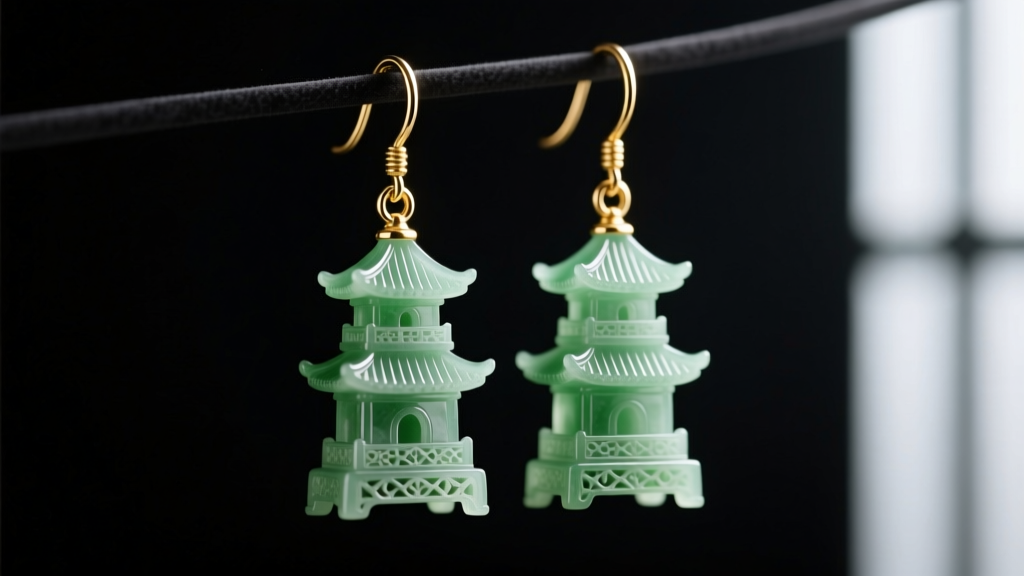
When collectors, bench jewelers, and gemologists discuss pagoda earrings, they are typically referencing one of two distinct categories: the intricate, tiered architectural drop earrings popularized during the Art Deco and Mid-Century periods, or the highly prized carved jade pagoda drops originating from East Asian lapidary traditions. Furthermore, the term "pagoda" is frequently used in jewelry engineering to describe a specific type of wide-base earring clutch designed to support heavy drops. This expert deep dive dissects the structural, metallurgical, and gemological realities of pagoda earrings, providing actionable data for collectors and serious enthusiasts navigating the 2026 vintage and bespoke jewelry markets.
The Dual Definition: Architectural Drops vs. Engineering Components
To properly evaluate pagoda earrings, one must first clarify the terminology. In a design context, a pagoda earring features a multi-tiered, stepped silhouette that mimics traditional Asian wooden or stone pagodas. This can be achieved through metalwork (such as stacked geometric bezels in 1920s Art Deco pieces) or through direct lapidary carving (such as mid-century jadeite drops). In a mechanical context, a "pagoda back" or "pagoda clutch" refers to a specialized earring finding. Because authentic carved jade pagodas and multi-tiered gold drops are exceptionally heavy, standard earring backs fail to distribute the weight, leading to lobe damage. The pagoda clutch was engineered specifically to solve this biomechanical problem.
Lapidary Deep Dive: Carved Jade Pagoda Earrings
Carved jade pagoda earrings are masterclasses in subtractive sculpture. The defining feature of a pagoda—the sweeping, extended eaves—presents a massive structural vulnerability in gem carving. A single miscalculation in grain orientation during the carving process can result in catastrophic shearing along the eaves.
Nephrite vs. Jadeite: Structural Integrity in Carvings
According to the Gemological Institute of America (GIA), "jade" is an umbrella term for two distinct minerals: nephrite and jadeite. For intricate pagoda carvings, the internal crystal structure dictates the survival rate of the piece.

- Nephrite: Composed of interlocking fibrous amphibole crystals. This felt-like matrix gives nephrite unparalleled toughness (resistance to breaking and chipping), making it the superior historical choice for the delicate, protruding eaves of a pagoda carving.
- Jadeite: Composed of granular pyroxene crystals. While it offers superior translucency and a wider color spectrum (like Imperial Green), its granular structure makes it more brittle. Carving extended pagoda eaves in jadeite requires the lapidary to meticulously map the cleavage planes to avoid structural failure.
The Threat of Type B and Type C Treatments
When sourcing vintage or antique jade pagoda earrings, structural degradation from chemical treatments is a primary concern. Historical jade carving techniques relied on natural abrasives, but modern market pressures have introduced severe chemical alterations.
| Jade Grade | Treatment Process | Impact on Pagoda Carving Integrity | Market Value Impact |
|---|---|---|---|
| Type A | None (Traditional plum wax polishing only) | Maximum structural integrity; eaves are stable. | Premium (Investment Grade) |
| Type B | Acid bleached & polymer-impregnated | Polymer degrades under UV/heat; eaves become brittle and prone to snapping. | Severe Depreciation |
| Type C | Chemically dyed | Dye concentrates in micro-fractures; highlights structural weaknesses in the tiers. | Negligible Collector Value |
Metallurgy & Engineering: Tiered Art Deco Pagoda Drops
For metal-based pagoda earrings, particularly those from the Art Deco era (1920-1935) or contemporary bespoke architectural lines, the engineering of the tiered connections is where most pieces fail. A five-tiered gold pagoda drop earring utilizes multiple jump rings and articulated hinges to allow the earring to move fluidly with the wearer.
Load-Bearing Mechanics and Gauge Specifications
The primary failure mode in tiered metal earrings is shear stress at the jump ring. If a heavy gold pagoda tier is suspended by a standard 22-gauge (0.64mm) jump ring, the constant kinetic movement of walking will cause metal fatigue, eventually pulling the ring apart at the seam.
Expert bench jewelers mandate the following specifications for articulated pagoda drops:
- Jump Ring Gauge: Minimum 18-gauge (1.02mm) for lower tiers bearing the most weight; 16-gauge (1.29mm) for the primary suspension ring connecting to the ear wire.
- Soldering Protocol: Jump rings must be soldered shut using hard solder (melting point approx. 1450°F / 788°C for 18k gold). Laser welding is increasingly preferred in 2026 for vintage restoration, as it avoids heating the entire tiered assembly, which could melt previous solder joints or damage heat-sensitive gemstone inlays like onyx or coral.
- Work Hardening: The ear wires themselves must be drawn to a half-hard or hard temper. A dead-soft 20-gauge ear wire will permanently deform under the 10-15 gram weight of a multi-tiered pagoda drop, causing the earring to hang at an awkward forward angle.
The "Pagoda Back": Ergonomics for Heavy Earrings
Heavy carved jade or solid gold pagoda earrings require specialized findings to prevent the "cheese-cutter effect"—a phenomenon where the thin post of a heavy earring slices downward through the earlobe piercing due to concentrated gravitational force.

Physics of the Pagoda Clutch
The pagoda clutch (often called a wide-base or fluted clutch) is engineered to increase the surface area against the posterior of the earlobe. According to the physical principle of pressure (P = F / A), increasing the area reduces the localized pressure.
"A standard butterfly clutch offers a contact area of roughly 15mm². A properly milled pagoda clutch features a fluted, domed base with a contact area exceeding 55mm². This disperses the kinetic and static load of a heavy pagoda earring by over 70%, effectively eliminating lobe fatigue and preventing piercing elongation."
Technical Specifications for Sourcing Pagoda Clutches:
- Post Hole Diameter: Must precisely match the earring post. For heavy pagodas, an 18-gauge (1.02mm) post is standard. The clutch aperture should be 1.05mm to allow for a friction-fit without bending the post during insertion.
- Base Material: Must be cast or machined from rigid metals (14k/18k gold, platinum, or surgical steel). Stamped sheet-metal pagoda backs will collapse and deform under the weight of heavy jade carvings.
- Friction Grooves: High-quality pagoda backs feature internal silicone or precision-milled metal grooves to grip the post's notch securely, preventing the heavy earring from slipping off during wear.
Sourcing, Pricing, and Authentication in 2026
Acquiring authentic pagoda earrings requires rigorous verification. For carved jade pieces, always demand a gemological report from a recognized laboratory (such as GIA, Gübelin, or SSEF) confirming Type A status. The presence of polymer resin in the crevices of the pagoda tiers is an immediate red flag for Type B treatment, which drastically compromises the structural integrity of the extended eaves.
For vintage Art Deco tiered metal pagodas, examine the solder joints under 10x magnification. Look for signs of lead-based soft solder repairs, which appear dull and granular, as opposed to the smooth, flowing seams of proper hard-silver or gold solder. Pricing for authentic, untreated mid-century jade pagoda earrings typically starts at $2,500 for commercial-grade nephrite and can easily exceed $45,000 for highly translucent, Imperial-grade jadeite with provenance. By understanding the lapidary risks, metallurgical requirements, and ergonomic findings inherent to these designs, collectors can confidently acquire and preserve these architectural masterpieces.


