Persian Turquoise Earrings: Gem Properties & Authenticity Guide
Explore the gemological properties of Persian turquoise earrings. Compare materials, analyze settings, and learn to identify authentic stones.

The Gemological Profile of Persian Turquoise
When evaluating high-end jewelry, few gemstones carry the historical weight and distinct material properties of Persian turquoise. Sourced primarily from the historic Neyshabur mines in Iran, this specific variety of copper aluminum phosphate (CuAl6(PO4)4(OH)8·4H2O) is celebrated for its intense, uniform "robin's egg" blue hue. According to the Gemological Institute of America (GIA), the absence of iron in the geological formation of Neyshabur turquoise prevents the formation of the brown or black matrix (veining) commonly seen in American varieties.
From a structural standpoint, natural Persian turquoise registers between 5.5 and 6 on the Mohs hardness scale. While this makes it harder than many other opaque gems like malachite (Mohs 3.5-4) or dyed howlite (Mohs 3.5), it remains significantly softer than quartz or sapphire. Its specific gravity ranges from 2.60 to 2.90, meaning a 12mm cabochon carries a noticeable, satisfying weight that directly impacts earring engineering and post-gauge requirements.
Material Comparison: Persian vs. American Turquoise vs. Imitations
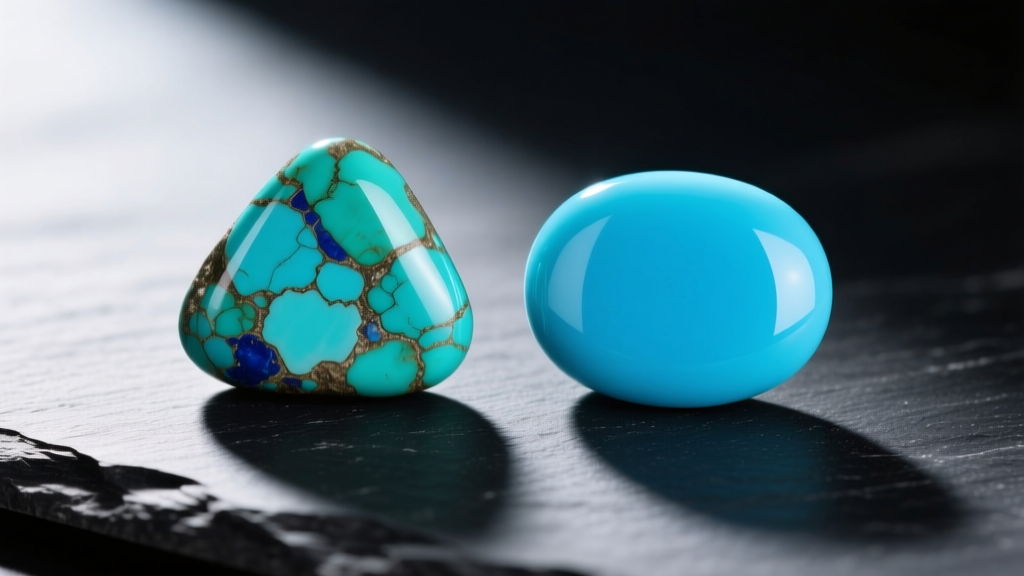
To understand the premium placed on authentic Persian turquoise earrings, we must compare its physical properties against other common market alternatives. American turquoise is frequently stabilized with epoxy resins to prevent crumbling, whereas high-grade Persian material is often left completely untreated due to its natural density.
| Material Type | Origin | Matrix Presence | Mohs Hardness | Common Treatments | Avg. Price per Carat |
|---|---|---|---|---|---|
| Persian (Neyshabur) | Iran | None to Very Sparse | 5.5 - 6.0 | None (Natural) or Zachery | $100 - $500+ |
| Sleeping Beauty | Arizona, USA | None | 4.5 - 5.5 | Epoxy Stabilization | $15 - $40 |
| Kingman | Arizona, USA | Heavy Black/Brown | 4.0 - 5.0 | Epoxy Stabilization | $5 - $25 |
| Dyed Howlite | Global | Fake Grey Veining | 3.5 | Dye + Resin Impregnation | < $1 |
As noted by mineralogical data on Mindat.org, the porous nature of lower-grade turquoise requires stabilization. However, the dense, high-grade Persian rough extracted from the upper levels of the Neyshabur mine possesses a natural, waxy luster that requires no chemical enhancement, making it the gold standard for luxury earring designers.
Earring Engineering: Settings and Gauge Specifications
Designing or purchasing Persian turquoise earrings requires specific structural considerations to protect the stone from impact and environmental degradation. Because turquoise lacks true cleavage but is inherently brittle, the choice of setting is critical.
Bezel vs. Prong Settings
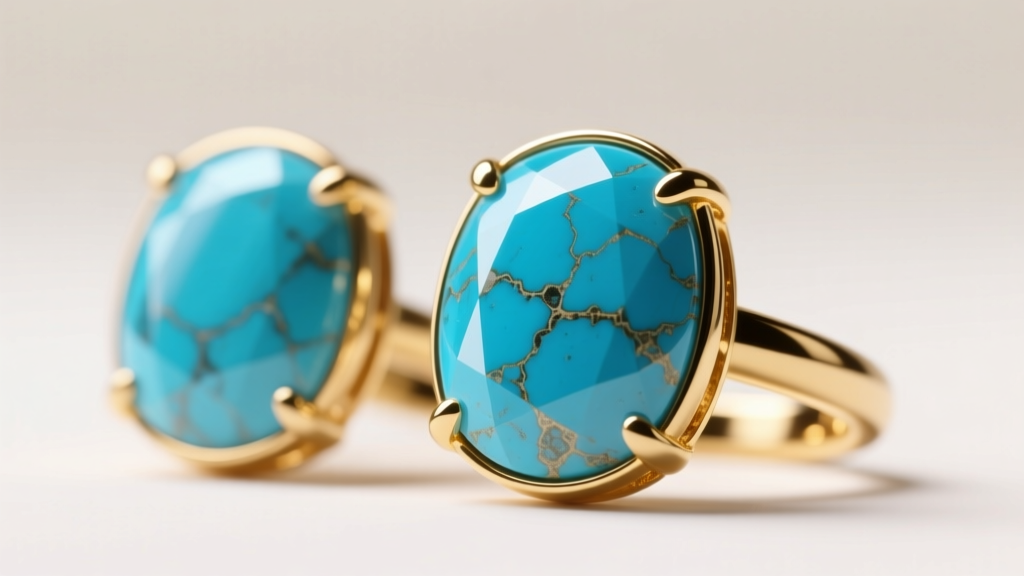
- Full Bezel Settings: The absolute best choice for turquoise. A continuous metal rim (usually 18k or 22k yellow gold to complement the blue) distributes pressure evenly around the cabochon's girdle, protecting the edges from chipping.
- Prong Settings: Highly discouraged. Prongs exert concentrated point-pressure on the stone. Over time, temperature fluctuations and minor impacts can cause the turquoise to fracture or crack directly beneath the prong head.
- Flush/Gypsy Settings: Acceptable for smaller stud earrings (under 8mm), but the stone must be perfectly calibrated to avoid stress fractures during the setting process.
Post Thickness and Earring Backs
Standard commercial earrings often use 22-gauge (0.64mm) or 20-gauge (0.81mm) posts. However, genuine Persian turquoise is heavy. For drop earrings or dangles featuring stones larger than 12mm, a 22-gauge post will easily bend under the stone's specific gravity, causing the earring to hang crookedly and eventually snap. Always look for 18-gauge (1.02mm) or 19-gauge (0.91mm) posts for larger turquoise drops, paired with secure jumbo friction backs or screw-backs to prevent loss.
Identifying Treatments and Imitations
The market is saturated with treated stones and outright fakes masquerading as Persian turquoise. Understanding the failure modes of these imitations is essential for any serious collector.
The Zachery Treatment
Developed in the 1990s, the Zachery method treats turquoise with a potassium silicate solution. Unlike traditional epoxy stabilization, which leaves a plastic-like feel and can yellow under UV exposure, the Zachery treatment enhances the stone's hardness and polish without introducing polymers. It is virtually undetectable without advanced EDXRF (Energy Dispersive X-Ray Fluorescence) testing, which looks for the elevated potassium levels introduced by the process.
Spotting Dyed Howlite and Block Turquoise
Dyed howlite is the most common counterfeit. Under a 10x jeweler's loupe, howlite reveals its deception through dye concentration. The grey veining in howlite is softer and more porous than the surrounding white material, causing the blue dye to pool and darken in the crevices. Furthermore, howlite will react with a drop of acetone, transferring blue dye to the cotton swab, whereas natural or Zachery-treated Persian turquoise will not.
"When evaluating high-value Persian turquoise earrings, always examine the drill holes. In natural stones, the hole is clean and sharp. In resin-stabilized or block turquoise, the drill hole often appears melted, rounded, or shows a glassy resin ring where the drill bit generated heat."
Pricing and Market Value in 2026
The closure of many historic Neyshabur shafts and strict export regulations have severely constrained the supply of natural, untreated Persian turquoise. Consequently, prices have appreciated significantly. A pair of high-grade, untreated 10mm round cabochon studs (weighing approximately 4.5 carats each) set in 18k gold bezels will typically retail between $1,200 and $3,500. Conversely, stabilized American turquoise earrings of the exact same dimensions rarely exceed $300. Buyers must demand independent gemological lab reports verifying the absence of polymer impregnation when paying Persian premiums.
Care and Maintenance for Porous Gems
Turquoise is highly susceptible to chemical alteration. The copper content that gives Persian turquoise its blue color can react with acids, oils, and cosmetics, causing the stone to slowly turn a muddy green over time. To preserve your earrings:
- The "Last On, First Off" Rule: Always put your earrings on after applying perfume, hairspray, and lotions. Remove them immediately upon returning home.
- Avoid Ultrasonic Cleaners: The high-frequency vibrations can shatter micro-fractures within the stone, and the cleaning solutions will strip the natural waxes from the surface.
- Proper Storage: Store turquoise earrings in a soft, dry cloth pouch. Do not store them in airtight plastic bags, as turquoise requires a minimal amount of ambient moisture to prevent dehydration and subsequent crazing (surface cracking).
- Water Exposure: Never wear turquoise earrings in the shower or swimming pool. Chlorine and harsh soaps will permanently dull the stone's waxy luster.
By understanding the unique material properties, structural requirements, and market realities of Persian turquoise, you can confidently select earrings that are not only visually stunning but engineered to last generations.


