The Photo Frame Earring Holder: A Technical Deep Dive
Master the mechanics of the photo frame earring holder. Explore mesh gauges, load-bearing limits, and archival anti-tarnish materials for jewelry storage.

Introduction: Beyond the DIY Craft
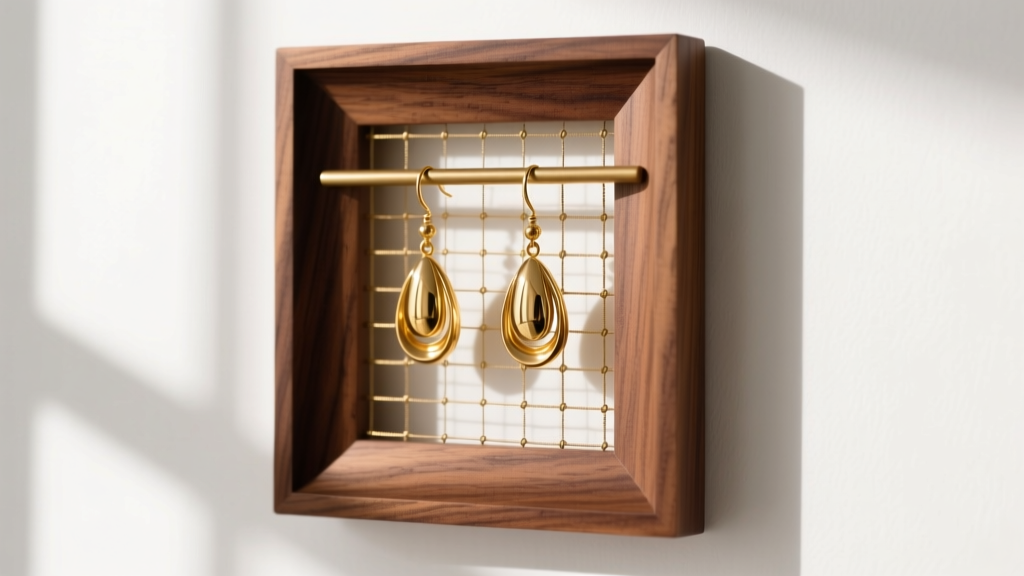
Most online tutorials treat the photo frame earring holder as a simple weekend craft project, focusing purely on aesthetics while ignoring the underlying physics of jewelry storage. In reality, engineering a reliable suspension system for fine jewelry requires a rigorous understanding of material science, load distribution, and archival preservation. When suspending everything from lightweight titanium studs to 40-gram gold chandelier dangles, the structural integrity of your frame and matrix is paramount.
As we move through 2026, advancements in anti-tarnish textiles and precision-cut framing materials have elevated this storage method from a makeshift hack to a museum-grade display solution. This guide deconstructs the technical specifications required to build or evaluate a premium photo frame earring holder capable of supporting a high-value collection without risking structural failure or chemical degradation.
The Anatomy of a Premium Photo Frame Earring Holder
Frame Material and Moisture Tolerances
The outer frame is the primary load-bearing chassis. While medium-density fiberboard (MDF) is common in mass-produced frames, it is fundamentally unsuitable for fine jewelry storage. MDF is highly hygroscopic; it absorbs ambient humidity and can swell or warp, altering the tension of the mesh matrix. Furthermore, standard MDF off-gasses trace amounts of formaldehyde and sulfur compounds, which can accelerate tarnish in porous gemstones like pearls or opals.
For a high-end build, kiln-dried hardwoods (such as walnut, cherry, or quartersawn oak) milled to a 6-8% moisture content are mandatory. According to Wood Magazine, understanding wood movement is critical when sizing the inner rabbet. Hardwood will expand and contract across the grain with seasonal humidity shifts. A proper photo frame earring holder must feature a 1/4-inch expansion gap between the mesh backing board and the frame rabbet to prevent the wood from buckling the wire matrix during high-humidity summer months.
Joinery and Corner Reinforcement
The sheer weight of a fully loaded frame—often exceeding 1.5 kilograms when holding 50+ pairs of hoops and drops—places immense rotational torque on the mitered corners. Standard V-nails alone will eventually fail under this dynamic load. The industry standard for archival framing utilizes a combination of aliphatic resin (PVA) wood glue, corrugated fasteners driven perpendicular to the miter line, and reinforced steel corner brackets.
Engineering the Suspension Matrix
The matrix (the mesh or screen material) is the functional core of the photo frame earring holder. It must withstand the localized sheer force of heavy earring hooks without sagging, tearing, or scratching the metal of the jewelry.
| Material | Optimal Gauge | Tensile Strength | Grid Spacing | Best For |
|---|---|---|---|---|
| Stainless Steel (304) | 24-gauge (0.020") | High | 1/4" (6mm) | Heavy chandelier dangles, large hoops |
| Brass Wire | 26-gauge (0.016") | Medium | 1/8" (3mm) | Leverbacks, standard fish hooks |
| Copper Screen | 30-gauge (0.010") | Low | 1/16" (1.5mm) | Lightweight studs, ear cuffs (with backing) |
| Archival Linen | N/A (Woven) | Variable | Tight Weave | Friction-back studs, clip-ons, vintage pieces |
Hook Geometry and Grid Compatibility
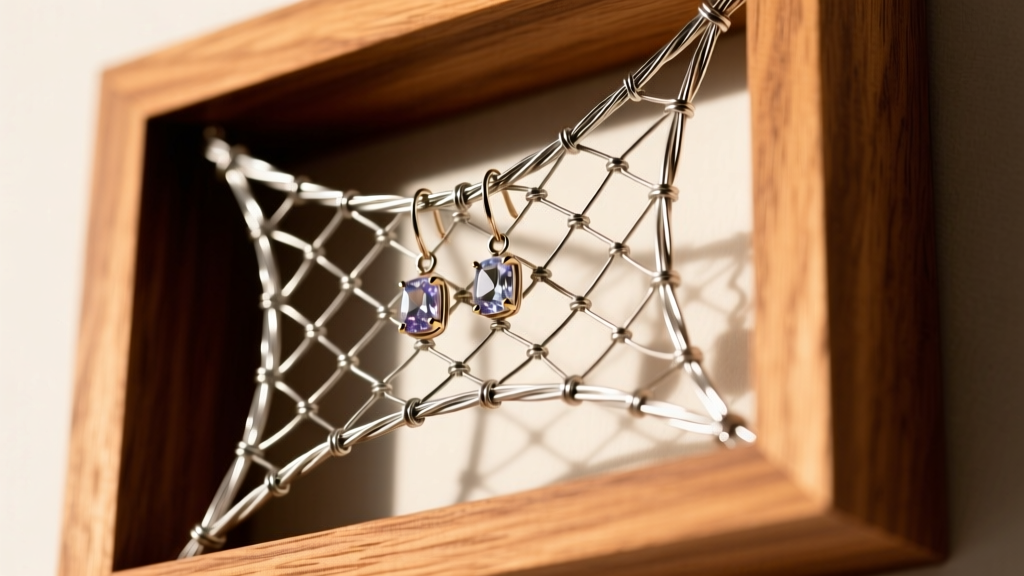
The spacing of your wire mesh must correspond to the wire gauge of the earrings themselves. Standard earring wires are typically 20-gauge or 22-gauge. If your mesh grid spacing is too tight (e.g., 1/8 inch), users will be forced to angle the earring hook to pass through, causing microscopic abrasions on both the earring wire and the mesh. A 1/4-inch (6mm) grid spacing accommodates standard fish hooks and leverbacks seamlessly, allowing them to slide in and out vertically without friction.
Archival Preservation and Anti-Tarnish Linings
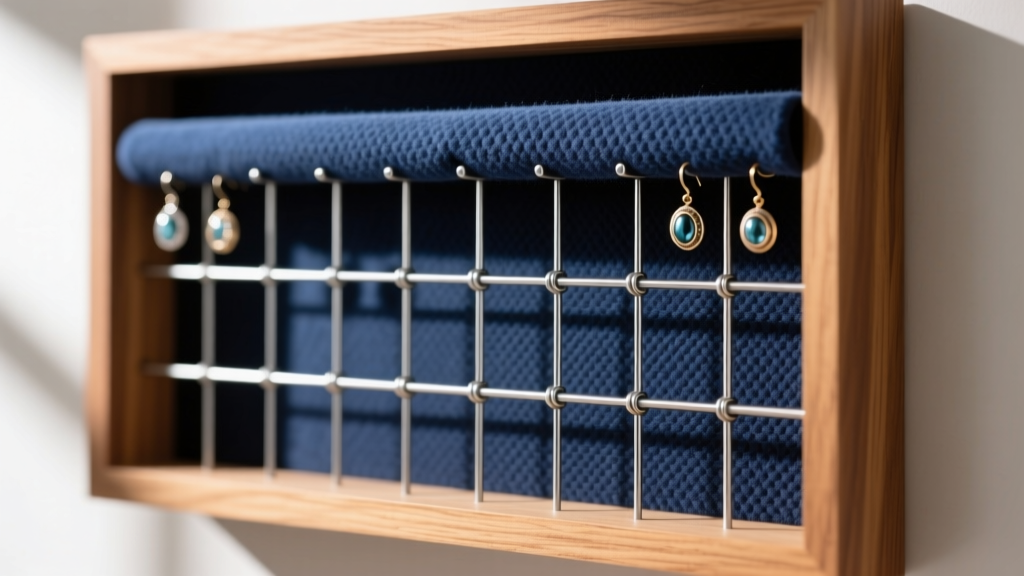
For collectors who prefer a fabric-backed photo frame earring holder—which is vastly superior for push-through studs, huggies, and clip-ons that cannot hang on a wire grid—the choice of textile is a matter of chemical preservation. Standard craft felt and polyester blends often contain sulfur-based dyes and acidic sizing agents that actively promote silver sulfide formation (tarnish).
Nano-Zinc and Silvercloth Technologies
Modern archival storage relies on reactive metal technologies. The GIA Gem Encyclopedia notes that silver tarnish is primarily caused by hydrogen sulfide in the atmosphere. To combat this, premium fabric matrices are now woven with nano-zinc particles or embedded with fine silver filaments (such as Pacific Silvercloth). These materials act as sacrificial anodes, absorbing and neutralizing H2S gases before they can reach your sterling silver or white gold jewelry.
'When designing a fabric-backed holder, never use standard hot glue or spray adhesives to mount the textile to the backing board. The solvents in these adhesives will off-gas and degrade the anti-tarnish properties of the fabric. Use acid-free linen tape or mechanical stretching over an acid-free foam core instead.' — Master Framer & Archival Conservator Guidelines, 2025.
Load Distribution and Sag Prevention
A common failure mode in large-format photo frame earring holders (e.g., 16x20 inches or larger) is matrix sag. When the center of the mesh bows outward, it alters the hanging angle of the earrings, causing dangles to tangle and putting uneven stress on the earring wires.
The Dual-Layer Tensioning System
To achieve a perfectly planar suspension surface, expert builders utilize a dual-layer system. The primary layer is the aesthetic and functional matrix (e.g., polished brass wire). The secondary layer, mounted 1/2 inch behind the primary matrix, is a rigid, welded steel grid. The primary mesh is lashed to the rigid grid at 2-inch intervals using ultra-high-molecular-weight polyethylene (UHMWPE) thread. This ensures that the localized weight of a 30-gram drop earring is distributed across a wide area of the rigid steel backbone, completely eliminating sag.
Troubleshooting Common Structural Failures
Even well-intentioned builds can suffer from mechanical failures over time. Here is how to diagnose and rectify the most common issues encountered with heavy-duty earring displays.
Issue 1: Mesh Tearing at the Rabbet Line
Diagnosis: The wire mesh was stapled directly into the softwood or MDF rabbet of the frame. The sharp edges of the staples, combined with the tension of the wire, cause the mesh to shear off over time.
Solution: Never staple wire mesh directly to the frame. Instead, cut a rigid backing board (such as 1/8-inch birch plywood) to the exact inner dimensions of the frame. Wrap the mesh over the plywood and staple it to the back face of the wood. The entire plywood panel is then press-fit into the frame's rabbet and secured with flexible framing points.
Issue 2: Earring Snagging and Scratching
Diagnosis: The cut ends of the wire mesh were left exposed on the front-facing side of the frame.
Solution: Always fold the cut edges of the wire mesh under the backing board. If using a metal frame where wrapping is impossible, apply a thin bead of clear, non-yellowing epoxy resin over the cut wire ends to create a smooth, protective barrier that will not catch delicate filigree or gemstone settings.
Conclusion
Building or selecting the ultimate photo frame earring holder is an exercise in precision engineering. By prioritizing kiln-dried hardwoods, calculating the correct mesh gauge for your specific jewelry profile, and integrating modern anti-tarnish textiles, you transform a simple wall decoration into a functional, archival-grade vault. Whether you are suspending delicate platinum studs or heavy artisan brass dangles, respecting the material science behind the frame ensures your collection remains secure, untangled, and perfectly preserved for decades to come.


