Cartilage Chain Earring Materials: Titanium vs Gold Guide
Compare implant-grade titanium, 14k gold, and surgical steel for your cartilage chain earring. Learn which metals prevent irritation.

The Biomechanics of Cartilage Chain Earrings
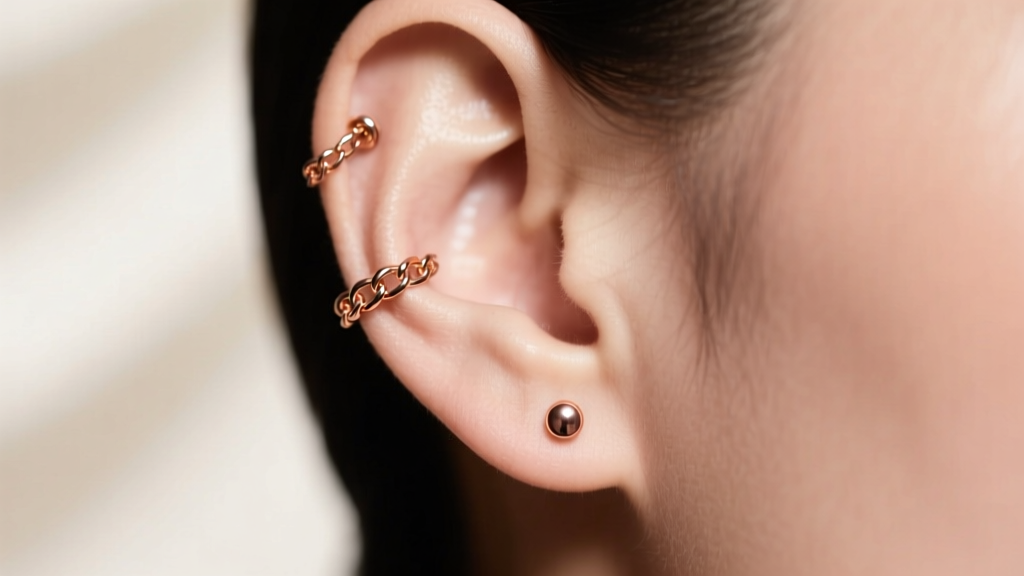
A cartilage chain earring is a striking aesthetic choice, typically bridging two distinct piercings—such as a lobe to a helix, or a double forward helix setup. However, connecting two independent fistulas with a flexible metal tether introduces complex biomechanical stress. Unlike standard earlobe tissue, auricular cartilage is avascular, meaning it lacks direct blood flow and relies on surrounding perichondrium for nutrient delivery and healing. When a chain snags on hair or clothing, the kinetic energy transfers directly to the anchor points, causing micro-tears in the delicate fistula lining.
This tension is the primary catalyst for hypertrophic scarring, commonly known as irritation bumps. Therefore, the material of your cartilage chain earring must satisfy two non-negotiable criteria: absolute biocompatibility to prevent contact dermatitis, and high tensile strength to resist warping under sudden lateral force. In this guide, we dissect the metallurgical properties of the most common jewelry alloys to help you build a safe, durable, and visually stunning chain setup.
Material Breakdown: Tensile Strength & Biocompatibility
Not all metals are created equal when subjected to the harsh, saline environment of a healing or mature piercing tract. The Association of Professional Piercers (APP) maintains strict guidelines on acceptable body jewelry materials, emphasizing the need for mirror finishes and specific alloy compositions.
Implant-Grade Titanium (ASTM F136)
For any cartilage chain earring, especially in fresh piercings or highly reactive ears, Implant-Grade Titanium (Ti6Al4V ELI, compliant with ASTM F136) is the undisputed gold standard. This specific alloy contains aluminum and vanadium for structural integrity but is entirely free of nickel. Titanium boasts an exceptional strength-to-weight ratio, meaning a 16-gauge titanium chain will exert significantly less gravitational drag on a helix piercing than an equivalent steel chain. Furthermore, titanium can be anodized using voltage to create vibrant, permanent oxide layer colors—like deep blues, purples, and golds—without the use of toxic dyes or plating that can flake off inside the fistula.
Solid 14k and 18k Gold
Gold is highly coveted for its luster and prestige, but its metallurgical reality requires careful navigation. Pure 24k gold is far too malleable for a cartilage chain earring; a heavy chain link will easily stretch and snap under minor tension. Therefore, gold must be alloyed. For body jewelry, you must seek out nickel-free 14k or 18k gold, typically alloyed with palladium or silver to maintain a white or yellow hue without introducing allergens. According to the American Academy of Dermatology (AAD), nickel allergies are among the most common causes of contact dermatitis, making nickel-free verification mandatory. High-quality brands like BVLA and Anatometal cast their gold using specialized palladium alloys that ensure both hypoallergenic properties and the tensile rigidity required for chain links.
The Surgical Steel (316L) Trap
Often marketed as 'hypoallergenic' by fast-fashion retailers, 316L Surgical Steel is a suboptimal choice for a cartilage chain earring. While the steel itself is highly polished and corrosion-resistant, it inherently contains between 8% and 10.5% nickel. In a static piece like a thick barbell, the nickel is often trapped within the crystalline structure of the steel. However, chain links experience constant friction against one another and the skin. This micro-abrasion can expose the nickel matrix, triggering localized allergic reactions, weeping, and subsequent irritation bumps in sensitive wearers. For cartilage chains, the risk-to-reward ratio of 316L steel is simply too high.
Chain Link Profiles and Snag Risks
The structural geometry of the chain links dictates how the earring drapes, how much it weighs, and, most importantly, how likely it is to snag on a sweater or towel. Choosing the right link profile is crucial for mitigating the 'cheese-cutter effect,' where a heavy, thin chain slowly migrates through the cartilage tissue over time due to constant downward pressure.
| Link Profile | Average Thickness (16G) | Snag Risk | Best Application |
|---|---|---|---|
| Cable | 1.2mm - 1.5mm | High | Short, taut lobe-to-helix bridges |
| Rolo | 1.6mm - 2.0mm | Low | Longer drapes, double flat connections |
| Curb | 2.0mm - 3.0mm | Medium | Heavy aesthetic, requires 14G anchors |
| Wheat | 1.5mm - 2.5mm | Very Low | Fluid movement, complex multi-piercing webs |
For setups connecting a lobe to a high helix, a Rolo chain is often the safest bet. The uniform, rounded links distribute weight evenly and lack the sharp, elongated edges of a cable chain that catch on hair. If you prefer a heavier, more industrial look with a Curb chain, you must upgrade your anchor piercings to 14-gauge (1.6mm) to provide a sufficient tissue base that can support the increased mass without migrating.
Anchor Points: Gauge Sizing and Threading Types
A cartilage chain earring is only as secure as the posts anchoring it to your ear. The connection between the chain and the anchor post introduces another point of potential failure.
- Gauge Sizing: Standard cartilage piercings are usually done at 16-gauge (1.2mm). However, if your chain spans more than two inches or features dense link profiles, the lateral pull can irritate a 16G fistula. Upgrading the anchor posts to 14-gauge (1.6mm) provides a wider surface area inside the piercing, dispersing the tension and drastically reducing the chance of rejection or migration.
- Threadless (Press-Fit) vs. Internally Threaded: This is a critical distinction. Chains naturally twist and rotate as you move. If your chain is attached via a tiny jump ring to an internally or externally threaded bead, the constant rotational friction will inevitably unscrew the bead, causing you to lose the earring. Threadless (press-fit) jewelry utilizes a bent pin that locks into the hollow shaft of the post via tension. This mechanical lock is entirely immune to rotational unscrewing, making it the mandatory choice for securing the anchor ends of a chain earring.
Real-World Troubleshooting: Irritation Bumps & Chain Tension
Even with perfect ASTM F136 titanium and threadless anchors, improper chain length can wreak havoc on your cartilage. If a chain is measured too tightly, it will pull the two piercings toward each other, creating a 'bowstring' effect that places immense pressure on the fistula walls. Conversely, a chain that is too long will loop and catch on external objects.
The Taping Method for Sleep: The most common time for cartilage chain earrings to cause trauma is during sleep. Tossing and turning can wrap the chain around the ear, leading to severe tearing. A practical, professional workaround is to use a small piece of porous, hypoallergenic medical tape (like 3M Micropore) to gently secure the chain flat against the skin of the ear at night. This immobilizes the links and prevents nocturnal snagging while allowing the skin to breathe.
Managing the 'Cheese-Cutter' Effect: If you notice the piercing hole elongating vertically, or if the jewelry begins to sit visibly lower in the tract, you are experiencing the cheese-cutter effect. This occurs when the chain is too heavy for the gauge of the wire passing through the cartilage. The immediate remedy is to downsize the chain weight or upsize the anchor wire to 14G or even 12G (2.0mm) to increase the tissue-bearing surface area.
Final Verdict: Building Your Custom Setup
Designing the perfect cartilage chain earring requires balancing aesthetic desires with anatomical realities. For the ultimate combination of lightweight comfort, absolute biocompatibility, and structural longevity, a custom setup featuring 16-gauge or 14-gauge ASTM F136 Implant-Grade Titanium with threadless anchor ends is the superior choice. If your budget allows for precious metals, ensure your 14k or 18k gold is explicitly certified as nickel-free and palladium-alloyed to withstand the rigors of daily wear. By respecting the biomechanics of your ear and selecting materials engineered for the human body, your chain setup will remain a secure, irritation-free statement piece for years to come.


