Princess Wales Greville Earrings: Gemological Deep Dive
Explore the technical gemology, Boucheron craftsmanship, and lobe mechanics behind the iconic Princess Wales Greville emerald chandelier earrings.

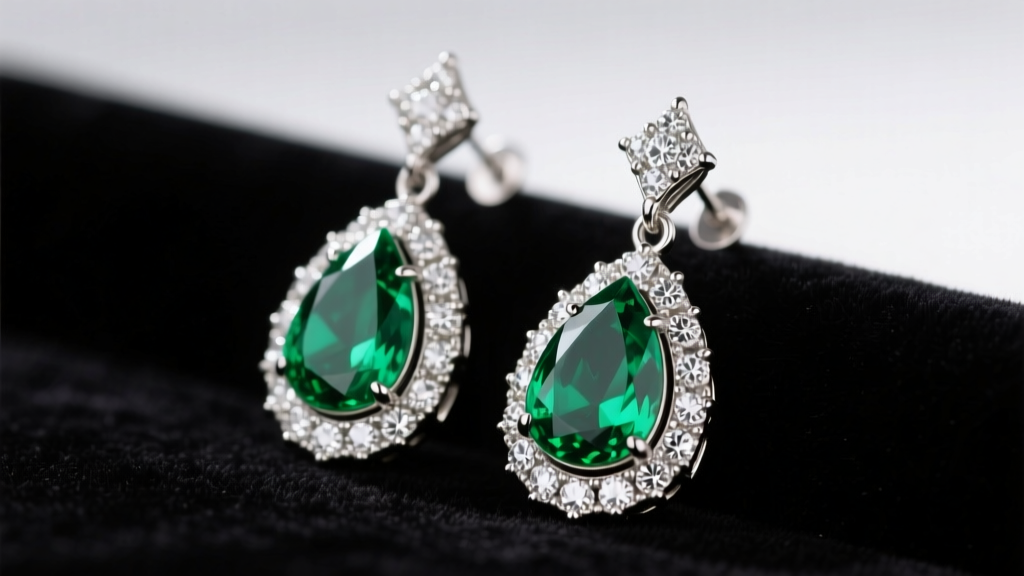
The global fascination with royal jewelry often centers on historical provenance, but for high jewelry specialists and bench jewelers, the true intrigue lies in structural engineering and gemological superiority. When examining the princess wales greville earrings—specifically the legendary Greville Emerald Chandelier earrings frequently worn by Kate, Princess of Wales—we are looking at a masterclass in 1920s lapidary work, platinum articulation, and weight distribution. This technical deep dive bypasses the standard royal gossip to analyze the exact metallurgical specs, gemological profiles, and structural mechanics that keep these multi-tiered drops secure and visually flawless.
The Historical Provenance: Boucheron and the Greville Bequest
Commissioned in 1929 by the Honorable Mrs. Ronnie Greville from the venerable Parisian maison Boucheron, these chandelier earrings represent the zenith of Art Deco transition into late-Edwardian romanticism. Mrs. Greville’s extensive jewelry collection was bequeathed to Queen Elizabeth (later the Queen Mother) in 1942, eventually passing to Queen Elizabeth II, and now frequently gracing the Princess of Wales. Unlike standard drop earrings, chandelier earrings of this era required bespoke armature designs to support the sheer carat weight of the lower-tiered gemstones without warping the primary lobe piercing.
Gemological Breakdown: Colombian Emeralds and Diamond Melee
The visual impact of the Greville earrings relies on the stark chromatic contrast between deep green beryl and high-color diamond melee. To understand their value, we must look at the stones through the lens of a certified gemologist.
Emerald Origin and Treatment
The primary pear-shaped emerald drops are widely believed by royal jewelry historians to be of Colombian origin, likely extracted from the Muzo or Chivor mines, which were the premier sources for high-saturation beryl in the early 20th century. According to the Gemological Institute of America (GIA), Colombian emeralds are prized for their pure green hue driven by chromium and vanadium trace elements. Under 10x loupe magnification, these stones typically exhibit characteristic three-phase inclusions (liquid, gas, and solid crystals) known as jardin. Because emeralds rank a 7.5 to 8 on the Mohs hardness scale and are inherently brittle, the original Boucheron lapidaries utilized specialized rub-over and partial-bezel settings to protect the vulnerable culets and girdles of the pear cuts.
Diamond Accent Configurations
The surmounts and intermediate articulation links are paved with brilliant-cut and transitional-cut diamonds. In 1929, the modern round brilliant cut was still being refined by Marcel Tolkowsky’s mathematical proportions. Therefore, the melee diamonds in the Greville earrings likely feature slightly higher crowns and smaller tables characteristic of transitional cuts, which scatter light in a softer, more diffuse pattern compared to the laser-sharp scintillation of 2026 precision-cut diamonds. The total estimated diamond weight per earring exceeds 8 carats, set exclusively in platinum to maximize light return without the color interference of yellow gold.
Structural Engineering of Chandelier Mechanics
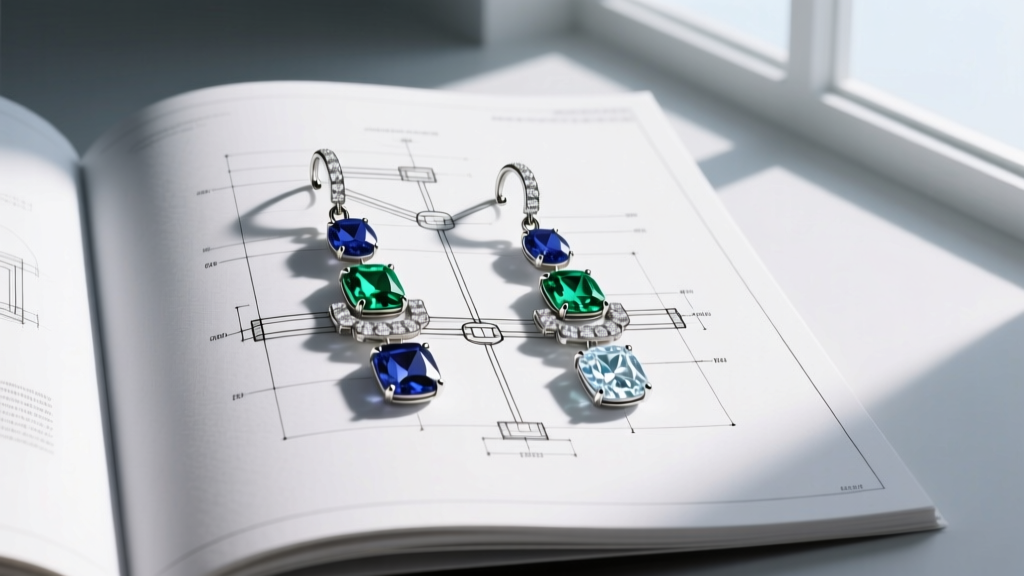
The defining feature of any chandelier earring is its articulation. If a multi-tiered earring is rigid, it will snap under lateral torque or tear the earlobe. The Greville earrings utilize a network of micro-jump rings to allow kinetic movement.
- Jump Ring Specifications: The connecting links are typically forged from 950 platinum wire, measuring approximately 0.9mm in outer diameter with a wire gauge of 18G (1.02mm). Platinum’s high tensile strength prevents these micro-rings from pulling open under the pendulum effect of walking.
- Center of Gravity: Boucheron engineered the diamond-set geometric surmounts to sit flush against the earlobe, acting as a counter-lever to the heavy pear-shaped emerald drops suspended below.
- Bezel Articulation: The emeralds are not drilled. Drilling compromises the structural integrity of included beryl. Instead, they are suspended via custom-fitted platinum basket settings that hook into the lowest diamond-set link.
Weight Distribution and Lobe Stress
High jewelry chandelier drops of this volume typically weigh between 18 and 26 grams per earring. Standard friction posts and butterfly backs are entirely insufficient for this mass, leading to the dreaded "cheese-cutter effect," where thin metal slowly slices through the earlobe tissue over time.
| Backing Mechanism | Weight Capacity | Lobe Stress Distribution | Security Rating |
|---|---|---|---|
| Standard Friction Post (20G) | Up to 8g | High (Concentrated point) | Poor |
| Omega Clip with Hinged Post | Up to 25g | Moderate (Wide base support) | Good |
| Screw-Back with Jumbo Silicone Clutch | Up to 30g | Low (Threaded grip + wide surface) | Excellent |
| French Clip (No Piercing) | Up to 15g | Moderate (Pinch tension) | Moderate |
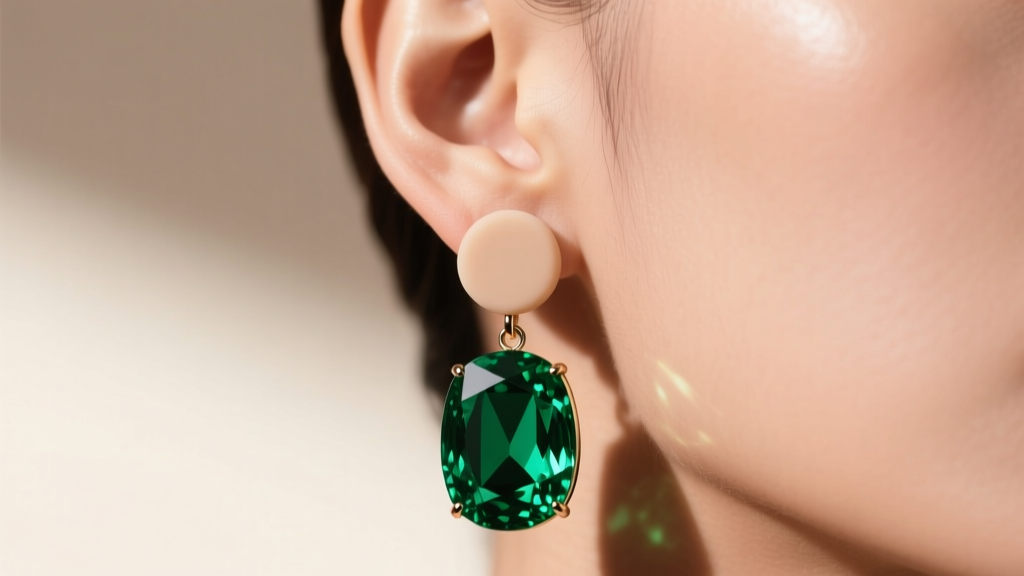
For modern bespoke jewelers recreating the princess wales greville earrings aesthetic, utilizing a 16-gauge (1.29mm) or 14-gauge (1.63mm) threaded post paired with a jumbo silicone stabilizer disc is mandatory to disperse the 20+ gram load across a wider surface area of the earlobe.
Replicating the Royal Aesthetic in 2026
While the original Boucheron pieces remain securely vaulted in the Royal Collection Trust, the demand for chandelier emerald drops has surged. Modern bench jewelers approaching this design must navigate updated ethical sourcing and advanced metallurgical options.
Sourcing Ethical and Lab-Grown Alternatives
In 2026, sourcing natural, untreated Colombian emeralds of the size required for chandelier drops is prohibitively expensive and fraught with supply chain opacity. Many high-end custom houses now utilize Chatham-created lab-grown emeralds. These hydrothermal synthetic beryls share the exact chemical composition (Be3Al2(SiO3)6) and specific gravity (2.67-2.78) as their mined counterparts but are grown in controlled environments, eliminating the need for cedar oil or Opticon fracture-filling treatments that complicate long-term conservation.
Modern Platinum Alloys
While the original 1929 pieces were cast in early platinum-iridium alloys, modern replicas benefit from 950 Platinum-Ruthenium (95% Pt, 5% Ru). This specific alloy provides superior hardness and a higher melting point, allowing for incredibly precise laser welding of the micro-jump rings without risking thermal shock to the adjacent emerald girdles.
Conservation and Maintenance Protocols
Owning or curating heavy, multi-tiered emerald chandelier earrings requires strict adherence to conservation protocols. The most common failure mode for vintage chandelier earrings is metal fatigue at the articulation points.
"Ultrasonic cleaners are strictly contricated for any emerald jewelry. The high-frequency cavitation will violently expel the natural oils and resins used to fill surface-reaching fissures in the beryl, leaving the stones looking cloudy and heavily fractured within minutes." — Senior Bench Jeweler & Conservator
Instead, maintenance must be performed using a soft goat-hair brush, lukewarm distilled water, and a pH-neutral surfactant. The platinum jump rings should be inspected under a stereo microscope every 24 months for signs of metal thinning or ovalization. If a jump ring shows more than 15% wear at the friction point, it must be cut out and replaced by a master jeweler using argon-arc welding to protect the surrounding diamond pavé from heat damage. By respecting the mechanical limits and gemological vulnerabilities of these magnificent pieces, collectors can ensure their chandelier earrings remain structurally sound and optically brilliant for generations.


