Red Beaded Earrings: A Technical Guide to Materials & Wear
Explore the material science, structural engineering, and authenticity testing of red beaded earrings in this expert technical guide.

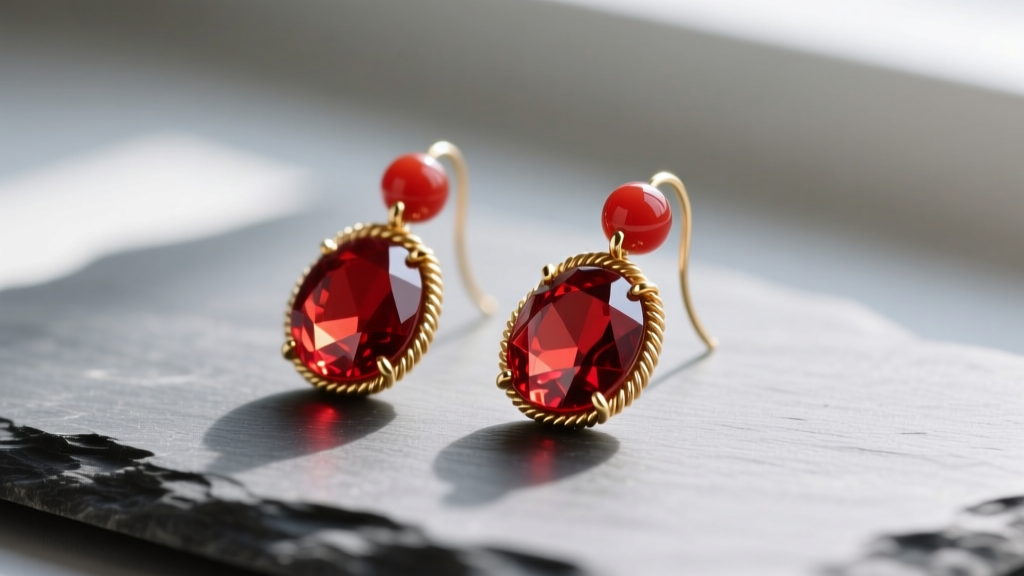
The visual dominance of red beaded earrings relies on the specific light-absorption properties of transition metal impurities—namely iron oxide in carnelian, organic pigments in coral, or cobalt and copper in lampwork glass. However, from an engineering perspective, constructing and wearing these pieces requires a rigorous understanding of material hardness, specific gravity, and wire temper. A poorly engineered beaded drop earring will suffer from catastrophic wire fatigue, lobe stretching, or bead abrasion within weeks of daily wear.
This technical deep dive bypasses aesthetic generalizations to examine the metallurgy, gemology, and biomechanics that dictate the longevity and comfort of red beaded earrings. Whether you are sourcing components, designing custom pieces, or evaluating high-end artisan jewelry, these material parameters are non-negotiable.
Material Matrix: Decoding the 'Red' Spectrum
Not all red beads possess the same structural integrity or weight profile. The specific gravity (SG) of a bead directly correlates to its gram weight, which in turn dictates the necessary gauge of the supporting earwire and headpin. Below is a comparative analysis of the four most common red bead materials used in premium earring fabrication.
| Material | Mohs Hardness | Specific Gravity | UV Stability | Optimal Finding Gauge |
|---|---|---|---|---|
| Carnelian (Quartz) | 6.5 - 7.0 | 2.58 - 2.64 | Excellent | 20g (0.81mm) Half-Hard |
| Lampwork Glass | 5.5 - 6.0 | 2.40 - 2.80 | High (Cobalt/Copper) | 20g (0.81mm) Dead-Soft |
| Dyed Coral (Organic) | 3.5 - 4.0 | 2.60 - 2.70 | Poor (Fades/Chalks) | 22g (0.64mm) Wrapped |
| Acrylic / Resin | 2.0 - 3.0 | 1.18 - 1.20 | Moderate (Yellows) | 24g (0.51mm) or Thread |
According to the Gemological Institute of America (GIA), carnelian's cryptocrystalline quartz structure makes it highly resistant to scratching, but its high SG means a 15mm round bead can easily exceed 4 grams. When multiplied by the hardware and a dangle leverback, the total earring weight can approach the biomechanical threshold for earlobe fatigue.
The Physics of Dangles: Weight and Lobe Biomechanics
The human earlobe is composed of fibro-fatty tissue lacking cartilage support. When red beaded earrings are designed as dangles or drops, the center of gravity shifts away from the piercing axis, creating a pendulum effect. This dynamic loading exerts sheer stress on the piercing fistula.
Clinical observations in dermatological and piercing communities suggest that continuous wear of earrings exceeding 14 grams per lobe accelerates tissue elongation and fistula stretching. Because gemstone and glass beads are dense, a pair of 20mm carnelian drops with brass hardware will routinely hit 12-16 grams. To mitigate this, expert jewelers employ specific hardware geometries:
- French Wire (Fishhook): Standard 20-gauge wire distributes weight across the lower curve of the ear. However, the pivot point at the front of the lobe experiences high friction.
- Leverback with Shield: A wider, flattened back-plate increases the surface area against the rear of the lobe, dispersing the pendulum load and reducing the risk of the 'cheese-cutter' effect.
- Silicone O-Rings: Adding a 2mm silicone stopper behind the earwire prevents the heavy bead from pulling the earring forward, maintaining a vertical drop and reducing lateral torque on the piercing.
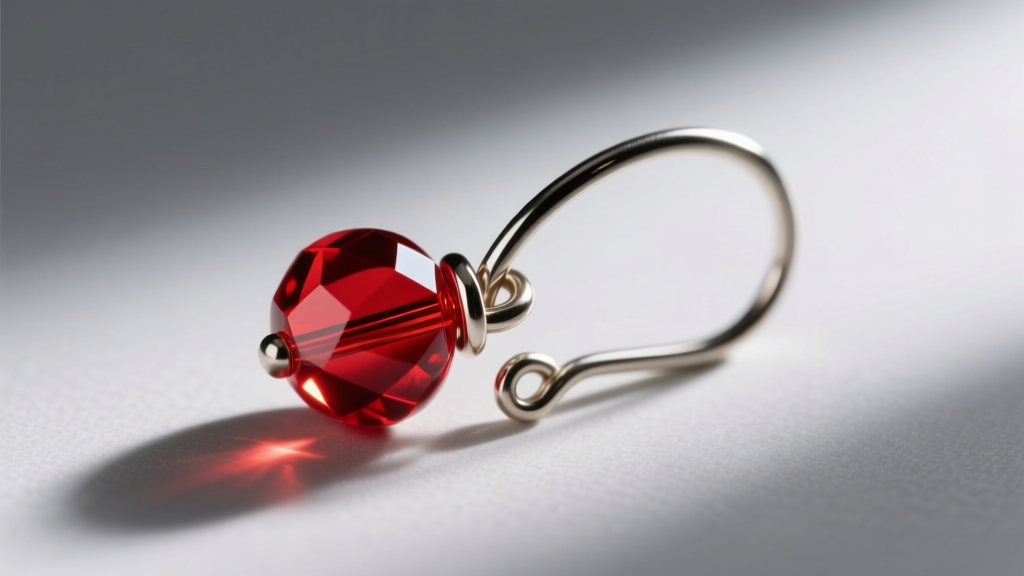
Niobium vs. Titanium Earwires
For heavy red glass or stone beads, the choice of earwire material is critical. Commercially pure titanium (Grade 1 or 2) offers immense tensile strength but is notoriously stiff, making it difficult to adjust the tension loop without specialized nylon-jaw pliers. Niobium, conversely, is highly malleable, hypoallergenic, and can be anodized to a deep crimson to color-match the red beads, creating a seamless visual line from hardware to gemstone.
Wire Wrapping vs. Stringing: Failure Modes and Tolerances
The most common point of catastrophic failure in red beaded earrings is the connection between the bead and the earwire. This junction must withstand repetitive micro-impacts as the wearer walks or turns their head.
The Abrasion Factor
Quartz-family beads (carnelian, red agate, jasper) have a Mohs hardness of 7.0. Standard sterling silver or copper wire has a Mohs hardness of roughly 2.5 to 3.0. If a carnelian bead is strung on a simple loop made of 22-gauge silver wire, the sharp inner edge of the bead hole will act as an abrasive file. Over 6 to 12 months of daily wear, the bead will literally saw through the wire, resulting in the loss of the gemstone.
Expert Mitigation: Always use a micro bead of epoxy inside the drill hole, or insert a microscopic rivet-lined metal tube (bead liner) to protect the soft wire from the hard quartz edges.
Work Hardening and the Wrapped Loop
According to technical guides from Rio Grande Jewelry Supply, wire temper dictates how a metal reacts to manipulation. Dead-soft wire bends easily but lacks the memory to hold a heavy bead. Half-hard wire has been drawn through dies to increase its crystalline dislocation density, providing 'spring-back' and structural rigidity. When fabricating a wrapped loop for heavy red beads, using 22-gauge half-hard wire ensures the mechanical wraps lock tightly against the headpin without snapping from over-manipulation.
Authenticity and Dye Detection in Red Beads
The market for red beaded earrings is heavily saturated with treated, dyed, or synthetic materials masquerading as premium organics or gemstones. Identifying these materials requires specific diagnostic protocols.
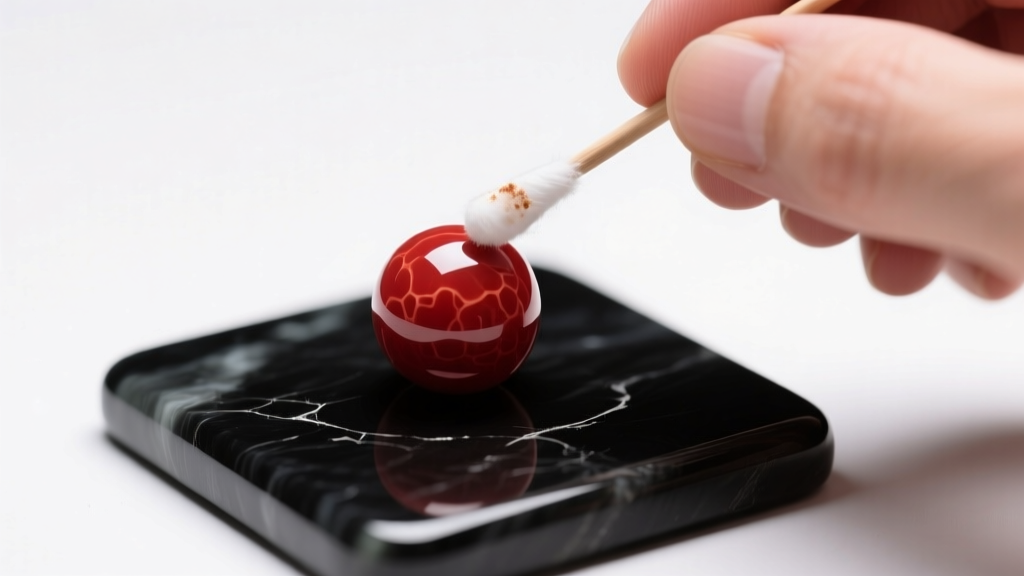
The Acetone Swab Test (Organic Detection)
Genuine red coral (Corallium rubrum) is increasingly rare and heavily regulated. Much of the 'red coral' on the market is actually white howlite or porous magnesite dyed with organic red pigments. To test, apply a drop of pure acetone to a cotton swab and rub it vigorously against an inconspicuous area of the bead. If the swab turns pink or red, the bead is dyed. Genuine coral will not transfer color to acetone, though it may react with a mild effervescence to hydrochloric acid (a destructive test best left to gemologists).
Spectroscopic Analysis of Carnelian vs. Dyed Agate
Natural carnelian derives its color from finely dispersed iron oxide (hematite) inclusions. When heated, these inclusions oxidize, deepening the red. Conversely, dyed red agate is saturated with sugar solutions and sulfuric acid to create a permanent, but artificial, red carbon/iron stain. Under a gemological spectroscope, natural carnelian exhibits a distinct absorption band in the blue-green region (around 500-550 nm). Dyed agate often shows a muddled, broad absorption without sharp spectral lines, and under magnification, the dye will concentrate in the concentric banding fractures of the chalcedony.
Maintenance: Combating Oxidation and UV Degradation
Preserving the structural and aesthetic integrity of red beaded earrings requires understanding the chemical vulnerabilities of both the bead and the hardware.
'Never use ultrasonic cleaners on porous red beads like coral, turquoise, or dyed howlite. The high-frequency cavitation will fracture the organic matrix and strip artificial dyes in seconds.' — Master Lapidary Bench Note
For hardware maintenance, brass and copper headpins will oxidize rapidly when exposed to the acidic pH of human sebum and environmental humidity. This oxidation creates a dark, abrasive patina that weakens the wire over time. To prevent this, high-end red beaded earrings should utilize Argentium silver (which contains germanium to resist tarnish) or gold-filled wire (which features a thick outer layer of 14k gold mechanically bonded to a brass core). When storing these earrings, keep them in anti-tarnish cloth pouches infused with silver sulfide-absorbing compounds, and strictly avoid direct UV exposure to prevent the photodegradation of any organic red dyes.
Ultimately, the creation and care of red beaded earrings is an exercise in applied physics and materials science. By respecting the hardness scales, specific gravities, and metallurgical limits of the components involved, jewelers and collectors can ensure these vibrant pieces remain structurally sound and visually striking for generations.


