Authentic Red Jade Earrings: Gemology, Treatments & Settings
Discover the gemological truth behind red jade earrings. Learn about jadeite treatments, carnelian alternatives, and secure setting techniques.

The Gemological Reality: What is "Red Jade"?
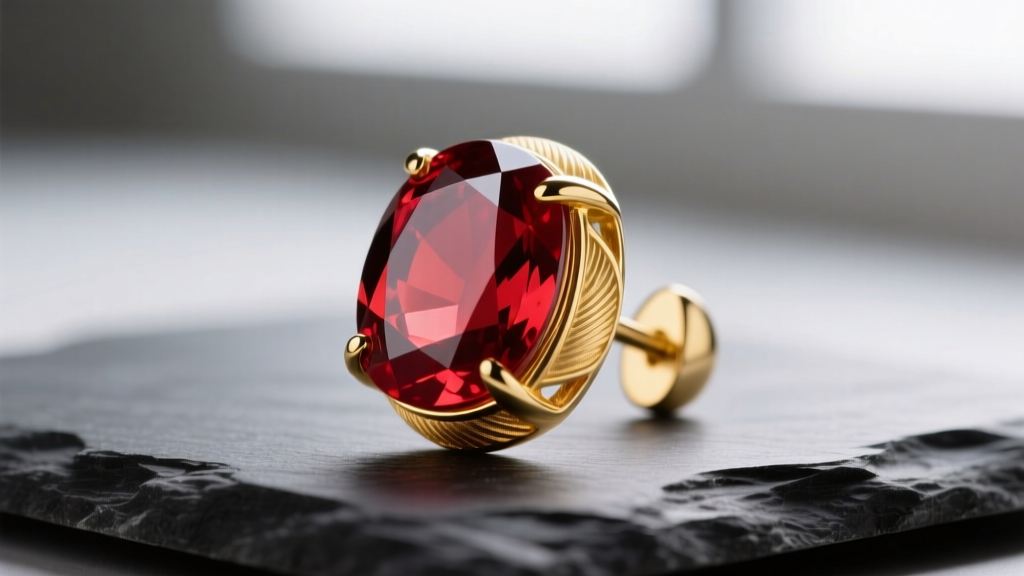
When collectors and enthusiasts search for red jade earrings, they are often met with a marketplace rife with misnomers, synthetic simulants, and heavily treated stones. To approach this category as an informed buyer or jeweler in 2026, one must first confront a fundamental gemological truth: natural, vivid cherry-red jadeite is virtually non-existent. True jadeite (NaAlSi2O6) and nephrite (Ca2(Mg,Fe)5Si8O22(OH)2) do not naturally occur in the bright, translucent reds demanded by modern jewelry consumers.
Natural reddish hues in jadeite are caused by secondary iron oxide staining (hematite) that penetrates the outer rind of the boulder. This results in opaque, brownish-red or rust-colored "skin" that is occasionally carved into earrings, but it lacks the gemmy translucency of fine jade. Consequently, the vast majority of vivid red jade earrings on the market fall into one of three categories: heavily dyed Type C jadeite, polymer-impregnated Type B+C jadeite, or misidentified carnelian (a variety of chalcedony). Understanding these distinctions is critical for both valuation and structural jewelry design.
Type A, B, and C Jadeite Classifications
The Gemological Institute of America (GIA) strictly categorizes jadeite treatments to protect consumers. Type A jadeite is entirely natural, untreated except for surface waxing. Type B jadeite has been acid-bleached to remove brown iron stains and subsequently impregnated with polymer resin to improve transparency. Type C jadeite is dyed. The most common "red jade" on the market is Type B+C, where the stone is first bleached, then dyed with organic or inorganic red colorants, and finally stabilized with resin. This treatment fundamentally alters the stone's structural integrity, which directly impacts how it must be set in earrings.
Technical Specifications & Durability Matrix
Designing earrings requires a deep understanding of a material's toughness, not just its hardness. While jadeite and nephrite are often grouped together by laymen, their crystal structures dictate entirely different behaviors under the stress of daily ear wear. Furthermore, carnelian is frequently passed off as "red jade" by unethical dealers. The table below provides a comparative durability matrix for gemologists and bench jewelers.
| Material | Mohs Hardness | Toughness / Tenacity | Specific Gravity | Refractive Index |
|---|---|---|---|---|
| Jadeite (Natural Type A) | 6.5 - 7.0 | Exceptional (Interlocking grains) | 3.30 - 3.36 | 1.66 (Spot) |
| Jadeite (Treated Type B/C) | 6.5 - 7.0 | Brittle / Compromised | 3.00 - 3.30 (Resin lowers SG) | 1.66 (Spot) |
| Nephrite | 6.0 - 6.5 | Superior (Fibrous mat structure) | 2.90 - 3.02 | 1.61 (Spot) |
| Carnelian (Imposter) | 6.5 - 7.0 | Brittle (Conchoidal fracture) | 2.58 - 2.64 | 1.53 - 1.54 |
Notice the specific gravity (SG) discrepancy. A simple hydrostatic weighing test can immediately expose a carnelian imposter or a heavily resin-impregnated Type B+C jadeite cabochon, as the polymer resin significantly lowers the overall density of the stone.
Earring Setting Engineering: The Danger of Prongs
One of the most frequent catastrophic failures in jade jewelry occurs when bench jewelers apply standard prong-setting techniques to jadeite cabochons. Jadeite lacks true cleavage, but it is brittle. When a stone has undergone Type B acid bleaching, the interlocking crystalline lattice is partially dissolved, leaving a porous, sponge-like microstructure that is held together only by polymer resin.
Point-Source Pressure vs. Radial Compression
Prongs exert extreme point-source pressure (measured in PSI at the tip of the bur). If a prong is pushed against a Type B+C red jadeite cabochon, the localized stress can easily exceed the tensile strength of the compromised crystal lattice, resulting in internal crazing, chipping, or a complete split. Therefore, full bezel or rub-over settings are mandatory for all jadeite earrings. A bezel applies uniform radial compression, securing the stone without introducing localized stress fractures.
Gauge and Post Specifications for Heavy Drops
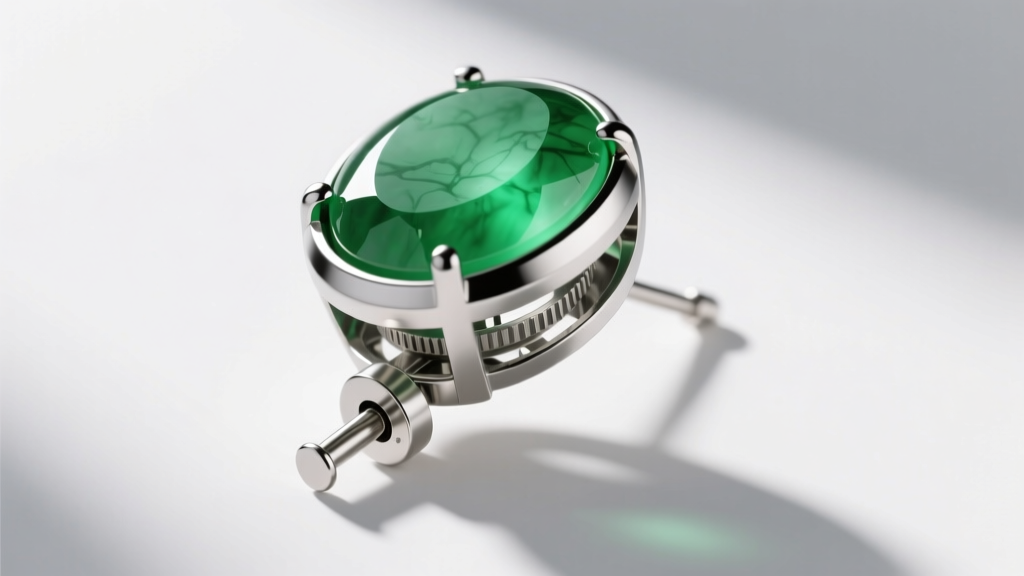
Jadeite is a dense material. A pair of 12mm x 16mm teardrop jade cabs can easily weigh 6 to 8 carats each. Setting heavy stones on standard 20-gauge (0.81mm) earring wires is a critical engineering flaw. The weight of the stone will cause the thin wire to bend, warp, or slice through the earlobe over time—a phenomenon known in the industry as the "guillotine effect." For heavy jade drops, you must mandate 18-gauge (1.02mm) or 16-gauge (1.29mm) posts forged from high-tensile metals such as platinum, 18k yellow gold, or Grade 5 titanium. Furthermore, heavy drops should utilize omega-backs or screw-backs to distribute the weight across a wider surface area of the earlobe.
Market Pricing & Authentication Protocols
As of the mid-2020s, the market for fine jadeite has reached record highs, making authentication more critical than ever. A pair of natural, untreated (Type A) reddish-brown jadeite earrings with good translucency will command anywhere from $1,500 to $5,000+. Conversely, a visually similar pair of dyed Type C earrings has a wholesale value of less than $40.
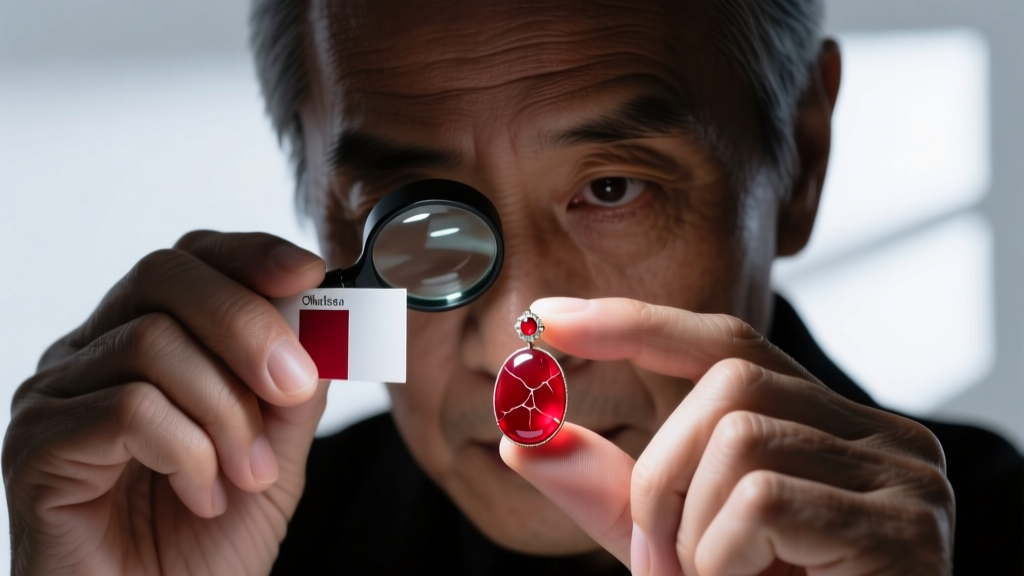
Expert Authentication Tip: Never rely solely on visual inspection or a Chelsea color filter for red jadeite. While older chromium-based dyes may glow red under the filter, modern organic dyes do not. Always require a lab report from a tier-one laboratory like the Swiss Gemmological Institute (SSEF) or GIA for any red jade earrings priced above $500.
Advanced authentication relies on Fourier Transform Infrared (FTIR) spectroscopy. FTIR is the only definitive method to detect the polymer resins used in Type B and B+C treatments. The resin will exhibit characteristic absorption peaks around 3060, 2925, and 2855 cm⁻¹. Additionally, UV-Vis-NIR spectroscopy can identify the specific absorption spectra of artificial dyes, which lack the natural 437 nm iron absorption line characteristic of untreated jadeite.
Care and Maintenance of Treated vs. Untreated Stones
The care protocols for red jade earrings depend entirely on their treatment status. Because the vast majority of red jade on the market is polymer-impregnated and dyed, standard jewelry cleaning methods will destroy the earrings.
- Never Use Ultrasonic Cleaners: The high-frequency vibrations and heat generated by ultrasonic baths will degrade the polymer resin in Type B/C jade, causing the dye to leach out and the stone to turn cloudy or white.
- Avoid Steam Cleaning: Sudden thermal shock can cause micro-fractures in treated jade, and steam can melt or soften the stabilizing resins.
- Chemical Exposure: Hairsprays, perfumes, and chlorine (from swimming pools) will chemically attack the surface polish of resin-treated jade, leaving a dull, pitted finish.
- Proper Cleaning Method: Use only lukewarm water, a drop of mild pH-neutral dish soap, and a soft-bristled baby toothbrush. Gently scrub the bezel setting and the stone, then pat dry with a microfiber cloth.
- Storage: Store jade earrings in a soft pouch separate from diamonds or sapphires. While jadeite is relatively hard (6.5-7), it can still be scratched by harder gemstones commonly found in mixed jewelry boxes.
By understanding the gemological realities, structural vulnerabilities, and strict setting requirements of red jadeite, collectors and jewelers can navigate this complex market with confidence, ensuring their earrings are both structurally sound and accurately valued.


