What Is a Regular Earring Gauge? A Complete Sizing Guide
Discover what is a regular earring gauge, standard piercing sizes for lobes and cartilage, and how to choose the right thickness for your jewelry.

Shopping for earrings online can feel like navigating a maze of confusing terminology, especially when it comes to wire thickness. You have found the perfect design, but will the post actually fit your piercing? If you have ever asked yourself, "what is a regular earring gauge," you are not alone. Understanding gauge sizes is the single most important factor in ensuring your jewelry is comfortable, secure, and safe for your ear tissue.
In this comprehensive buying guide, we break down the exact measurements of standard earring gauges, explain the metallurgy behind why thickness matters, and provide a practical framework for measuring your own piercings at home. Whether you are shopping for delicate lobe studs or structural cartilage hoops, this guide will ensure you never buy the wrong size again.
The Core Answer: What Is a Regular Earring Gauge?
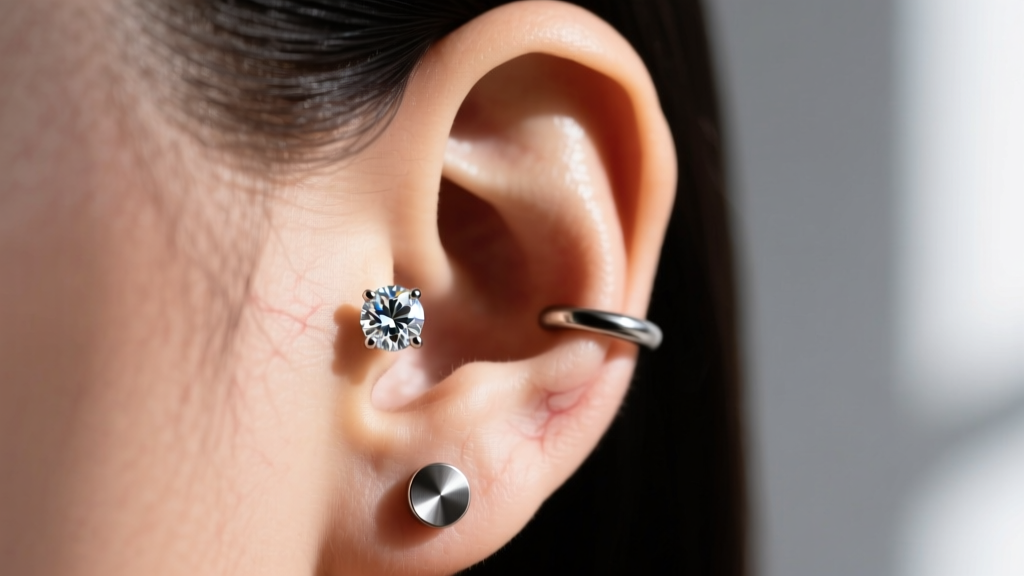
To answer the question directly: a "regular" earring gauge depends entirely on where the piercing is located on the ear and how it was originally pierced. However, in the jewelry industry, the most universally accepted standard for a traditional earlobe piercing is 20-gauge (20g) or 18-gauge (18g). For cartilage piercings (like the helix, tragus, or conch), the standard is typically thicker, usually 16-gauge (16g) or 14-gauge (14g).
The jewelry industry uses the American Wire Gauge (AWG) system, which operates on an inverse logarithmic scale. This means that the higher the gauge number, the thinner the wire. A 22-gauge wire is incredibly thin and fragile, while a 0-gauge wire is thick enough to stretch a piercing. Because the AWG system can be counterintuitive, professional piercers and high-end jewelers often rely on exact millimeter (mm) measurements to avoid confusion.
According to the Association of Professional Piercers (APP), choosing the correct gauge is not just about the jewelry fitting through the hole; it is about maintaining the structural integrity of the fistula (the tube of healed tissue). Wearing wire that is too thin for the piercing can lead to irritation, rejection, and tissue tearing.
Standard Gauge Sizes by Piercing Location
When shopping for body jewelry, referencing a standardized sizing chart is crucial. Below is the industry-standard gauge and millimeter conversion chart for the most common ear piercings. Keep in mind that individual anatomy and the technique used by your original piercer can cause slight variations.
| Piercing Location | Standard Gauge (AWG) | Thickness (mm) | Common Jewelry Styles |
|---|---|---|---|
| Standard Lobe | 20g or 18g | 0.81mm - 1.02mm | Butterfly-back studs, lightweight hoops, huggies |
| Upper Lobe / Lobule | 18g or 16g | 1.02mm - 1.29mm | Flat-back labrets, small clickers, seamless rings |
| Helix / Forward Helix | 16g | 1.29mm | Captive bead rings, flat-back studs, ear cuffs |
| Tragus / Conch | 16g | 1.29mm | Flat-back labrets, barbells, shield rings |
| Daith / Rook | 16g | 1.29mm | Curved barbells, clicker hoops, heart rings |
| Industrial (Scaffold) | 14g | 1.63mm | Long straight barbells, custom chains |
The Piercing Method Factor: Gun vs. Needle
Why do some people wear 20g in their lobes while others wear 16g? The answer often lies in how the ears were originally pierced. Mall kiosks and jewelry stores that use piercing guns typically utilize 20g or 18g studs with sharp, pointed tips and butterfly backs. Piercing guns rely on blunt force trauma to push a relatively thin stud through the tissue.
Conversely, professional piercing studios use single-use, hollow beveled needles. A needle cleanly removes a tiny crescent of tissue, allowing for a smoother healing process. Professional piercers rarely use anything thinner than 16g for cartilage or 18g for lobes, as thicker needles cause less tissue compression and result in a more stable fistula. If your lobes were pierced with a gun, you will likely need 20g or 18g jewelry. If they were pierced with a needle, you may require 16g.
The Physics of Jewelry: Metallurgy and the Cheese-Cutter Effect
Understanding what is a regular earring gauge also requires a basic understanding of physics and metallurgy. The thickness of your earring post directly dictates which materials can be safely used. This is especially critical when dealing with precious metals like 14k and 18k gold.
Gold is inherently a soft, malleable metal. If a jeweler crafts a hoop earring out of 18k gold at a 20-gauge (0.81mm) thickness, the wire will lack structural rigidity. Simply sleeping on the earring or taking it off with too much force can permanently warp the metal. Therefore, high-end jewelers reserve 20g and 18g sizes for small, lightweight studs or reinforced alloys, while utilizing 16g and 14g for structural hoops and heavy gemstone settings.
Furthermore, wearing thin-gauge jewelry in a larger piercing hole can trigger a phenomenon known in the body modification community as the "cheese-cutter effect." If you place a heavy, gemstone-encrusted earring on a thin 20-gauge wire, the downward force is concentrated onto a microscopic surface area of the fistula. Over time, this high pressure acts like a wire cutting through a block of cheese, slowly migrating the piercing downward and eventually splitting the earlobe entirely. To prevent this, heavier statement earrings should always feature thicker posts (16g or 14g) or be backed by a wider, supportive silicone o-ring.

How to Accurately Measure Your Current Gauge
Guessing your gauge size based on how a piece of jewelry "looks" is a common buying mistake that leads to frustrating returns (and since earrings cannot be returned for hygienic reasons once opened, this is a costly error). Here is how to accurately determine your size:
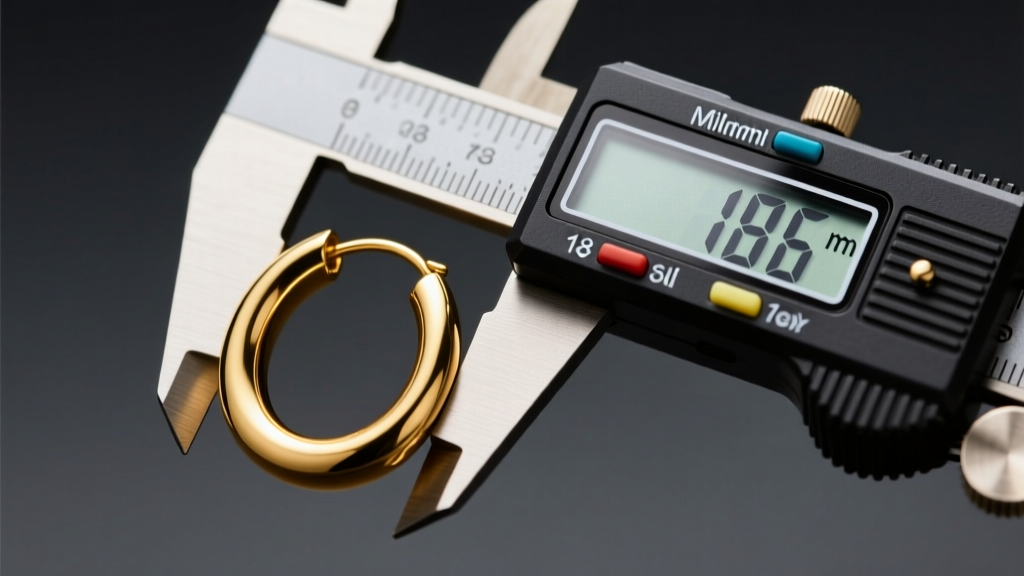
- Use Digital Calipers: For the most precise measurement, purchase a basic set of digital calipers (available for $15–$30 online). Measure the thickest part of the post or wire that actually passes through your skin. Do not measure the decorative front or the backing mechanism.
- Invest in a Gauge Wheel: A metal gauge wheel is a flat tool with precisely cut notches corresponding to standard AWG sizes. Simply slide the clean post of your earring into the slots until you find the notch where the metal fits perfectly without forcing it.
- Check the Original Receipt or Packaging: Reputable online body jewelry brands like Neometal, Anatometal, and Maria Tasha clearly stamp or list the gauge size on the packaging or the product specification page.
- Consult Your Piercer: If you are still unsure, walk into a reputable APP-certified piercing studio. A professional can measure your current jewelry and assess the health of your fistula in seconds.
Expert Buying Checklist for Online Shoppers
When browsing jewelstyleradar or any online jewelry retailer, keep this expert checklist in mind to ensure you are purchasing safe, high-quality, correctly sized earrings.
"Never compromise on material quality just to achieve a specific gauge size. If you need a 16-gauge earring for your cartilage, ensure it is crafted from implant-grade materials like ASTM F-136 Titanium or solid 14k/18k gold, rather than mystery alloys that can cause contact dermatitis."
- Verify the Material Grade: For fresh piercings or sensitive ears, look for ASTM F-136 Grade 5 Titanium or Niobium. Avoid "surgical steel" if you have a known nickel allergy, as 316L steel contains trace amounts of nickel that can leach over time.
- Read the Post Length Specifications: Gauge is only the thickness. If you are buying flat-back labrets for a tragus or helix, you must also know your required post length (usually 6mm to 8mm for healed cartilage) to avoid the backing pressing into the back of your ear.
- Examine the Threading Type: For thicker gauges (16g and 14g), avoid externally threaded jewelry (where the screw is on the post). Externally threaded posts can tear the delicate tissue of the fistula during insertion. Always opt for internally threaded or threadless (push-pin) jewelry.
- Assess the Weight-to-Gauge Ratio: If you are buying a large, heavy dangle earring for a standard lobe piercing, ensure the wire is at least 18g or 16g to prevent the cheese-cutter effect mentioned earlier.
Final Thoughts on Earring Sizing
Ultimately, understanding what is a regular earring gauge empowers you to make informed, safe purchasing decisions. While 20g and 18g remain the standard for traditional lobe piercings, the modern jewelry landscape heavily favors 16g for its superior balance of structural integrity, material versatility, and tissue health. By measuring your current jewelry with precision tools and paying close attention to metallurgy and threading types, you can curate an ear curation that is not only visually stunning but anatomically sound for years to come.


